


When a request came into the editorial office at the end of July – in fluent Dutch no less – to review a CD of clarinet music from Uzbekistan, my curiosity was immediately aroused, because a dozen days later I would see the youth orchestra of neighboring Turkmenistan at work in Berlin. Before I would venture into a CD review, I first wanted to know more about this music and about the clarinetist himself. This interview emerged from that curiosity.
When you meet Sayyod Mirzomurodov, you meet not only a clarinetist, but also a teacher, researcher and restless creator of new musical projects. He is currently completing his Doctor of Musical Arts at the University of Iowa, but his ambitions extend beyond that title: performance, research, recording and collaboration with composers increasingly flow into each other for him. Above all, the discovery, performance and documentation of Uzbek clarinet music is central to this – a repertoire that is hardly known outside Central Asia.
That interest is also personal. Mirzomurodov grew up in a Tajik family in southern Uzbekistan. His father, Sultonmurod Saidov, was an artist and founded the Tajik music group Parvin – and initially saw in his son primarily a future pilot. Sayyod himself thought so too for a while. There was never a dramatic turning point – it happened gradually. At the same time, he received music lessons from a local teacher before the family moved to Tashkent, and from fifth grade onwards he attended the V. A. Uspenski Specialized Music School for more intensive training. "The more I studied, performed and played together," he says, "the harder it became to imagine myself doing anything else."
He didn't choose his instrument himself either. He wanted to study piano, but had started too late. The saxophone was suggested as an alternative, with the clarinet as an intermediate step – until that intermediate step became his instrument: "I had already become attached to the clarinet and decided to stick with it." What continues to fascinate him is its flexibility: the clarinet articulates at lightning speed, sounds extremely light, and at the same time comes close to the human voice – exactly what Uzbek melodies need to be able to breathe, bend and ornament.
Music from different worlds
His musical identity cannot be traced back to one tradition. At home, Tajik music sounded, at celebrations much Persian and Iranian pop; in Tashkent came an environment where Uzbek and Russian culture carried more weight and his training was mainly based on European and Russian classical music. At the State Conservatory of Uzbekistan, clarinetist Bakhodir Salikhov laid the foundation for his instrumental development – important works by Mustafo Bafoyev and Anvar Ergashev were originally written for him. Conductor Timur Mirzaev taught him to look beyond the right notes in the wind ensemble: character, structure and the larger purpose of a phrase counted at least as much.
The influences also came from unexpected quarters. During his conservatory years, he became fascinated by Danny Elfman's main theme for Spider-Man, which further fueled his interest in orchestral and film music. Amanda McCandless helped him build further training in the United States; his current professor Jorge Montilla encourages him to think more freely about sound and phrasing. For Montilla, technique is not an end in itself, Mirzomurodov emphasizes: it must always be in service of the musical idea.
An unfamiliar musical landscape
When people think of Central Asian music, they usually first come to folk music. Understandable, but according to Mirzomurodov it's only half the story: Uzbekistan has an extensive academic tradition, with symphonies, operas, concertos and contemporary experimental music. Not European classical music with a folk melody on top, but its own language in which composers work with maqom in very different ways – the system of modal melodic patterns that underlies the classical music traditions of Central Asia – regional rhythms and national forms of expression. It is precisely this interplay that makes the music so interesting to him.
But what makes it recognizable to us, Western listeners? Often it lies in the way a melody moves: ornamentation, a flexible approach to rhythm, modal colors, phrases that sing rather than proceed strictly metrically. The influence of maqom need not be literally audible; sometimes it lies in a single interval, or in how tension builds over a long phrase. A key concept is nola, an emotionally charged turn or sigh in a melodic line. "It is not one specific embellishment," says Mirzomurodov, "but rather a way of expressing." Even under modern, irregular time signatures, a feeling of dance or speech can still be hidden.
The tradition has many names. Yunus Rajabiy preserved and notated the maqom repertoire; Mutal Burhanov, Sulaymon Yudakov, Tolibjon Sadikov and Mansur Mansurov developed the professional composition school in the twentieth century, and Felix Yanov-Yanovsky later developed an individual language that extended far beyond a national context. Among more recent composers, Mirzomurodov particularly mentions Mustafo Bafoyev, for the scope of his oeuvre, and Anvar Ergashev, for his theatrical energy. Younger composers such as Nurali Erkaev, Farrukh Akramov and Sherzod Sobirov are seeking their own relationship to that tradition – and it is precisely this diversity that matters: there is no uniform style within Uzbek classical music.
Discipline and freedom
The legacy of the Soviet Union is still clearly felt in current music education. The specialized system of music schools produced a high technical level, with thorough training in harmony, analysis and orchestration. But that same structure is also a limitation: it can be hierarchical, and students sometimes learn to follow an existing model rather than develop their own artistic direction. For a long time, too, European and Russian repertoire played the leading role, while Uzbek works were not always systematically taken up and disseminated. Mirzomurodov does not see the future in rejecting that tradition, but in combining its discipline with more artistic freedom, where musicians set up their own projects, record and collaborate internationally.
Contemporary composers each seek their own balance. Habibulla Rahimov's Poema-ballada remains abstract and experimental, while Farrukh Akramov combines modern harmony with a strong lyrical character. For Mirzomurodov, a composition does not need to quote a traditional melody to sound Uzbek: it can just as easily lie in the breathing of a phrase, or in the relationship between rhythm and speech.
From repertoire to CD
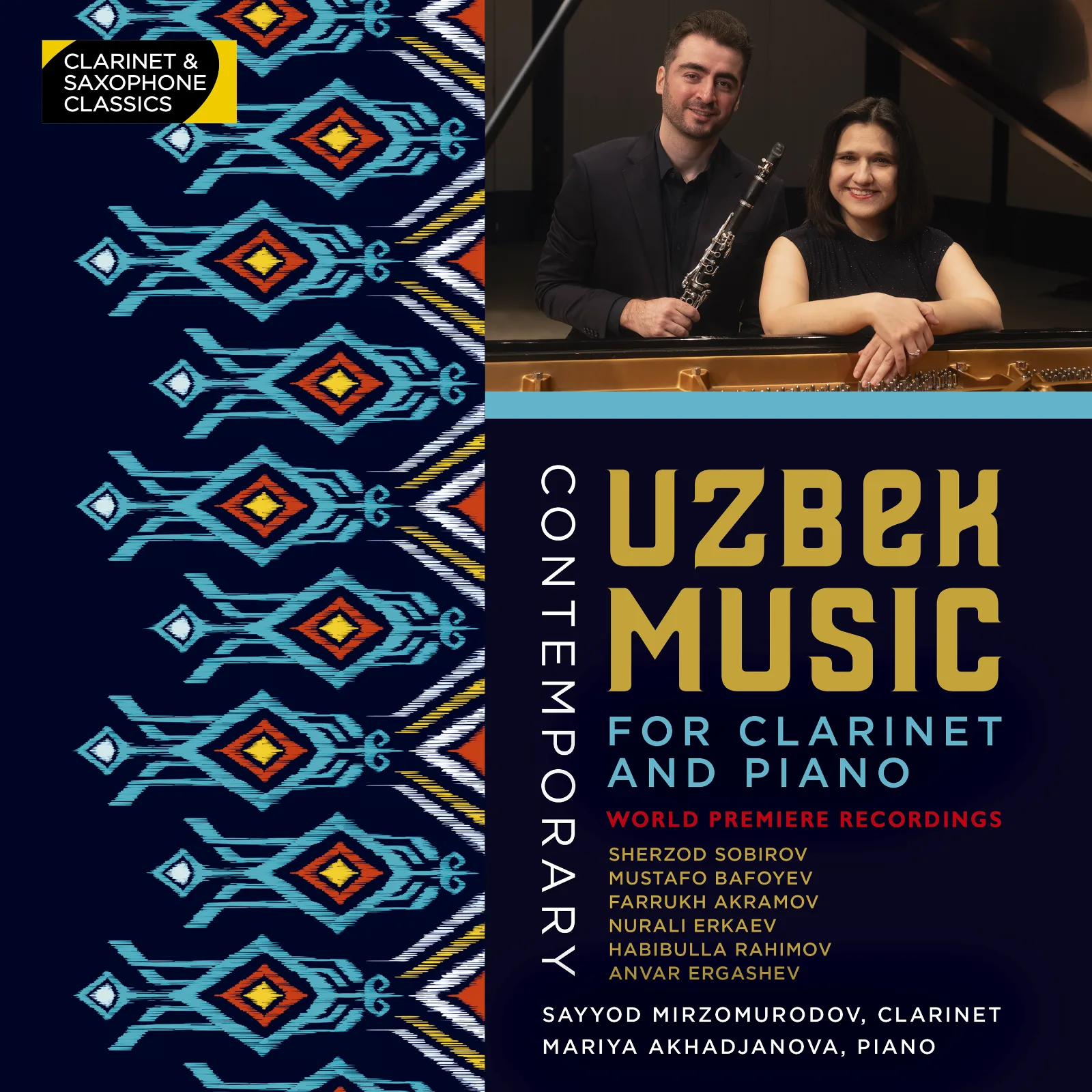 Already during his bachelor's studies, Mirzomurodov noticed how difficult it was to find Uzbek clarinet music – sometimes a work existed, but a score or professional recording was missing. During his doctorate, he had the opportunity to do something about it: a large-scale recording project. What began as the idea of documenting existing repertoire grew into something much larger. He contacted composers, gradually discovered more and more music, until the album became much more extensive than planned.
In compiling the album, variation was essential. Alongside lyrical works there are also theatrical, virtuosic and experimental ones; alongside short pieces a fantasy, sonatas, a capriccio and a large concerto, deliberately by composers from different generations: "The album had to be a musical journey, not a collection of loose tracks." For the interpretation, he could not rely on a long performance tradition: he starts with the score, but also explores the composer's background and style. A good example is Buxorcha by Mustafo Bafoyev. The composer explained to him the connection with the traditions of Bukhara, in particular mavrigi, a local vocal-instrumental tradition from Bukhara – traditions that Mirzomurodov himself had experienced at weddings there, where the musical energy gradually builds: musicians start moderately and increase the tempo, until the excitement almost emerges by itself. In Buxorcha too, that acceleration must sound organic, never mechanical. With Nurali Erkaev, the discussions were mainly about form, harmony and the interaction between clarinet and piano in his Sonata-Fantaziya.
The clarinet as human voice
That the clarinet works so convincingly in this repertoire is no coincidence for Mirzomurodov: the instrument naturally possesses vocal qualities, allows a phrase to breathe and shifts effortlessly between intimate and powerful. The piano creates the environment around that voice – sometimes it stays in the background, sometimes it gives a rhythmic impulse reminiscent of dance; in the concerto it must even suggest the colour of an orchestra. Neither instrument tries to literally imitate a traditional instrument; the connection arises through phrasing and tonal behaviour. In Buxorcha, the clarinet sometimes sounds almost like improvised singing, in Erkaev's Sonata-Fantaziya both instruments constantly exchange material, and in Ergashev's Eastern Capriccio a swift, theatrical conversation emerges.
As an ideal introduction to Uzbek music, Mirzomurodov therefore does not choose one work. If you mainly want to get to know the regional tradition, according to him you are best to start with Buxorcha. If you love virtuosity and theatrical colour, in Eastern Capriccio you will find an ideal introduction. And if you particularly want to hear how national ideas combine with contemporary composition, Erkaev's Sonata-Fantaziya is an excellent gateway.
Making music together, discovering together
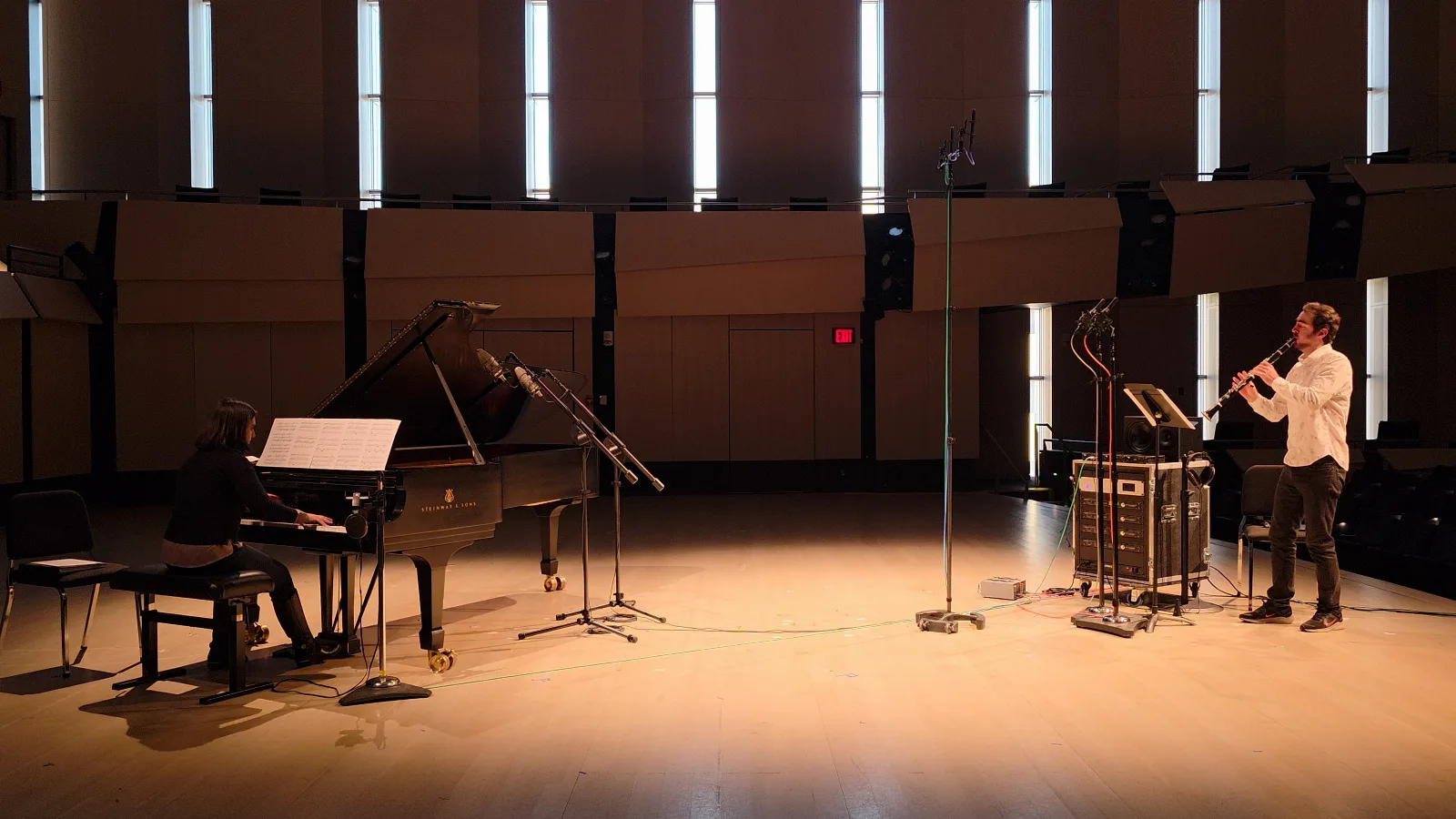
A special role in the project is reserved for pianist Mariya Akhadjanova, with whom he collaborated during his studies at the State Conservatory. Over the years, a strong understanding of each other's musical instincts grew, which deepened further when both moved to the United States. A recording differs fundamentally from the preparation of one concert: living with the same repertoire for months makes the process a continuous dialogue. According to Mirzomurodov, Akhadjanova has a strong sense of structure and balance – particularly valuable when the piano assumes an almost orchestral role.
Their shared cultural background sometimes played a role in details that were difficult to put into words: they felt that a phrase should not be played too rigidly, even when the notation seemed to suggest otherwise at first glance. That did not mean they worked exclusively on intuition – score study and experimentation remained essential, and sometimes they recorded a rehearsal to listen back to it critically afterwards. It was precisely this interplay that made it possible to treat the piano not as mere accompaniment.
Music as a bridge
 A listener does not need to know anything about maqom to feel longing, tension or tenderness, but the specific way in which an Uzbek melody shapes those emotions can deepen the experience: "Music does not need to shed its cultural identity to become universal. On the contrary, it is precisely the specific details that make communication stronger." The cd thus reflects different facets of Uzbek culture: Buxorcha is connected to the musical life of Bukhara, while other works carry elements from maqom, vocal ornamentation or dance rhythms. At the same time, the forms of sonata, concerto and capriccio tell something about the encounter between Uzbek traditions and European academic music in the twentieth century.
That this bridge is actually being crossed is evident from the reactions to the album. These convinced Mirzomurodov that there is indeed interest outside Uzbekistan. Musicians asked where they could find scores and inquired about the contact details of composers. "When a musician decides to learn a work or contact a composer," he says, "the repertoire begins to have a truly international life." Since the release, the project has led to interviews, radio programmes and conversations with educators in various countries. Composers in Uzbekistan have also responded enthusiastically: some collaborations are already in preparation, and various female composers showed interest – Mirzomurodov is even considering an album devoted entirely to music by female Uzbek composers.
He sees his own role as deliberately modest: he wants to perform the music at the highest level, but not pretend that he holds the definitive truth about Uzbek music. "I would rather open a door," he says, so that musicians, teachers and listeners can more easily access scores and information to discover further on their own. The project taught him that a performer can do more than choose music from an existing catalogue: he became involved in searching for manuscripts, conversations with composers and families, and publication. At the same time, he began to view his own cultural background more consciously. "The project has not narrowed my identity," he says, "it actually gave me a clearer picture of what I myself can contribute."
A repertoire that must continue to live
What would he want a young clarinetist to take from his cd twenty years from now? Above all, that Uzbek music deserves the same curiosity and respect as the established French, German or American repertoire – not because it is Uzbek, but because it has something artistic to tell. A young musician must ask himself how a melody breathes and what sound it needs, and above all understand that a performer does not only have to play what already exists: new works can be created, unknown repertoire unlocked. "Then the album remains no isolated project," Mirzomurodov concludes, "but becomes part of a much larger movement."
Perhaps that is ultimately precisely where Sayyod Mirzomurodov as a musician stands between two worlds: not choosing between tradition and future, between Uzbekistan and the United States, but connecting those worlds with each other.
More info: sayyodmirzomurodov.com