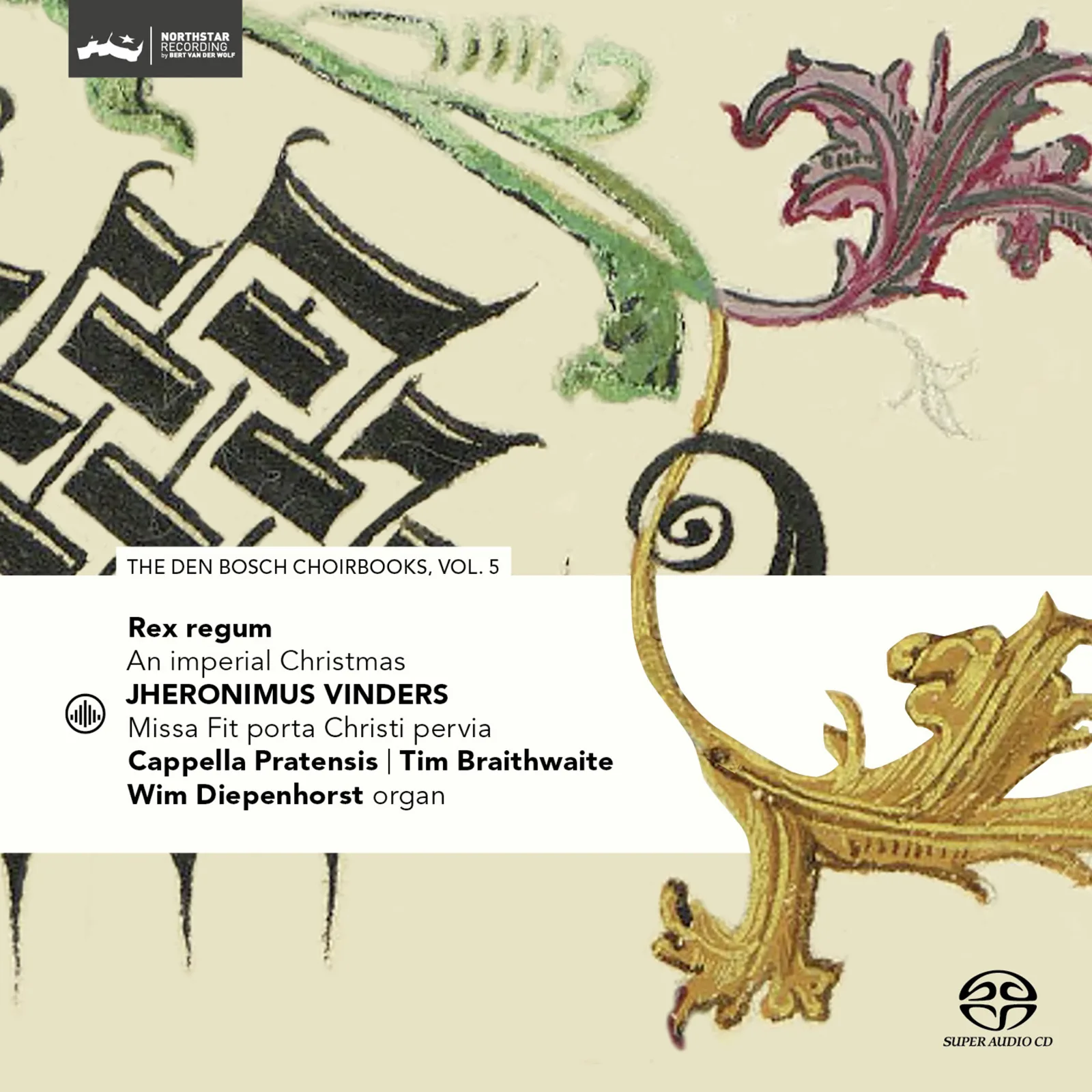
December 1545. While the winter cold settles in around the walls of 's-Hertogenbosch, the most powerful man in Europe staggers into the city. Charles V, on his way to Utrecht for a chapter of the Order of the Golden Fleece, is felled by a new attack of gout. What was meant to be a brief stopover grows into a stay of nearly a month. And so it happens that the emperor, his court, members of the Illustere Lieve Vrouwe Broederschap and the inhabitants of Den Bosch together celebrate Christmas in the Sint-Jan.
Almost five centuries later, that painful foot gives us one of the most intriguing musical Christmas reconstructions of recent years.
Anyone listening to Rex Regum without knowing the background might wonder where the splendour of the imperial court has gone. I caught myself thinking exactly that. A visit by Charles V conjures images of trumpet blasts, processions, banners, jingling spurs, shawms and drums. And indeed: on his arrival the emperor was welcomed by city militias, guilds, 120 torchbearers, five trumpeters and ten drummers.
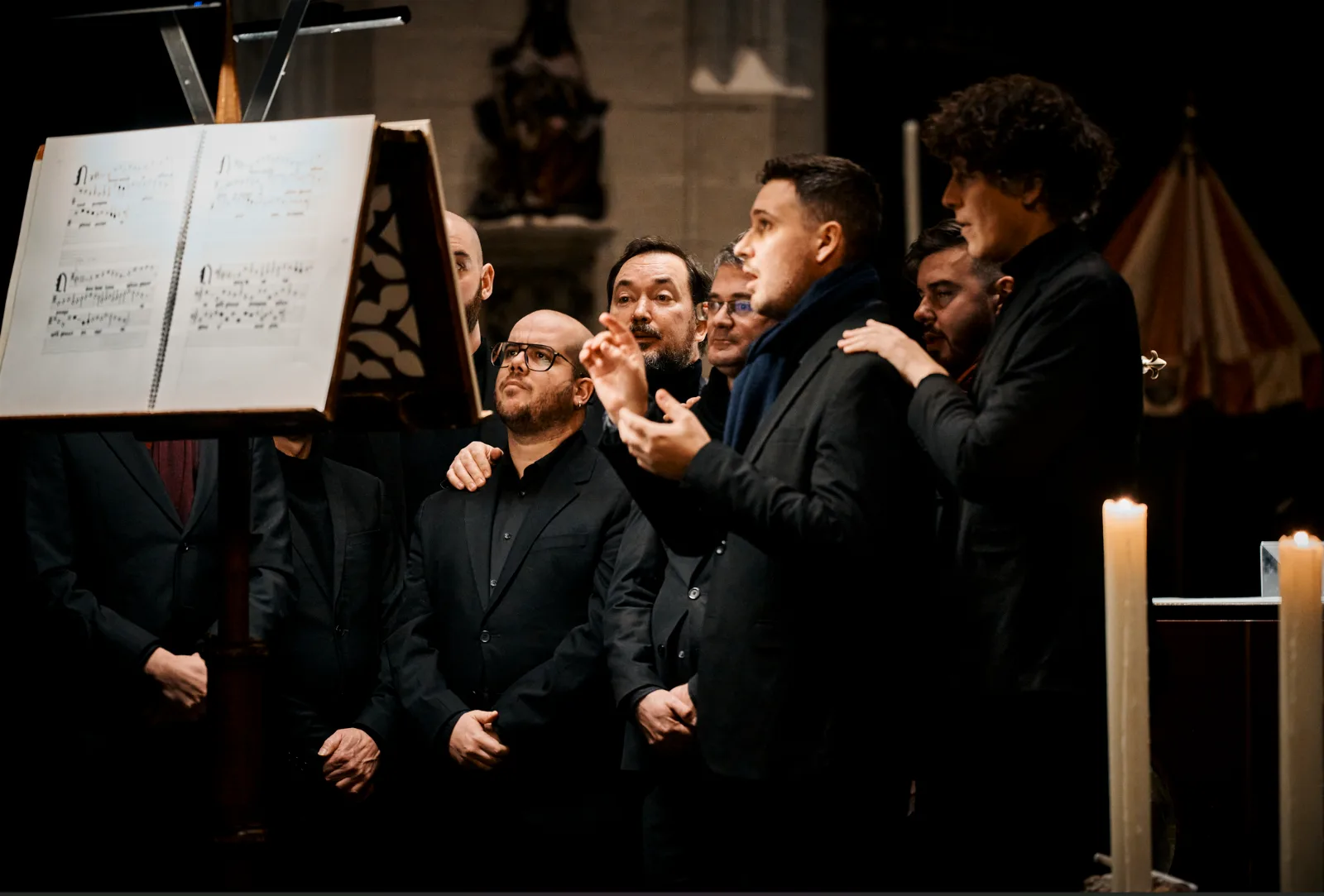 But after reading the excellent accompanying booklet, and above all the colourful text by Jennifer Bloxam, it became clear which choice Cappella Pratensis has deliberately made here. The aim is not to reconstruct the full soundscape of Den Bosch in December 1545, but the music of the Christmas that may have resounded in the Sint-Jan on 25 December. That is an essential difference. What the sources have left us is mainly chant and polyphony from the famous Bossche choirbooks; of much instrumental music nothing at all has survived. The paradox is well known: the more historically careful a reconstruction becomes, the less spectacular it sometimes seems to modern ears.
The accompanying booklet is, moreover, a pleasure to read. Bloxam not only sketches the historical context but also brings the listener fully into the mindset of the time. Her description of Christmas morning 1545, with the ringing Salvator bell, the singers gathering around their choirbook and the unexpected encounter between the local brotherhood and the imperial chapel, reads almost like a novella. And when at the end she muses that the aged Charles V, years later in his remote monastery at Yuste, may have looked back wistfully on that Christmas in Den Bosch, that seems not far-fetched at all.
Central to the disc is the Missa Fit porta Christi pervia by Jheronimus Vinders, a composer who for many, including the present writer, will be a rather unknown name. That makes this recording all the more interesting. Remarkably little is known about his life. His only documented position was a brief appointment as song master of a Marian brotherhood in Ghent. Yet three of his four surviving masses have been preserved solely in Bossche sources, pointing to a special bond with Den Bosch and the Lieve Vrouwe Broederschap.
Vinders proves moreover to be a composer of stature. His style breathes the influence of Josquin des Prez, with refined imitation, natural text setting and an impressive sense of the "polyphonic edifice". The mass unfolds as a polyphonic labyrinth in which the Christmas hymn repeatedly surfaces like a familiar signpost.
Alongside this we hear music by Nicolas Gombert, plainchant, anonymous Christmas carols and organ arrangements by Antonio de Cabezón. Gombert's beautiful O magnum mysterium is perhaps the most direct musical link with the imperial entourage. Ironically, by 1545 Gombert had already fallen from favour and been condemned to the galleys for offences that brought him into disgrace, although he eventually regained Charles's favour. It inevitably prompts reflection on how we today deal with artists who have fallen from grace.
The other direct connection with the court of Charles V is found in Antonio de Cabezón. As court organist he travelled with the emperor through Europe for many years. His arrangements of works by Josquin and Jean Mouton bring a piece of the musical reality of the Habsburg court into this Bossche Christmas liturgy.
The organ playing of Wim Diepenhorst deserves special mention here, not only for its virtuosity but also for the instrument itself. For this recording use was made of the Van Straten organ in the Amsterdam Orgelpark, a meticulous reconstruction of the organ built in 1479 for the Utrecht Nicolaïkerk. The result is a sound world that closely approximates what Charles V and his contemporaries may have heard.
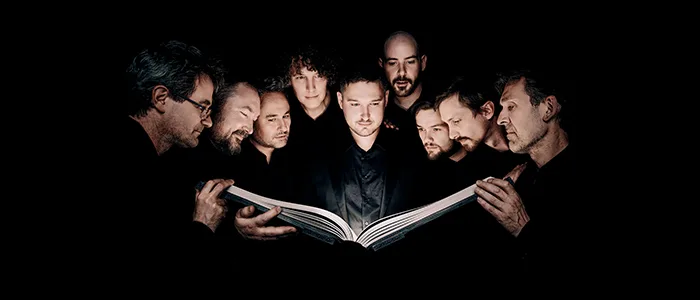
Vocally, Cappella Pratensis once again does not disappoint. The ten singers deliver precisely that combination of excellence and accessibility the ensemble has been known for over many years. The sound remains consistently transparent, never heavy or academic. On the contrary: the many small details in the polyphony invite concentrated listening. This is not background music. It is a historical document that demands attention and then richly rewards it.
I was moreover particularly charmed by the Dutch-language beginning and end of the programme. Nu sijt willecome opens the CD with a warmth that immediately creates the right Christmas atmosphere. The closing song Omnes nu laet ons Gode loven, a delightful blend of Latin and Dutch, concludes the recording with an almost festive exuberance. Both are superbly sung and give the CD just that extra touch of Christmas. Precisely such moments lend the recording a human and folk-like character. Personally, I would even have liked to hear a little more of that Dutch-language Christmas tradition.
With Rex Regum, Cappella Pratensis at the same time concludes its impressive series around the Den Bosch Choirbooks. That this last recording happens to be a Christmas project feels fitting. Everything begins with Christmas and everything ends with Christmas. That is how it should be, really.
For almost eighty minutes, Cappella Pratensis succeeds in making a vanished world tangible once again. Not by impressing with spectacle, but by giving the listener a place among the singers around the choirbook, somewhere in the Sint-Jan on a cold Christmas morning of 1545. How beautiful polyphony can be!