

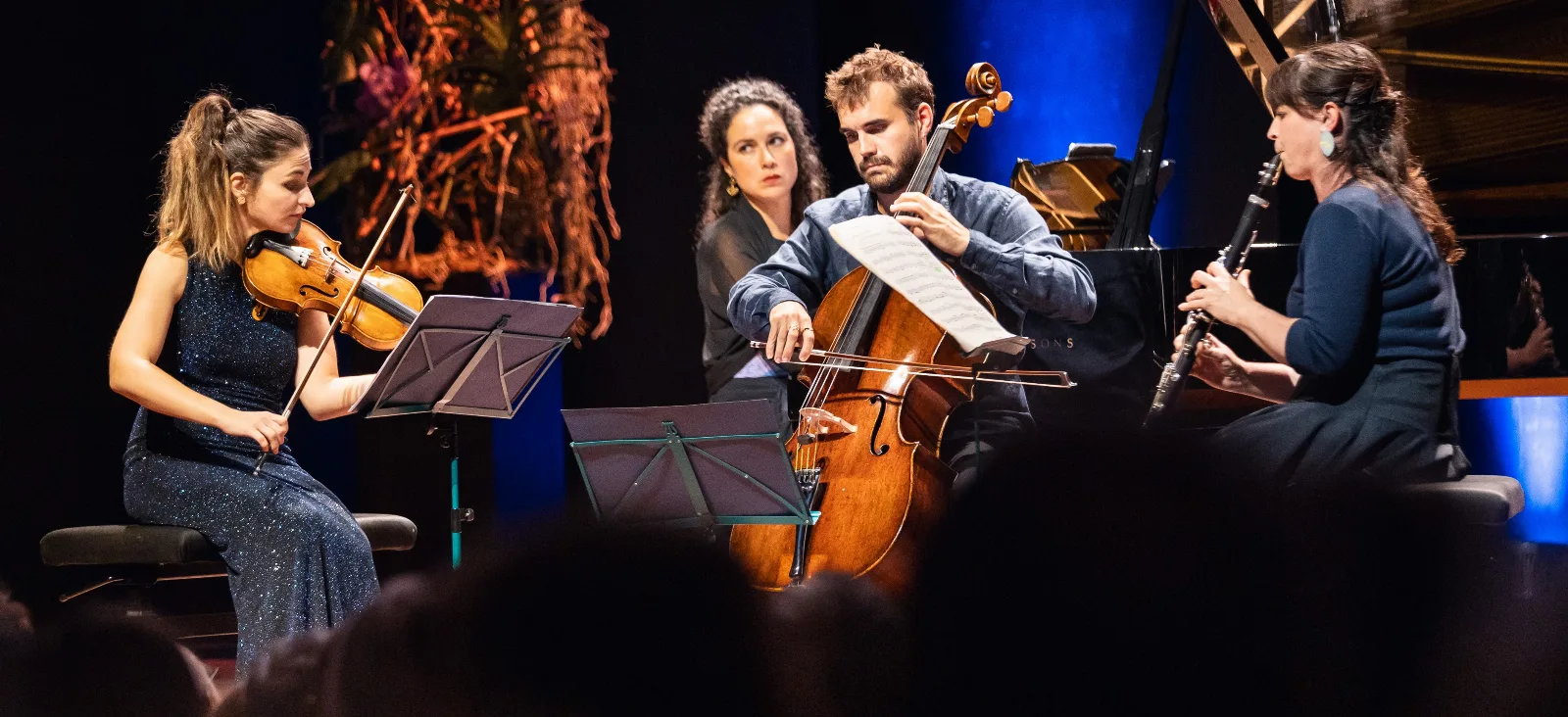
This concert of the Festival van Vlaanderen Gent centred on Olivier Messiaen's Quatuor pour la fin du temps. Klarastem Greet Samyn opens the concert. The French composer Olivier Messiaen is known as a religious, Catholic-inspired composer whose work is not performed very often. Besides clarinettist Annelien Van Wauwe, three other musicians stand on the stage: violinist Alexandra Soumm, cellist Louis Rodde and pianist Paloma Kouider.
Besides large orchestral works and chamber music, he is known for his organ works. Often sad, tragic works, musically giving voice to meditations on the suffering of Christ. For this quartet for clarinet, violin, cello and piano too, Messiaen found inspiration in the Bible, more specifically in the Book of Revelation, in which John writes about the end of the world and the end of time.
Annelien Van Wauwe
The violinist, pianist and cellist are members of the Carousel Chamber Music Ensemble, founded in 2019 by clarinettist Annelien Van Wauwe.
Van Wauwe is the Belgian pride of the clarinet world. Not yet forty, she is a worthy successor to great clarinettists such as Walter Boeykens or Freddy Arteel. It was the first time I could hear her live.
Before Messiaen, there are two works as stepping stones towards Messiaen. Three preludes by the Russian composer Vsevolod Zaderatsky performed by pianist Paloma Kouider, and then two songs, arranged for violin and clarinet, by violinist Alexandra Soumm and Annelien Van Wauwe.
Even before they begin Messiaen, it is clear: these are musicians of the very top rank.
Prisoner of war
What is special about the Quatuor is that it was written during Messiaen's captivity in 1940 in the Stalag prisoner-of-war camp in Görlitz. Despite the difficult camp conditions, there was also respect for the composer. A German camp commandant helped him obtain pencils and manuscript paper and a quiet room where he could compose. In the cold winter of 1941 it was also performed in the camp theatre for four hundred prisoners!
In the eight movements, the violinist, pianist, cellist and clarinettist do not always play together. Some movements are solo pieces, such as the third, Abîme des oiseaux, in which Annelien Van Wauwe masterfully shows what one can do with a clarinet. There are very long notes, which she begins barely audibly and blows out as a drawn-out crescendo wind.
Tears
There are very meditative, subtle movements, alongside a coarse, almost violent dance, the Danse de la fureur (sixth movement), in which the four play in unison like a giant stamping around. In the fifth movement something happens. It is a movement for cello and piano. It stands out how shaky the vibrato of cellist Louis Rodde sounds. Perhaps this was intended in the Louange à l'éternité de Jésus, I thought. But in the middle of the movement he stops, overcome by his tears. Is it stage fright? I think he was rather too emotionally gripped and moved. After a silence of several minutes he starts the movement again and plays it to the end.
Birds always play a role with Messiaen; there is a rainbow in the seventh movement. It ends with a meditative Louange à l'immortalité de Jésus.
With that immortality, time also returns: the negation of time through death. When we die, we enter another dimension and time stops. We travel to heaven or hell, depending on the case; we leave earthly reality and earthly time. Messiaen was obsessed with that metaphysics.
Moving
The transcendent often shines through in his music. That is what makes it so fascinating and also mysterious. Especially when it is performed by brilliant musicians like tonight. There could have been a bit more information about them and the Carousel ensemble in the attractive programme booklet. Alexandra Soumm is a sublime violinist, but where does she come from? A bio of a few lines would have sufficed; the same goes for pianist Paloma Kouider and cellist Louis Rodde.
In short, it is not easy but very moving music. Difficult for both listener and musicians. Annelien Van Wauwe tells me this when, after the concert, I buy a few of her CDs and have them signed. It is sometimes said that the greatest musicians are the easiest to deal with. So it is with Annelien Van Wauwe. Unpretentious and friendly, she speaks with me. What a talent, wow!