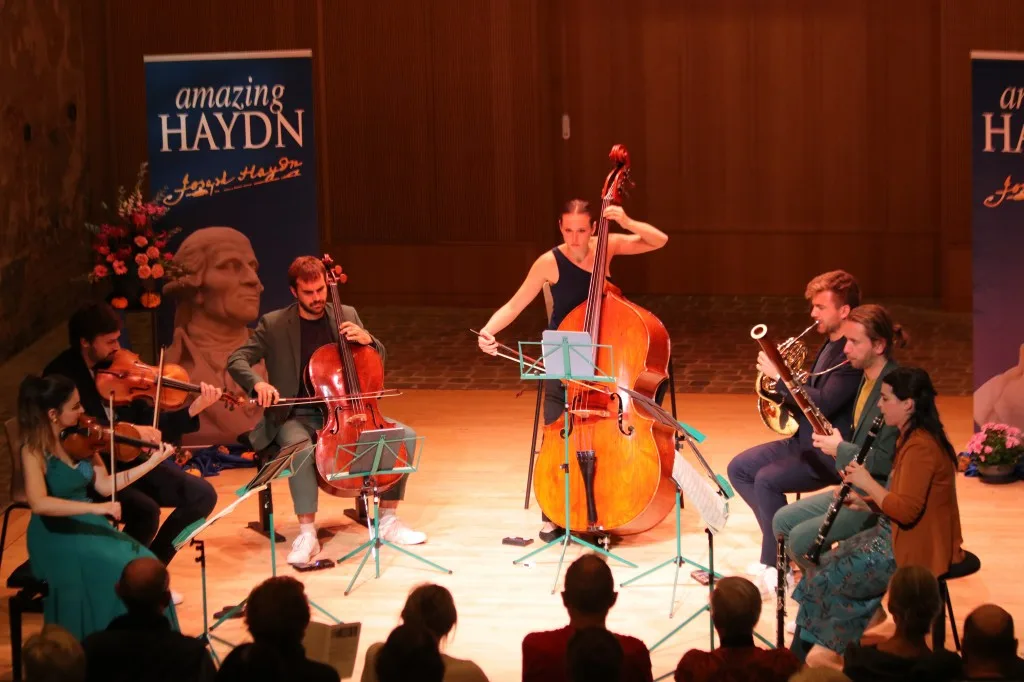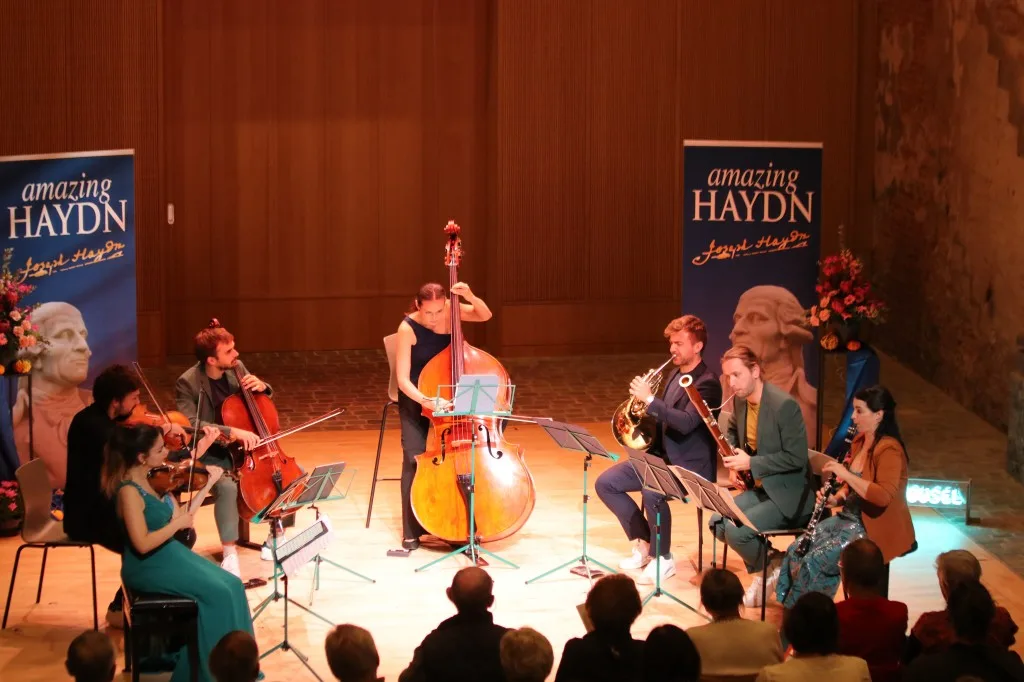
If anyone deserves a statue, it is Alfons Deleus, for his discreet, unassuming but unrelenting explorations into valuable neglected classical music. Thanks to him I have developed my boundless admiration for composers such as Henri Herz, Joseph Mayseder and, since the chamber ensemble Carousel filled the Predikheren last Sunday, for Adolphe Blanc.
"Adolphe who?" This question alone is tragic
As if prizes at the Conservatoire de Paris, training under names of renown, an impressive conducting career, performances in evocative venues such as the now-vanished Salle Herz and the one in the rue Lafitte, and active membership of the most influential societies were not enough, of the 57 years this Provençal from Manosque was allotted, almost nothing remains in music history. Not even a mention in The Grove! And yet his Septet for clarinet, horn, bassoon, violin, viola, cello and double bass, Op. 40, is among the most beautiful things I have heard in decades.
"Anyone who thinks only Haydn with his 'Sonnenaufgang' or Vaughan Williams with his 'Lark Ascending' can reach the highest peaks should listen to the heavenly opening melody that the first violin and, shortly after, the clarinet send soaring." This quote from the programme booklet is no exaggeration: Blanc is synonymous with melodic inventiveness, skilful construction, harmonic feeling and surprising fantasy. Witness a genuine Tarantella in the Scherzo of the Septet, which deserved an encore.
Where many of his 19th-century contemporaries chose blazing Romanticism, Adolphe Blanc remained faithful to the Viennese Classical style, which made him a full-fledged heir to Mozart and Haydn. The name 'Haydn' also led many astray. Not the elder brother Joseph but the younger Michael, five years his junior, was the one involved. With a charming Divertimento whose opening theme quickly shifts from disarmingly simple to what could have been an enticing aria, ending in a folk dance finale. You are either Austrian or you are not... It should be noted here that in Salzburg, at the archiepiscopal court, where Michael Haydn gave his best, he too remained in the shadow of his illustrious brother, whom Alfons Deleus described as "a European celebrated pop star."
From the unknown and lesser-known to the overly familiar. And on to the fascinating confrontation between Blanc's four-movement Septet and Beethoven's five-movement Septet, as performed by Carousel. This is an ensemble of about ten internationally acclaimed musicians, who, after their debut at DeSingel in 2020 (with the Beethoven Septet), have expanded their activities internationally. As flexible as they are, they chose the comparison with a carousel, where you can hop on or off effortlessly and ride along for a spin.
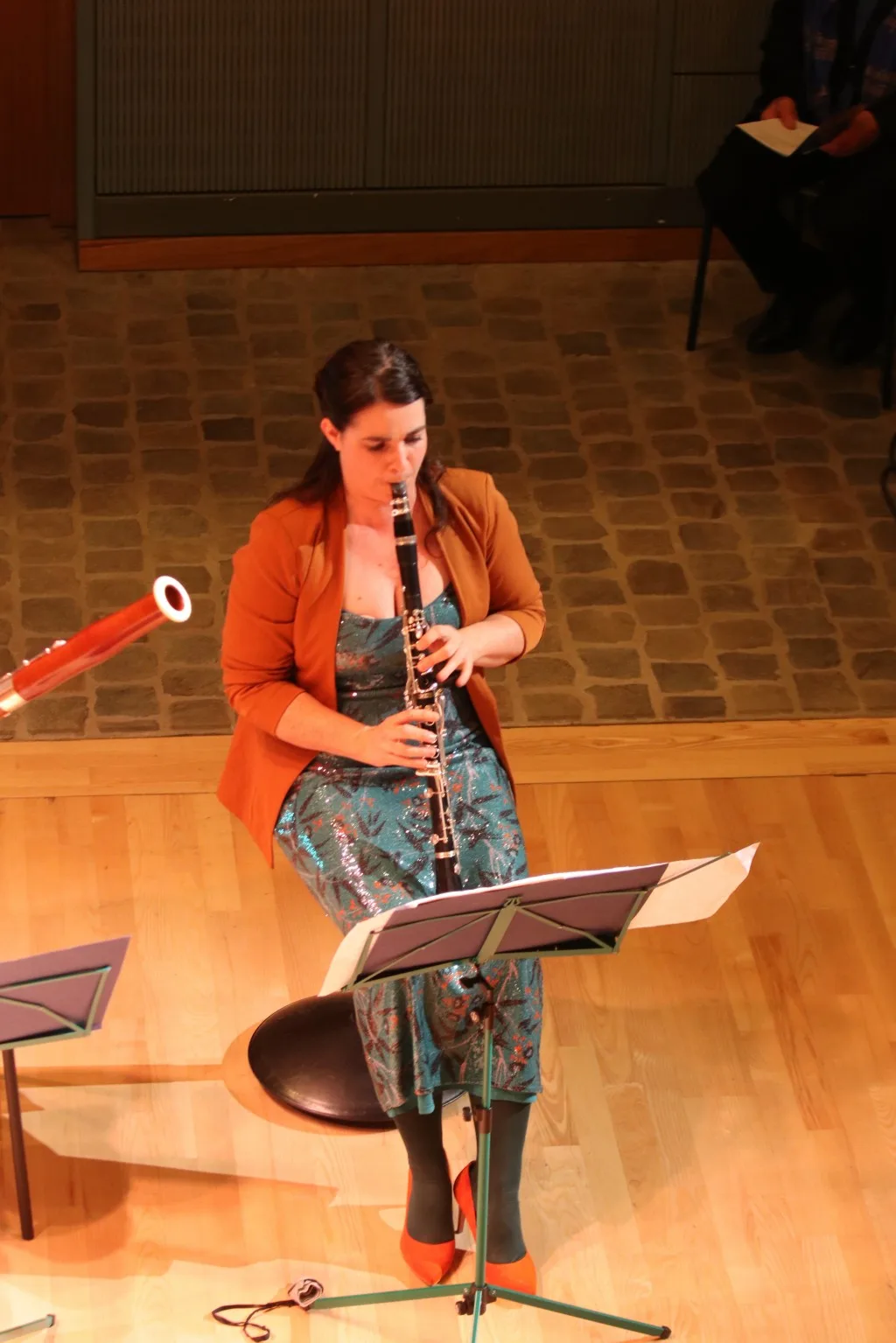 The linchpin is clarinettist Annelien Van Wauwe
They had recently been in Mechelen with the charged 'Quatuor pour la fin du temps'. Now they could let themselves go more freely. And that is what they did: the Franco-Russian violinist Alexandra Soumm, the Franco-Swiss violist Mathis Rochat, the French cellist Louis Rodde, the Finnish-Russian double bassist Maria Krykov, the London-born horn player Ben Goldscheider, and the French bassoonist Marceau Lefèvre.
Sober yet spirited, and with professional mastery, they did justice to the individuality of each work: Haydn was light, Blanc captivating, Beethoven brilliant. And also, of course, clarinettist Annelien Van Wauwe, from Hamme and now from Mechelen. Training and masterclasses practically everywhere, prizes practically everywhere, orchestral engagements practically everywhere, successes practically everywhere.
Yet she integrated completely into the group, without a trace of 'leading lady allure'. The British conductor Andrew Manze knew it: "Annelien is lovely to work with because she can be the soloist that stuns everybody. But she wants to be part of the orchestra." That was also the case here, and it led to a homogeneity worthy of the highest respect. All the performances flowed seamlessly into one another.
After her steady rise as the bearer of the Klara Public Prize for Best Young Musician in 2015, I came to see her as the 'Snow White of the Clarinet', by analogy with her near-namesake, the 'Snow White of the Harp'. As beautifully as the instruments were tuned to one another, so harmoniously did a refined blend of exclusively petrol green, midnight blue and rust tones charm. The eye, too, likes to get its share...
Besides this perfection, organiser Deleus could also rejoice in the presence of alderman Kristof Calvo and his personal successor in the support of the Mechelen City Council, of Cardinal Jozef De Kesel, and of a loyal audience that is not put off by unfamiliar names on the programme.
Mischievous mnemonics
However irreverent, I must get this off my chest. A very long time ago, my piano teacher, a respected concert pianist, linked the melody of Beethoven's Piano Sonata Op. 49/2, on which the third movement of his Septet is based, to the text 'Ach, meneer, ach, madam, 'k eet zo gaarne apennootjes' (roughly: "Oh sir, oh madam, I so love to eat hazelnuts"). Ridiculous, but efficient as a memory aid. Later I discovered that the much-praised musicologist and professor Hélène Nolthenius (1920–2000) made the 'Unfinished' immortal in her youth book 'Zwerftochten door het Rijk der Muziek' by means of the text 'This is the Symphony that Schubert wrote and never completed.' And that is true. That remains. That helps.
One can also go from text to music, as in Beethoven's 'Gassenhauer', Schubert's 'Quartettsatz', or in what Hummel, Wranitzky or Schönberg came up with for 'O, du lieber Augustin'. But that would lead too far!