

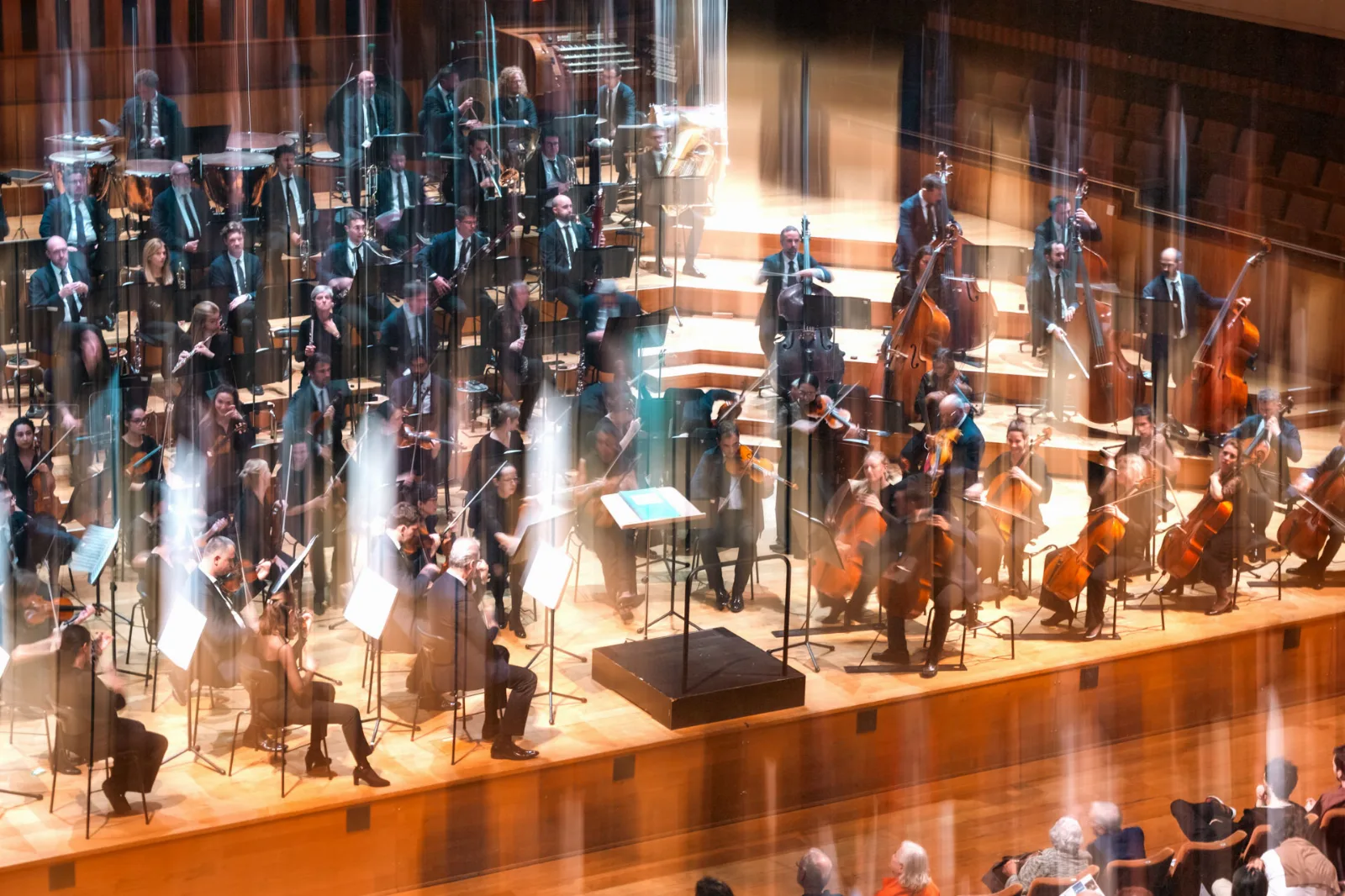
An evening that begins with the bubbling overture to Ruslan & Lyudmila by Mikhail Glinka (1804-1857) and ends with the Sixth Symphony of Sergei Prokofiev (1891-1953), in which exuberance and unease lie close together, immediately sets up a striking musical contrast. In between sounds the First Violin Concerto of Dmitri Shostakovich (1906-1975), with Alena Baeva as soloist. Lyricism, sarcasm, virtuosity and stillness constantly alternate. On Saturday 3 October, Kazushi Ono and Brussels Philharmonic brought these three works together at Flagey.
The overture to Ruslan & Lyudmila was performed with infectious joy in playing. Brussels Philharmonic let the music bubble, and Ono drove it forward with visible pleasure. The fast passages gained momentum without becoming rushed, and the orchestral sound had a clear sheen.
The silence speaks
Afterwards the atmosphere shifted. In Shostakovich's First Violin Concerto, Alena Baeva found a tone that commanded attention from the very beginning. Her playing was driven but never overdone. She can give a long melodic line tension without forcing it, and even in the most virtuosic passages she lets the music take precedence over technique. This is essential here, because Shostakovich does not make the soloist a hero who must constantly assert himself against the orchestra. The violin sometimes seems to stand in the middle of the orchestra rather than above it. The orchestral sections each had a distinct character without the cohesion being lost, and especially the dark colours of the low strings and woodwinds gave the work an undercurrent of tension.
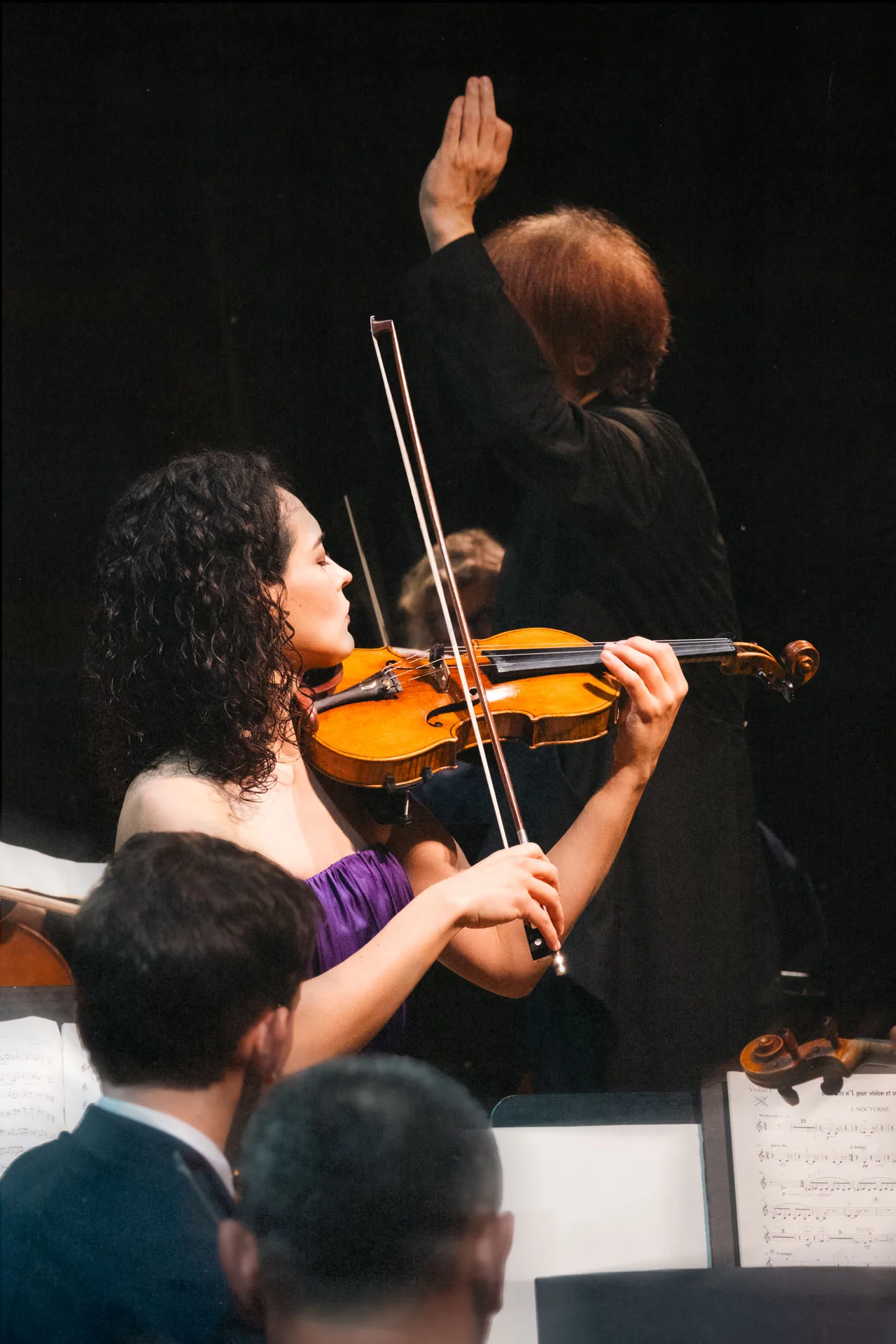 That tension was immediately palpable in the Nocturne. The music hardly seems to move, but beneath that apparent calm the unrest remains present. Baeva let the violin speak rather than sing: no sentimental lyricism, but a restrained narrative, fragile and concentrated. This contrasted with the scherzo, which came across as very lively and sharp. Here Shostakovich took on something mischievous. The soloist's virtuosity and the rhythmic precision of the orchestra produced plenty of bravura, without the music sliding into superficial spectacle. That combination of seriousness and biting humour is what makes this concerto so fascinating.
For me, the heart of this performance lay in the Passacaglia and the cadenza. After the nervous energy of the preceding movement, the music almost falls silent. Baeva played with great inner calm, and the orchestra created around her a sound world in which time seemed to stand still. That stillness reached its peak in the cadenza, played with piercing beauty and tragedy. You could have heard a pin drop.
What broke loose afterwards gained a different meaning through that silence. In the Burlesque, virtuosity returned, but it did not sound like pure bravado. What had just been restrained and almost vulnerable regained momentum and sharpness, as if the composer, after a moment of introspection, were putting on a mask again. The exuberance did not hide the seriousness; rather, it seemed to protect it.
The history of the work also carries such tension. Shostakovich kept his concerto back for years after completing it in 1948, and it could only be premiered in 1955, more than two years after Stalin's death. Baeva, Ono and the orchestra drove it towards an almost frenzied ending, in which virtuosity, tension and energy piled up one final time. When the last note sounded, the audience erupted. A release valve after so much accumulated emotion.
Celebration with a shadow
After the interval came Prokofiev's Sixth Symphony. The first movement was built up steadily, with fine rhythmic accents from the orchestra driving the tension ever higher. Brussels Philharmonic played with great conviction, and Ono held the various layers together. That charged quality suits a work that Prokofiev himself regarded as a response to the horrors of war.
The premiere in Leningrad in 1947 was initially warmly received, but in the months that followed the political climate turned. During the condemnation in the Zhdanov campaign in February 1948, Prokofiev's music too was labelled formalist and insufficiently in line with official Soviet aesthetics. That background sheds extra light on the transitions between lyricism, menace, sharpness and exuberance that Ono drew out of the orchestra.
The Largo was the dramatic high point of the evening. The music takes on something elegiac and ominous there, with a slowly advancing tension that becomes ever harder to escape. The orchestra built intensely towards the climax, and the release after the cymbal was enormous. Remarkably, the large orchestra remained homogeneous throughout: even in full force the whole stayed clear and controlled, while the individual sections kept their own colour. The power of the brass and the sure-footed entries of the percussion contributed to the impact of the moment.
In the final movement the atmosphere shifted again. The music acquired an irresistibly restless quality, and the energy held up to the end. The rhythmic sharpness already present in the first movement took on a far more exuberant character here. After the dark Largo, this finale sounds almost like liberation. Prokofiev sets the music dancing once more, but it never becomes entirely carefree. Under Ono, Brussels Philharmonic executed the movement with great enjoyment and rhythmic precision. After the abrupt ending, the audience remained seated for a fraction of a second, startled. Prokofiev had made his point.
The ambiguity connects Prokofiev with Shostakovich. In both composers, a cheerful movement can suddenly acquire a dark undercurrent, virtuosity can turn into nervousness, and lyricism can sound at once comforting and oppressive.
With Alena Baeva as a convincing soloist and a Brussels Philharmonic that under Ono showed its strength in both the finer moments and the great outbursts, it was above all the undercurrent of tension that lingered after the evening. Glinka brought lightness, Shostakovich let the silence speak, and Prokofiev, after his Largo, let the music dance once more, but beneath that smile the pain remained audible.