Nikolai Rimsky-Korsakov is perhaps best known for the popular "The Flight of the Bumblebee", and few will pause to consider that it is an excerpt from one of his fantastical operas, The Tale of Tsar Saltan. It is wonderful that the Muntschouwburg has both this opera and The Golden Cockerel in its repertoire, but we did not want to let the opportunity to see The Night Before Christmas at the Frankfurt opera pass us by.
Naval officer becomes composer
Nikolai Rimsky-Korsakov was born in 1844 into an old but impoverished noble family. He was destined for a career in the navy. He therefore received an education at the cadet school in Saint Petersburg, and music was a passionate pastime. He did take piano lessons and, in 1861, as the youngest of the group, joined the "Mighty Handful", to which Modest Mussorgsky, César Cui and Alexander Borodin belonged. After completing his naval studies, he sailed around the world for nearly two years. On those voyages he became fascinated by all kinds of natural phenomena and cosmological occurrences. This is reflected in his operatic stories.
Fairy-tale fantasy and richness of colour are therefore the two main characteristics of his work, whether it concerns the symphonic suite Scheherazade or his fifteen operas. In his operatic oeuvre we find historical drama alongside fairy tale, magic play alongside legend and satire. He does not compose operas set in realistic everyday life with intimate emotional events, as Pyotr Tchaikovsky did in Eugene Onegin or The Queen of Spades. No passion, no probing of psychology; instead he chooses a fairy-tale tone, the fantastical, the depiction of nature and the mystical.
The Night Before Christmas, a fantastical love story
The Night Before Christmas is based on stories by Nikolai Gogol that contain motifs of Ukrainian folklore and blend events from everyday village life with fantastical elements. The story takes place on Christmas Eve. In the Ukrainian village of Dikanka, the blacksmith Vakula is madly in love with Oksana, the daughter of a large landowner. She will only marry him if he can give her the golden slippers of the tsarina. In despair, Vakula calls on the help of the devil, who helps him fly to the capital, but who of course has false intentions. However, upon arriving at the tsarina's court, she gives him her most beautiful pair of slippers. Back in Dikanka, Oksana regrets her strict condition and realises her love for Vakula. Now nothing stands in the way of the marriage.
Nikolai Rimsky-Korsakov interweaves the Christian Christmas celebration with pre-Christian customs of the winter solstice. Thus, behind the reality of village life with its songs and dances, a second archaic world appears. The Koliada songs of the winter solstice give Rimsky-Korsakov the opportunity for colourful, vital scenes. Nature magic, the conjuring of the supernatural and musical folklore, as in the dance of the stars or the witches' ride, are a typical aspect of Rimsky-Korsakov's style, alongside poetry and drastic humour.
Christoph Loy: once again a fantastical director.
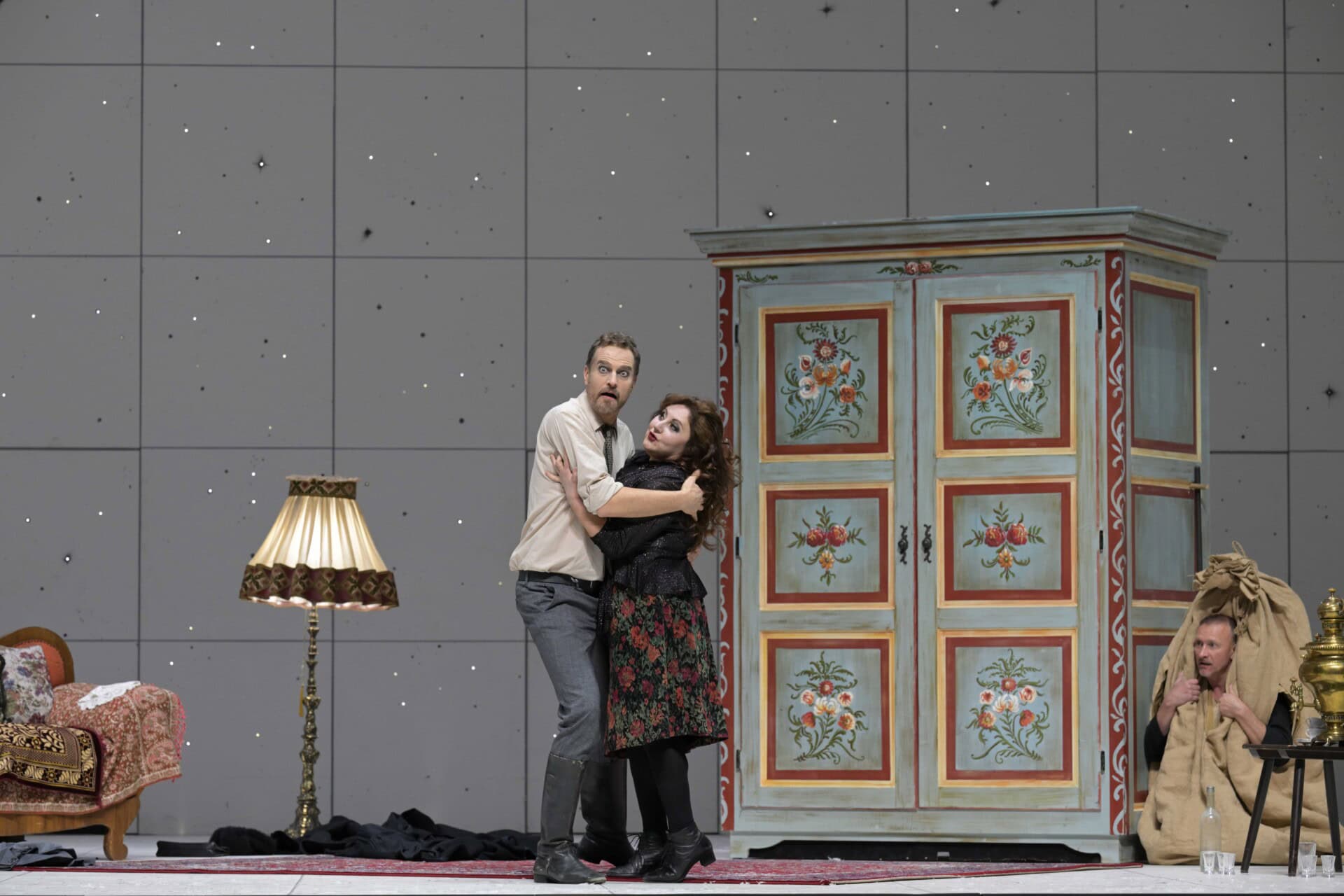
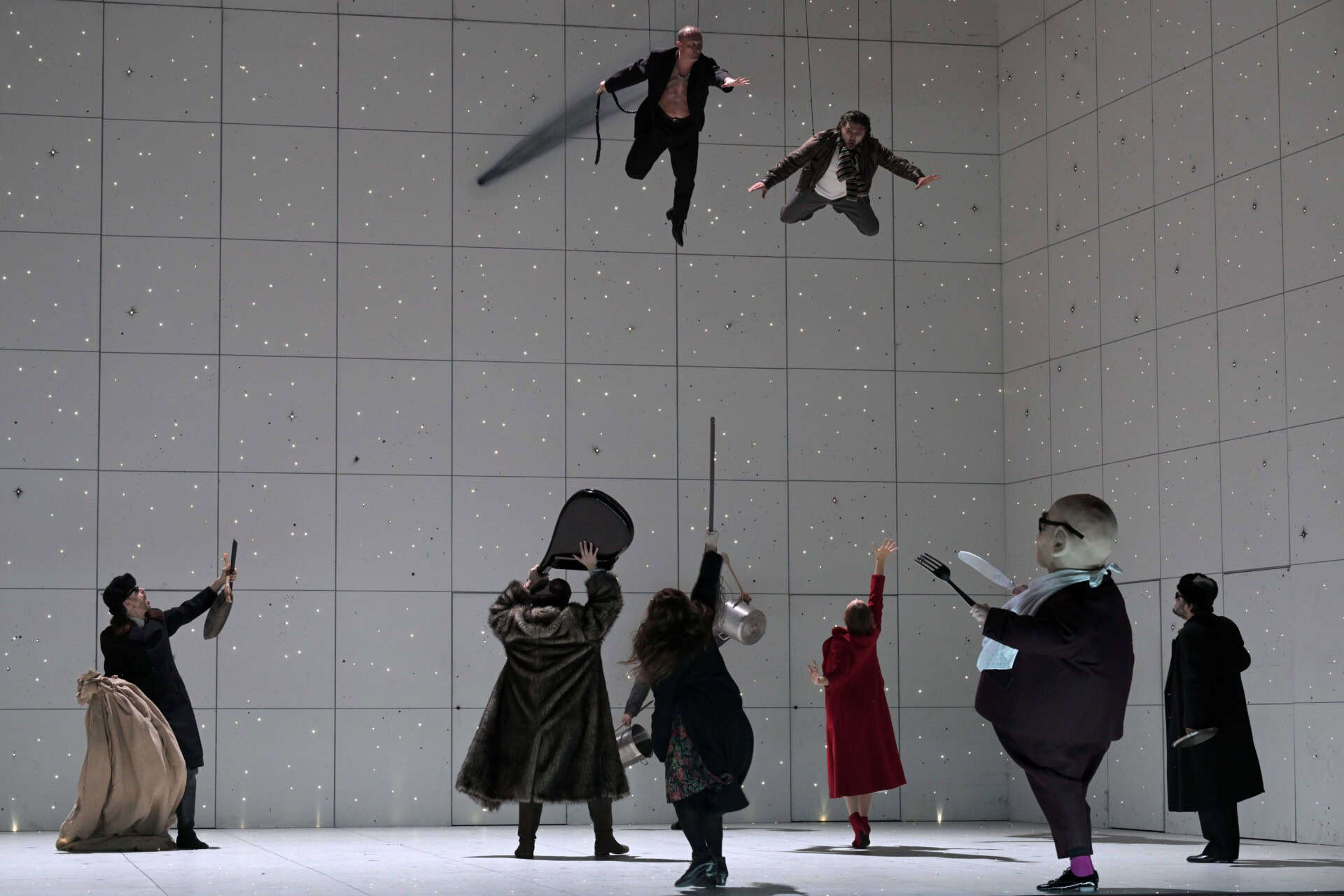
It is a perfect match for director Christoph Loy. This production (in Russian) of Die Nacht vor Weihnachten in Frankfurt is once again proof that Christoph Loy understands the spirit of the work he stages and presents it with remarkable inspiration, yet always with respect! For the occasion, the stage curtain is a cosmic scene with celestial bodies and stars. In this way Loy refers to the natural phenomena that inspire Rimsky-Korsakov's richness of colour and the play of light that he translates into sound in his operas. It stimulates the fairy-tale fantasy with which the production is filled. The characters, each of whom receives a characteristic intonation in the music, Loy portrays with just the right diversity and imagination: the simple Vakula and the complex witch, the delightfully attractive girl Oksana and the malicious devil. And indeed the witch can fly on her broom and, together with the devil, cut through the airspace. There is no shortage of acrobatics; what an achievement by the performers!At the same time, the staging shows that Nikolai Rimsky-Korsakov is anything but a naive teller of fairy tales, for the malice of people is also addressed, for example when Oksana's rival swears that he will never be able to get hold of the tsarina's slippers and so stand a chance with his bride. In the scene where the witch Solokha and the devil plot against Vakula and repeatedly stuff the guest arriving in a sack, Loy exploits the story fully for mockery, humour and satire. Equally well, the happy ending receives a delightful portrayal, both amusing and touching.
Captivating musicality
This production was first seen in 2021 in Frankfurt, where Opernwelt named it "production of the year". For this revival, the young conductor Takeshi Moriuchi takes up the baton and, with the orchestra, makes it a musical celebration. Each scene receives its precise orchestral colouring, from exuberant to serene, from demonic to heavenly, with the emphasis on the emotionally expressive cello in Oksana's beautiful declaration of love. The solo roles are taken by singers from the ensemble of Oper Frankfurt, and they prove what a wealth of talent is available there. The Polish soprano Monika Buczkowska-Ward sang Oksana with a crystal-clear voice, Enkelejda Shkoza was a chilling witch (Solocha), and Georgy Wasiliev a moving Wakula. The folk scenes that Rimsky-Korsakov paints with a rich palette of musical colours are glorious choral passages.
Let us hear the words of the important musicologist of Russian music, Richard Taruskin: "Rimsky-Korsakov is a composer who does not easily transplant. But for those who approach him with the appropriate openness, he can be the most exciting and fascinating music in the world." Taruskin also calls on intendants, dramaturges and directors to bring his work into the spotlight!