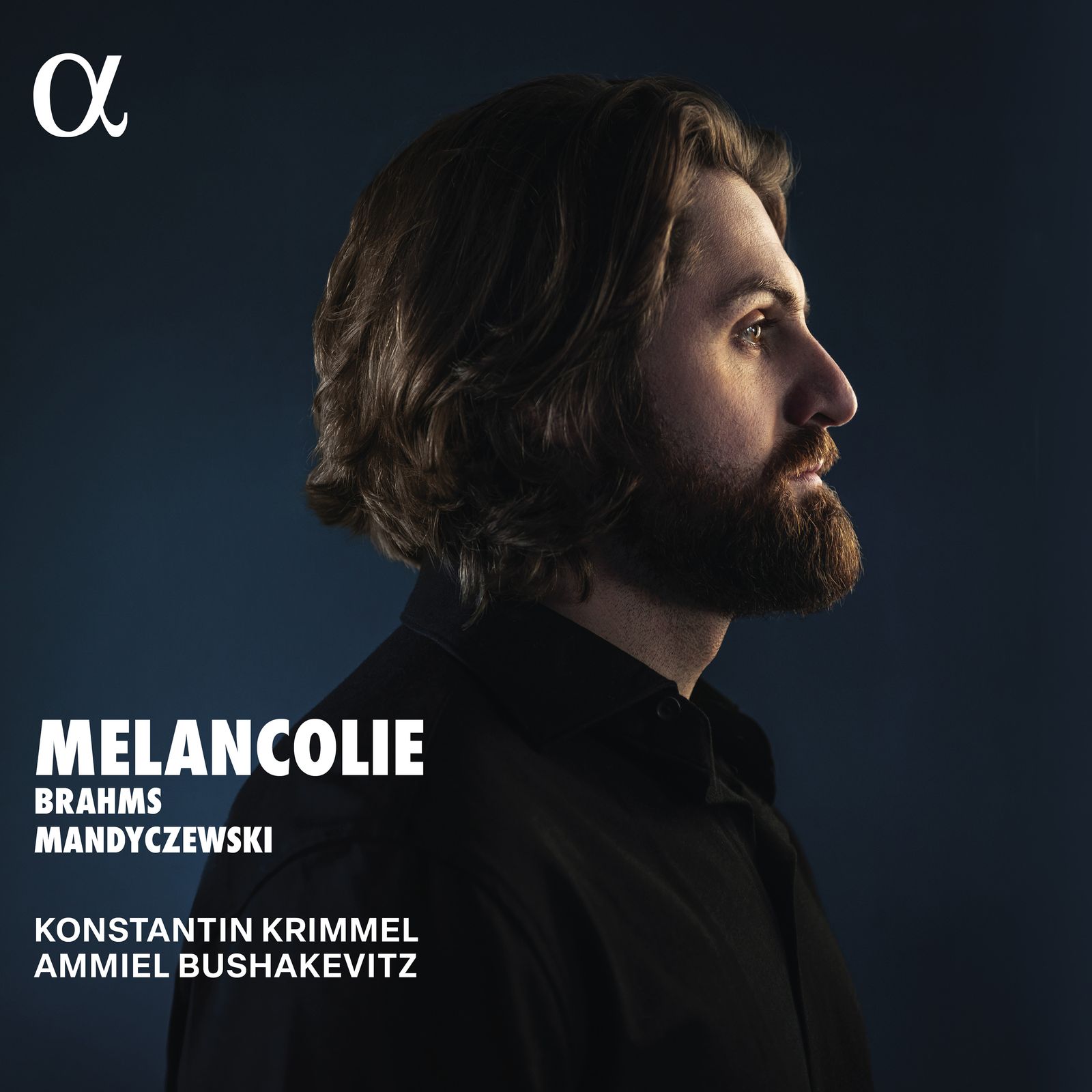
At first glance, the combination of Johannes Brahms (1833-1897) and Eusebius Mandyczewski (1857-1929) is unusual. Opposite one of the great masters of the German Romantic lied stands a composer who has hardly any fame beyond specialist circles. Yet precisely this combination is the strength of Melancolie, the CD on which baritone Konstantin Krimmel and pianist Ammiel Bushakevitz bring together songs by both composers. Mandyczewski is here not a footnote to Brahms, but a composer with a voice of his own.
The title, deliberately without the h of the German Melancholie, refers to Mandyczewski’s Romanian background and to a central idea of the recording: melancholy, longing and memory cannot be bound to national borders. Brahms came from Hamburg, Mandyczewski from Bukovina; both ultimately found their musical home in Vienna. Krimmel and Bushakevitz, too, carry different cultural roots with them. “Home” thus becomes an inner experience, shaped by memory and by life between cultures.
The combination is also historically grounded. In 1879 Brahms met the young Mandyczewski. A close friendship developed that lasted until Brahms’ death. That Mandyczewski became known mainly as a musicologist, pedagogue and editor makes one forget that he also composed: he wrote songs, choral works and liturgical music.
Mandyczewski was born in the vicinity of Czernowitz, in a multilingual region of the Habsburg monarchy. German became the language of his education and career, but his Romanian background remained significant, as the eighteen Cântece românești, Op. 7 demonstrate. These songs appeared in 1885 in Vienna, in a Romanian-German edition, and largely set texts by the poet and folk-song collector Vasile Alecsandri to music.
On Melancolie they sound in the original Romanian. Krimmel treats them not as an exotic accent within a German programme, but with the same seriousness as the Brahms songs. This gives the choice a personal charge: in the CD booklet the singer, who himself has German-Romanian roots, describes living between different worlds as a richness.
A story in word and music
The 26 songs on this CD do not stand in separate blocks, but alternate, so that correspondences and differences gradually become visible. In Brahms, longing, loss and the proximity of death often carry a pronounced psychological charge, as in Auf dem Kirchhofe, Die Mainacht, Meerfahrt and Feldeinsamkeit. The tension lies not only in the vocal line, but also in the harmony and in the independent role of the piano.
Mandyczewski more often opts for a more direct, almost folk-song-like melodic style that appeals immediately. In him, too, love, loss and transience recur, but the emphasis lies more on the melodic line and the direct connection between word and music. This does not make his work a lighter variant of Brahms: he expresses related feelings from a personal musical identity. Not every song is, moreover, equally melancholic. Alongside wistfulness there is room for lyrical lightness and for the charm of a melody that convinces through its simplicity.
Krimmel’s clear, warm baritone combines a fine timbre with a strong feeling for text. His German diction is so natural that in the Brahms songs one hardly needs the booklet. The words grow organically out of the phrase, rather than lying loosely on top of it.
This is particularly beautiful in Brahms’ Unbewegte laue Luft. The hushed nocturnal atmosphere is here not a romantic backdrop, but the starting point for a longing that grows beneath the surface. The garden and the gentle splashing of the fountain evoke an image of calm, while the musical line gradually acquires more inner tension. Krimmel lets that development arise through his controlled phrasing and through the way he shapes the vocal line, without breaking the intimacy of the song.
The same attention to the text speaks from the Romanian songs. In Lăcrimioare the delicate lily-of-the-valley stand against the cold wind, La o copiliță connects love with the transience of life, and O Zi evokes a lost moment of love. Even one who does not understand the language can sense the emotional world. Krimmel colours his vowels carefully and lets the phrases breathe, without exoticising them.
I previously heard Krimmel live in Berlin, in songs by Richard Strauss at the Staatsoper Unter den Linden. The opulent orchestral sound of that repertoire made me curious about how his voice would function in the more intimate world of the lied, where every nuance in the voice and every turn in the accompaniment becomes directly audible. Melancolie presents a singer who approaches the song not as a reduced operatic scene, but respects the distinctive character of the genre. His expressiveness lies not in the scale of the gesture, but in the precision with which he connects text, sound and tension.
Bushakevitz is much more than an accompanist. His playing forms an independent interpretive layer, without pushing the singing into the background. In Brahms he gives the piano part all the space to follow its own line alongside the voice. His playing supports the atmosphere of Unbewegte laue Luft and lets the piano speak as an independent voice in the song.
With Mandyczewski, the more direct melodic writing calls for a different approach. The accompaniment must not overwhelm the simplicity of the songs, but neither may it remain colourless. Bushakevitz maintains the balance between clarity and expression and gives these songs their own character as well. The recording allows this interplay to come fully into its own: voice and piano are clearly balanced, while the piano retains sufficient depth and warmth.
From night to solitude
As the programme progresses, the coherence grows. Brahms’ Der Tod, das ist die kühle Nacht, An die Nachtigall and Feldeinsamkeit are followed by Mandyczewski’s Mormântul and Omul singuratic, in which night, nature, death and solitude merge into one another. Omul singuratic in particular gives weight to the theme of isolation.
The coherence arises not because all the songs share the same mood, but because they touch, from different angles, on the relationship between humanity, nature, love and transience. In this way the title acquires its meaning: melancholy here is not merely sorrow, but also the awareness that love, beauty, youth and life pass away. Sometimes this sounds heavy and inescapable, sometimes light and lyrical.
Melancolie is a carefully constructed recital that does more than bring a forgotten composer to attention. Krimmel and Bushakevitz turn the alternation between Brahms and Mandyczewski into a substantive dialogue, in which the distinctive character of both composers becomes more sharply audible. Ultimately, music proves to be a homeland of the heart: a place where different cultural backgrounds meet in feelings that remain recognisable.