


Josep Colom (*1947) enjoys a great reputation not only in Spain as a pianist and teacher. He has won a large number of awards in his own country and has performed worldwide, both in solo and concerto repertoire. He is also no stranger in the recording studio: his interpretations have been released by a large number of music labels, including Harmonia Mundi, Mandala, Columna Musica and for quite some time by the Spanish Eudora Records, run by Gonzalo Noqué.
It is not what it appears to be at first glance... The cover does not mention it, but this album offers a far from ordinary view of these four Mozart sonatas, also inspired by the idea that the composer himself did not always (or perhaps rarely: who can say?) adhere to his own notation in his performances; that he improvised on it when it suited him (whereby it is questionable whether his listeners noticed!). We know for certain that he was very good at this, just as Beethoven after him - contemporaries confirmed it in all its aspects - proved to be a true master in this regard. Moreover, in those times it was not unusual for composers and instrumentalists to compete with each other on this front, each trying to master this very special art best.
Colom may also have thought: there are already so many recordings of Mozart's sonatas, I want to do it differently. He did that before, albeit less drastically than on this Mozart album, in his Beethoven edition recorded in 2016, which you can read about here.
Colom's easily imaginative interventions are formed by the interludes he composed between each sonata section (seven in total in these four sonatas). This was not even unusual until the beginning of the last century. The intermezzo – without a break! - serves here as a 'guide' from one section to the next. Motifs from the preceding section or the section to come provide both an aura of anticipation and a new dimension and as creatively and tastefully as Colom has done it, any criticism of it should quickly be silenced. That these interludes are not even far removed from the cadenzas customary in many concerts may be mentioned in passing here.
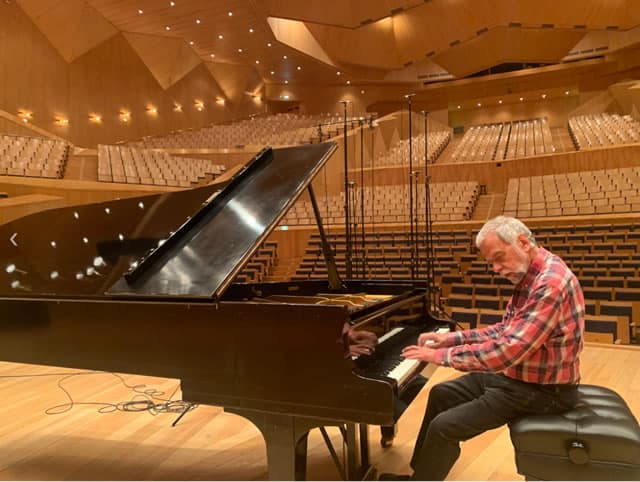 However, that is only one aspect, for Colom furthermore adds new ideas to the existing notation entirely as he sees fit, sometimes only modest, but also extensive. Whoever then follows the music with the score at hand will probably soon lose track.
New music woven into old music, but - whatever may be said about it - it is done inventively and completely organically embedded. Anyone who didn't know better could truly think that Mozart himself had come up with it, this scenario moving outside the performance tradition with its many varied metamorphoses! To which another important consequence is attached: that the existing notes that many will know so well also come to stand in an entirely different light.
As I mentioned, Colom is an interpreter of great stature whose playing testifies to much finesse and subtlety, and who, as evidenced by this Mozart album, has added a number of creative dimensions to it. The 'purists' may be averse to it (possibly), but whoever wants to look (and listen) further might experience this as an impressive listening adventure that is moreover excellently suited for repeated listening. Where the beautiful recording adds another dimension to it, both in stereo and in surround: the sound of the Steinway D comes beautifully from the speakers.