


Weinberg: Sonatas for solo cello no. 1 op. 72 - no. 2 op. 121 - no. 3 op. 106 - no. 4 op. 140bis
Mario Brunello (cello)
Arcana A 559 • 88' •
Recording: March 2022, Antiruggine, Vallà, Treviso (I)
There is so much inspiration in these four sonatas and Mario Brunello's musicianship that it is much more than merely heart-warming: it touches the soul at its deepest, this music that wells up from a richly varied source that combines a beautifully stylized color palette with an expressive force field that spares nothing and no one, with the overwhelming effect that we also know from his 24 Preludes op. 100, likewise composed for solo cello (later arranged by Gidon Kremer for solo violin).
Many know the turbulent history of Polish Jew Mieczyslaw Weinberg (Warsaw, 1919 - Moscow, 1996), fleeing the Nazis and finding sanctuary in what would become his new homeland: the Soviet Union, where he soon gained recognition as a pianist and composer. Much thanks to Shostakovich, by the way, who had already acquired considerable status and saw in Weinberg an emerging great talent. However, like so many artists of that time, Weinberg too fell victim to Stalin's tyranny and his clique's all-encompassing grip, their merciless claws lashing out at all those who were suspected and subsequently accused of 'formalism', with the Jewish intelligentsia as one of the first targets.
Able defender
It is certainly to Shostakovich's credit that he publicly opposed the growing criticism of Weinberg, taking his side during one of the many meetings of the Composers' Union. Although not with regard to Weinberg as a person, but rather his music, which he described as important and promising, written by a gifted composer. Though this was accompanied by his 'offer' to 'critically guide' Weinberg in his further musical development (as if this were necessary at all). Between the lines: thus to show him the way toward a musical development that could withstand the test of 'criticism' (usually initially delivered by the Composers' Union). Which, however, did not prevent the newly-minted 'teacher' himself from coming under heavy fire from that same Composers' Union later, in 1948, which would result in an outright, publicly expressed act of contrition by a 'guilt-stricken' composer...
Accusation
Nevertheless, a formal charge was brought against Weinberg concerning his Sinfonietta, completed in 1948, which according to the accusers showed too much Jewish influence, could thus be classified as 'Jewish nationalism' and therefore 'anti-Soviet'. It seemed more likely, however, that he had been arrested because he was Jewish, since one of the most prominent 'hardliners' of the Composers' Union, Tikhon Khrennikov, had actually found it to be an excellent composition!
Arrested
That a trifle or even nothing could land you in a cell was also experienced by Weinberg, who in early 1953 was arrested without notice and taken to the notorious Butyrka prison in Moscow. The charge: Jewish bourgeois nationalism. For that alone you could be locked up for years or sent to an inhospitable labor camp. It could even be for considerably less. Weinberg the Jew who had never adopted Yiddish as his own, but who was completely fluent in Polish and Russian.
A courageous letter
That Weinberg was still released shortly after Stalin's death (the dictator died on 5 March 1953 at his dacha near Kuntsevo) seems largely to be credited to Shostakovich, for he had the courage to write a letter in favor of Weinberg to the head of the secret police, the greatly feared Lavrenti Beria. In that letter, Shostakovich bravely stood up for his friend, recalling his great talent as a composer and musician, and emphasized above all that in his view Weinberg concerned himself exclusively with music and thus not with politics. But also that he vouched for him and Weinberg moreover suffered from serious back problems. As if that were not enough, Shostakovich then paid a visit to Voroshilov, the chairman of the Supreme Soviet, to explicitly plead with him as well for Weinberg's release. What precisely tipped the scales remains uncertain, but it was this Voroshilov who ultimately ordered Weinberg's release, after which Weinberg, on 23 April 1953, after having spent more than three months in custody, could see and feel the sun again.
Difficult aftermath
For Weinberg, the gradual and meager 'thaw' that set in after Stalin's death had only limited meaning. He withdrew to his own stronghold, composed scarcely at all. Obediently, he did accept commissions from the Composers' Union, consisting of propagandistic works interspersed with film and circus music, with which he nonetheless reaped considerable success. The remarkable thing about it was that this music became even much better known than the composer's name! It also turned out to be a great contrast: that cheerful film and circus music versus the melancholic, even extremely somber sounds that emanate from his other works. That his financial circumstances at that time were certainly not unfavorable (he earned a tidy sum with his popular music) did not make him a happy man.
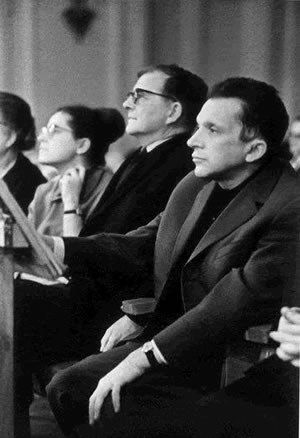
Irina and Dmitri Shostakovich and Weinberg (Moscow, ca. 1965)
Growing significance
In the course of February 1956, under the rule of the new party leader Chroesjtsjov, although the 'thaw' may have entered a new phase and cultural exchange with the free West became possible, this did not mean that Weinberg's music thereby gained significance in Western Europe. Only in the early nineties did that, initially hesitantly, get off the ground thanks to the British record label Olympia which in the following decade released much of Weinberg's music. It also proved to be the driving force for Weinberg's fame as a Polish-Russian composer of Jewish origin. It even came to pass that his work was then increasingly performed on many concert stages, the number of Western musicians growing who brought it to the attention of the public. For Weinberg it can hardly have been of significance: for him it was simply too late. He had been suffering for some time from spinal tuberculosis, struggled continuously with all sorts of setbacks (also in his private life) and spent his final years in great solitude and gloom, virtually forgotten in his own country.
The end
After the collapse of the Soviet Union in December 1991 and the subsequent dissolution of the Composers' Union, he faced moreover a great loss of income, after which as if that were not enough, those from among other things film also disappeared (young, contemporary film composers meanwhile enjoyed by far the preference of film producers). Grief and sorrow, it just would not stop. A year before his death he was virtually bedridden, suffered from a serious form of arteriosclerosis and heart failure. On 26 February 1996 Weinberg died in Moscow, he was 76.
Four cello sonatas
This far from fortunate life story (of which the misery extends far beyond what I have sketched here) and the music which for the most part forms the unmistakable reflection of it, naturally did not pass these four sonatas by, completed in 1960 (op. 72), 1971 (op. 106), 1977 (op. 121, the second version), and 1986 (op. 140bis, after a major revision of op. 140 from 1985) respectively. They span a period of exactly a quarter century: op. 72 was created during the 'thaw' initiated by Chroesjtsjov (introduced by the 20th party congress) and op. 140 under the rule of Gorbatsjov, who had just taken office as secretary-general of the Communist Party of the Soviet Union.
However different the circumstances under which these four works came into being may have been, what unites them is their compositionally daring character, which gives them a visionary character and consequently a special, if not unique place in the twentieth-century cello repertoire. That they were created during Weinberg's best years as a composer seems no less evident, just as a number of stylistic characteristics of them cannot be seen separately from the oeuvre of his friend Sjostakovitsj (who, however, never produced a sonata for solo cello). They knew and admired each other's work, inspired each other as well, with great respect for classical form (in particular sonata form).
In the CD booklet Mario Brunello truly touches the heart of these sonatas:
'In the four cello sonatas, Weinberg simply invents a new model of expressiveness for the instrument, maintaining a suitable distance from the homage to the Bach Suites – it is about time someone said it – that characterizes most of the solo cello repertoire since the end of the nineteenth century. In these sonatas one notices the relish for story-telling, for theatre, characteristics rooted in the environment in which the composer was trained during his youth.'
The pencil drawings by Euro Pavanetto reproduced in the booklet, specially selected by Brunello for this purpose, are in direct relation to this phenomenon cited by the cellist:
'And just as Pirandello introduced theatre into theatre, so Weinberg introduces music (his music) into music.'
Below an example of this, a 'drawing of drawing':
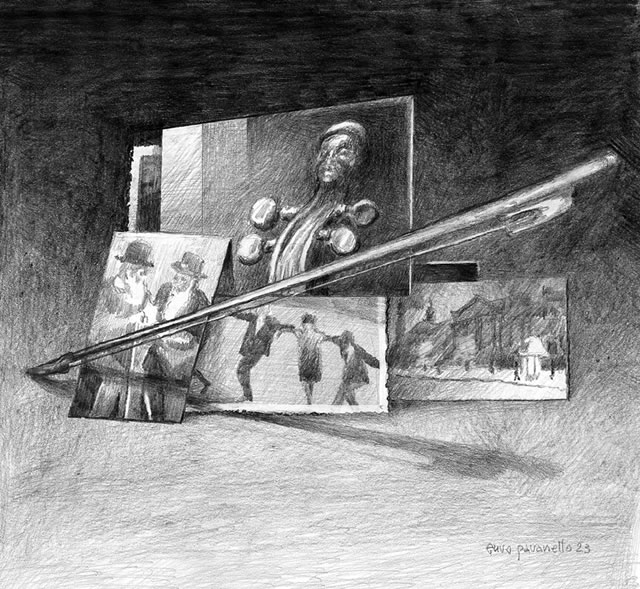
Brunello has wished to emphasize in his interpretations the narrative properties of them:
'I conceive the four sonatas as four stories, comedies, tales, which autonomously explore the personality of a hypothetical protagonist – maybe the composer himself.'
Which according to Brunello fits seamlessly with Pavanetto's pencil drawings, their 'semantic intensity in their representation of everyday images, stories and narratives such as I believe the musical poetics of Weinberg can express.'
Brunello, once engaged as cellist with the Orchestra Mozart led by Claudio Abbado, came into contact with Weinberg's music only relatively late and thanks to Gidon Kremer. This goes back to 2010, when Kremer, already the most important advocate of Weinberg's work, proposed to Brunello to conduct his Kremerata Baltica in Weinberg's (second) Sinfonietta op. 74.
It became an acquaintance that bore good fruit then and continues to do so now, as also appears from Brunello's imaginative and technically superior interpretation of these four sonatas for solo cello. The instrument of Pietro Santo Maggini (ca. 1600) has been magnificently recorded.