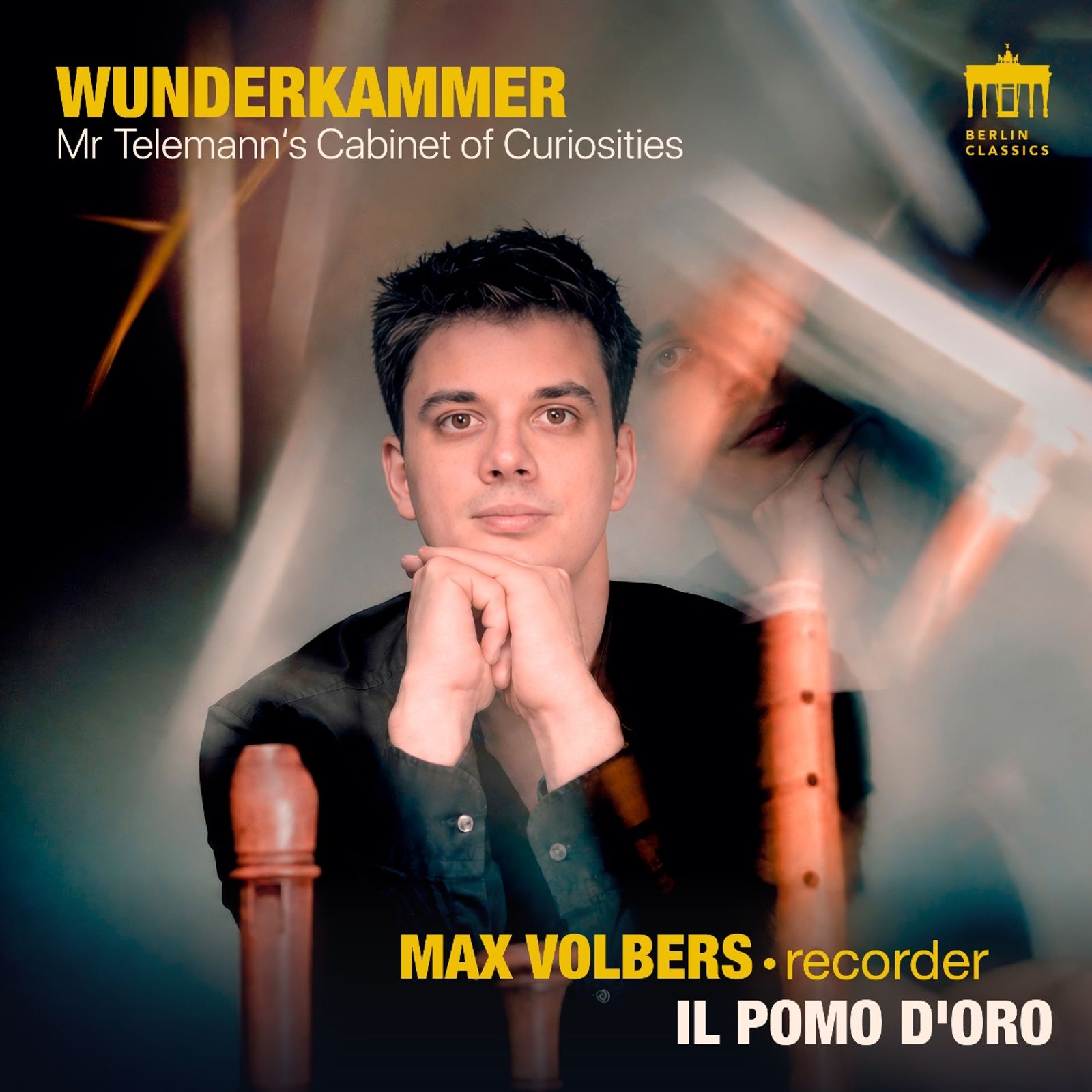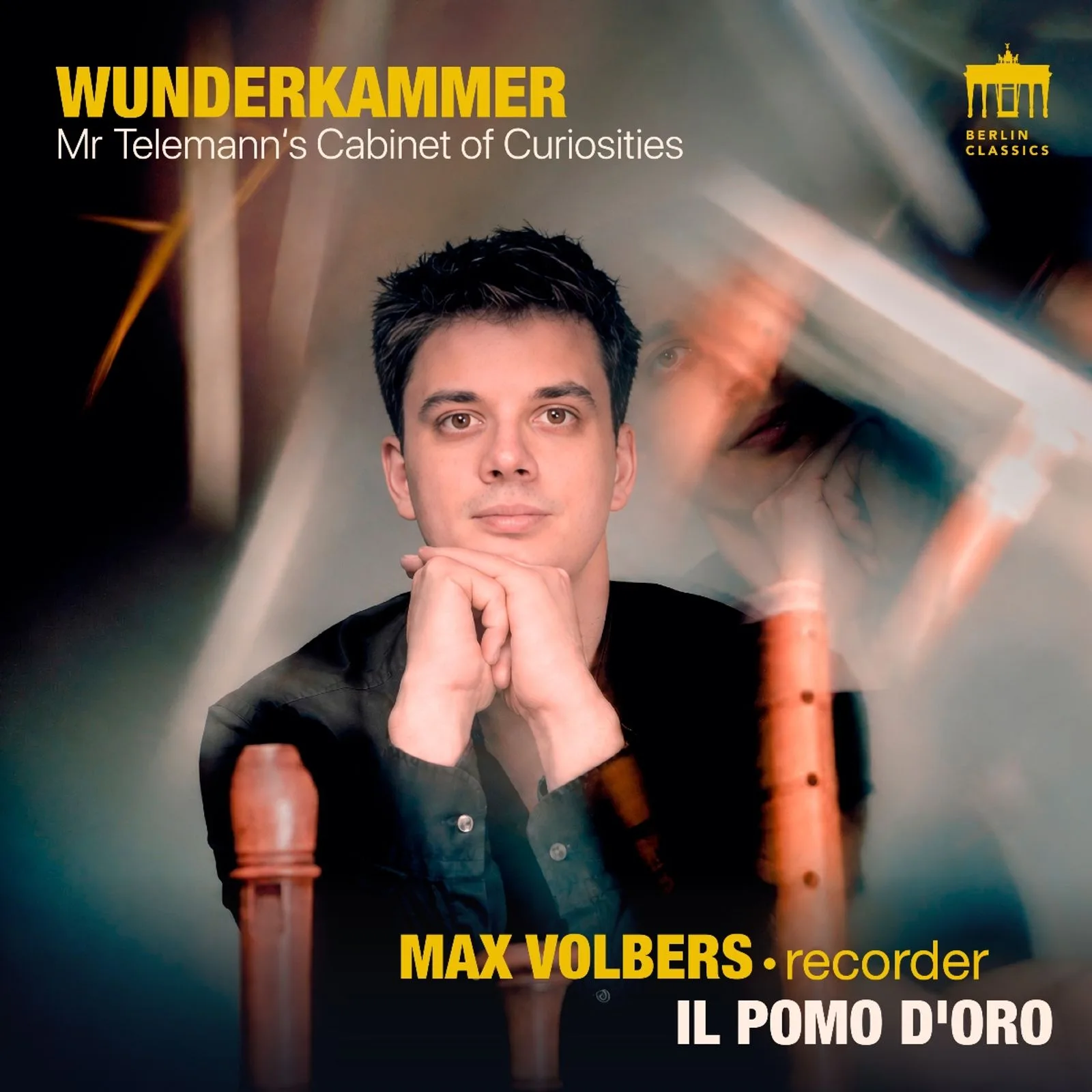
Georg Philipp Telemann (1681–1767) was a composer with an exceptionally broad range of interests. He drew inspiration from a wide variety of musical traditions and moved with ease between different genres and styles. This versatility forms the starting point of Wunderkammer, the album on which recorder player Max Volbers and the ensemble Il Pomo d’Oro bring together music from different corners of Telemann’s oeuvre. The title refers to the historical wonder chamber: a collection in which diverse objects stand side by side and, precisely through their mutual contrasts, form a surprising whole.
Musically too, the programme is conceived as an exploration of unexpected connections. Well-known works take on a different guise through transcriptions and arrangements, while less familiar compositions open up new perspectives. Volbers adds a personal touch with a composition of his own. The alternation between character pieces, dances and contrapuntal music ensures that the programme constantly changes colour.
A suite from different worlds
The first group brings together various character pieces that originate in Telemann’s orchestral suites. The titles already hint at the diverse moods: from the whimsical character of La Bizarre to the sighs of Les Soupirs de Quichotte and the birdlike Rossignol. L’Hypocondre, Harlequinade, Les vielles femmes and the Chaconne comique also show how eagerly Telemann translated musical characters and situations into sound.
In Rossignol, the recorder with its agile ornamentation evokes the song of a nightingale. L’Hypocondre is quite different: the recorder seems to try to cheer up the hypochondriac, while the orchestra sets against it a darker sonic world. In Les vielles femmes the tempo slows and the music takes on a languid, comic quality. Such contrasts make the group lively: behind the elegant Baroque forms lies a composer with a sense of theatre and human idiosyncrasy.
The recorder proves to be a versatile instrument in this context. It can sound light and agile, but it can also let the melody breathe and bring out a more contemplative side of the music. Volbers makes the differences between the pieces clearly audible and keeps the effects restrained. Il Pomo d’Oro follows the changes with a feeling for timing and regularly allows the accompanying voices a role of their own. In this way the music remains in motion, even when attention shifts for a moment from the soloist to the ensemble.
From melancholy to dance
A very different side of Telemann emerges in the Sonate in f klein, originally written for bassoon and basso continuo. The marking Triste sets the tone immediately: the minor key and the melancholic character distinguish this work from the more humorous and theatrical pieces on the disc. On the recorder, the melodic line takes on a lighter, more agile colour than one would expect on the bassoon, without the seriousness of the piece disappearing. Volbers keeps the phrasing restrained and lets the melody retain its own expressive power.
This is followed by the Sinfonia from the opera Pastorelle en musique, in which the shepherdess Caliste withdraws into sleep because she doubts her future with Damon. After the orchestral introduction, Volbers’ dreamy recorder playing evokes an almost otherworldly realm. The sound of his recorder at times takes on something of a shawm, which underlines the pastoral character of the music.
The dance music that follows shows how Telemann was inspired by the folk music he came to know during his travels through what is now Poland and the Czech Republic. Two Polish dances from the so-called Rostock manuscript were arranged for this recording by concertmaster Alfia Bakieva. They are purely orchestral pieces, in which the strings firmly set the rhythm and shape the melodies with great rhythmic energy.
Telemann as a source of inspiration
With the Hanakian Dance, Volbers himself steps forward as a composer. The piece is based on the Presto from Telemann’s twelfth fantasia for solo flute, but develops into a rondo in which the original material is supplemented with passages of his own. The virtuosic figures follow one another in quick succession, while rhythmic variations towards the end give the music extra momentum. Volbers uses Telemann’s music not only as a starting point but builds his own story with it. The result is a playful and technically demanding piece that forms one of the highlights of the album.
Volbers’ arrangement of the fourteenth fugue from Telemann’s Zwanzig Kleine Fugen for strings also deserves attention. The voices remain clearly distinguishable and together build a strong tension. After the dances and character pieces, this fugue provides a dramatic counterweight, with the musical progression arising entirely from the interplay of the strings.
A suite as finale
The Suite in a klein for recorder, strings and basso continuo forms the concluding piece of the programme. The Ouverture combines lively movement with a somewhat biting undertone and a touch of humour. Volbers and the ensemble keep the music light on its feet without smoothing away the sharp edges. Les Plaisirs has an elegant and dance-like character, with the recorder playfully in the foreground, while Air à l’Italien changes the mood. The sober continuo accompaniment allows the melancholy of the melody to come fully into its own, making this movement one of the more introspective moments of the suite.
The Menuet revisits the dance movement in a restrained form. Then Réjouissance lifts the energy again, with lively, emphatically present violin parts. In the Polonoise that energy finds a fitting continuation. Volbers moves smoothly between the different characters; Il Pomo d’Oro plays along with him, with precise accents and an interplay in which the smaller and softer instrumental lines also come fully into their own.
A Wunderkammer full of tonal colours
Wunderkammer stands out for the way Volbers forges the programme into a coherent whole. Dances, character pieces, counterpoint and his own composition complement one another and form more than a series of loose works.
In doing so, Volbers convinces through his sense for the distinct character of each piece: he lets the nightingale sing, gives the comic pieces their playful touches, and finds a restrained expressiveness in the slower movements. Il Pomo d’Oro follows him closely, with rhythmic sharpness and subtle nuances. The result is a CD that invites repeated listening, because Telemann here surprises again and again from a different angle.