


Some concerts don't let you go. The first concert of Symfonieorkest Vlaanderen under new chief conductor Martijn Dendievel – Martijn's Dream – belonged to those rare moments. Here music was not merely performed, but experienced: as a breathing structure in which sound, time and memory intertwine.
On Sunday 25 January, the programme at deSingel brought together three works, each offering a different perspective on interiority and time: the Third Symphony, Hommage, by Luc Brewaeys (1959-2015), the Violin Concerto in e minor by Felix Mendelssohn (1809-1847) and the First Symphony, Winter Dreams, by Peter Tchaikovsky (1840-1893). At first glance, very different worlds, but gradually they formed a coherent, poetic constellation. It was an afternoon in which listening itself became the connecting element, and music unfolded as a space in which questions mattered more than answers.
Echoes of another world
The concert opened with Brewaeys' Third Symphony, Hommage, a work that does not impose itself, but slowly and inescapably nestles into consciousness. Hommage is not a retrospective in a nostalgic sense, but a profound meditation on past and presence, on how music can carry memory without pinning it down. Brewaeys creates a sonic world in which time does not follow a linear trajectory, but behaves like a wave motion: from echo to anticipation, from memory to expectation.
 The fact that this complex musical language could speak immediately was largely due to Dendievel's insightful introduction at the beginning of the concert. By briefly outlining the structure and having the orchestra play some fragments, he gave the audience points of reference without undermining the mystery of the music. It was an intelligent, generous move: not to reduce the work to comprehensibility, but to remove the often paralyzing fear of the 'incomprehensible' in contemporary music. Those who know where they are listening listen differently.
For those – like the undersigned – hearing this work for the first time, this approach proved invaluable. The first movement, which unfolded rapidly in rolling crescendos, made clear how carefully Brewaeys charts his musical trajectory. The attacca transition to the hushed second movement worked like an abrupt change in breathing: from kinetic energy to an almost timeless stillness. Here became audible what Dendievel emphasized beforehand: the aleatoric passages are not arbitrary freedom, but function within a clear compositional plan. Freedom and structure reinforced each other.
The orchestration testified to Brewaeys' masterful sense of tone colour. Woodwinds whispered motifs that drifted through the space like distant memories. Strings wove a continuum of sound that was both transparent and sustaining. Percussion emerged as a subsurface heartbeat: barely explicit, but continuously palpable, with a particularly striking role towards the end of the work. Symfonieorkest Vlaanderen played this demanding work with concentration and precision. Each section knew its place within the whole; no single detail was gratuitous, everything served the greater breathing of the work.
Particularly striking was the conclusion of the symphony, which Dendievel had explicitly pointed out to the audience beforehand, without revealing what awaited us. This proved no unnecessary warning. Twice the music built up to an intense crescendo, as if a volcano could no longer contain its accumulated energy. The eruption was overwhelming, but what followed was even more impressive: the sound dissolved, almost evaporated, and left the listener in a thin space of silence and uncertainty. No conclusion, no reassuring final chord, but an open ending that posed questions rather than offering answers.
The moment inevitably recalled Robert Musil's famous statement: "Was bleibt von der Kunst? – Wir als Veränderte bleiben." What lingered here was not a melody that can be hummed, but an experience that had changed listening itself. Brewaeys' Hommage showed how music can function as a space for thought, as existential questioning, as an encounter with time and transience.
That this experience came across so sharply and convincingly was not only the credit of the composer, but also of a conductor who understood the work through and through and an orchestra that threw itself with complete devotion into this complex sonic world. Dendievel displayed not only musical authority, but also intellectual clarity and trust in his audience. The orchestra responded with a brilliant performance that testified to discipline, willingness to listen and artistic courage.
As an opening to the concert, Hommage was more than a programming choice: it was a statement. An invitation to listen without prejudice, to allow uncertainty, and to experience music as a space in which thinking and feeling coincide.
Whispers of the soul
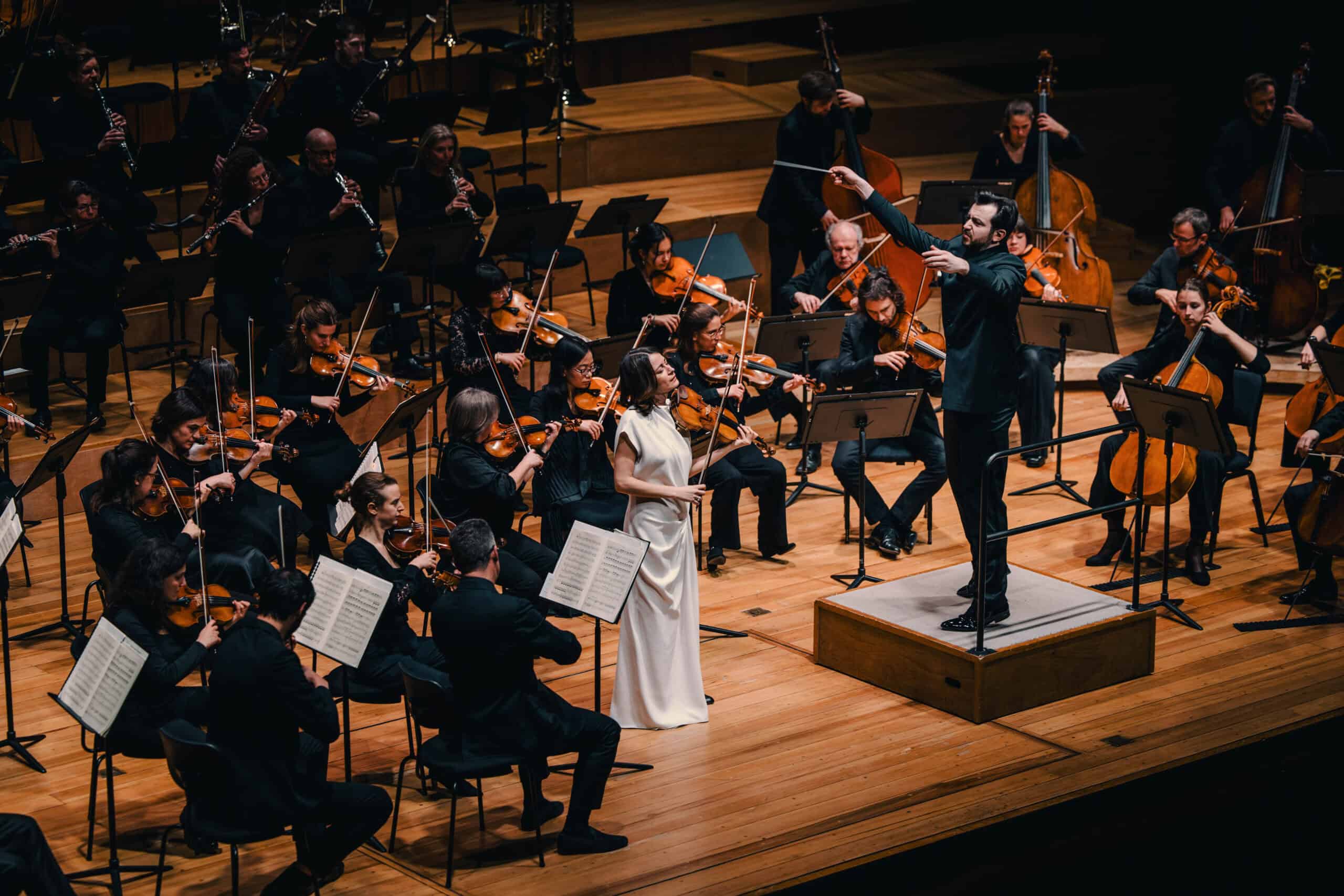 After the contemplative opening with Brewaeys, the afternoon took on a more pronounced lyrical character with Mendelssohn's Violin Concerto in E, a work that is often reduced to its elegant virtuosity, but which was revealed here as a subtle psychological landscape. From the first entry of the violin, it was clear that Liya Petrova did not approach this concerto as a demonstration of technical mastery, but as an intimate monologue, carried by exceptionally sensitive musical intelligence.
Petrova's playing was characterized by clear, breathing phrasing, in which every note found its place and meaning. Her tone was warm without becoming heavy, transparent without losing depth. The numerous nuances and accents – often barely audible, but all the more palpable – gave Mendelssohn's melodic lines a natural self-evidence, as if the music formed itself on the spot. In the slow passages, a rare concentration prevailed: the silence between the notes became as meaningful as the notes themselves, and the audience listened with such absorbed attention that you could have heard a pin drop.
The cadenzas were not moments of virtuoso self-display, but inner breathing pauses in which time seemed to stand still. Petrova let the music speak with a hushed intensity: every bow movement became a thought, every nuance an emotional shift. Her playing made the subtle tensions between major and minor tangible, allowed light and shadow to continually blend together, and revealed Mendelssohn's score as a fragile balance between hope and melancholy.
The Symfonieorkest Vlaanderen, under the inspired direction of Dendievel, played a role in this concerto that went far beyond accompaniment. The orchestra functioned as a breathing soundscape, a mental resonance in which the solo part could unfold. Strings played with a soft, homogeneous glow; woodwinds added color and commentary with crystal-clear, meaningful interventions; dynamic contours were finely delineated, never obtrusive, always serving the musical narrative. Dendievel maintained the balance masterfully, with a remarkable sense of timing, proportion, and tension-building.
What made this performance so special was the absolute unity of intention between soloist, conductor, and orchestra. Mendelssohn's harmonic and rhythmic structures were not exposed for the sake of their architecture, but experienced as carriers of emotion. The concerto thus became a meditation on vulnerability and longing, on the fleeting nature of feelings and the paradoxical power of lyricism.
This performance reminded us that Mendelssohn's music – often too quickly labeled as light and elegant – possesses a deep emotional precision that only comes into its own when approached with attention, tranquility, and inner conviction. In Liya Petrova, this concerto found a performer who listened while she played, and in Martijn Dendievel and the Symfonieorkest Vlaanderen partners who did not frame this poetry, but breathed with it. This powerful performance leaves us looking forward with anticipation to the next Mendelssohn works that will be performed in the coming seasons by Symfonieorkest Vlaanderen.
Groping through the winter storm
With Tchaikovsky's First Symphony, Winter Dreams, the afternoon reached its emotional core. This early work, often seen as a compositional exercise, revealed itself here as a gripping document of inner necessity. From the first measures, the listener was drawn into a world in which form and feeling probe each other, sometimes collide, but never let go. The opening, with its seemingly simple themes, did not sound naïve, but vulnerable: as if Tchaikovsky carefully unfolded his inner landscape, aware of the fragility of what he reveals.
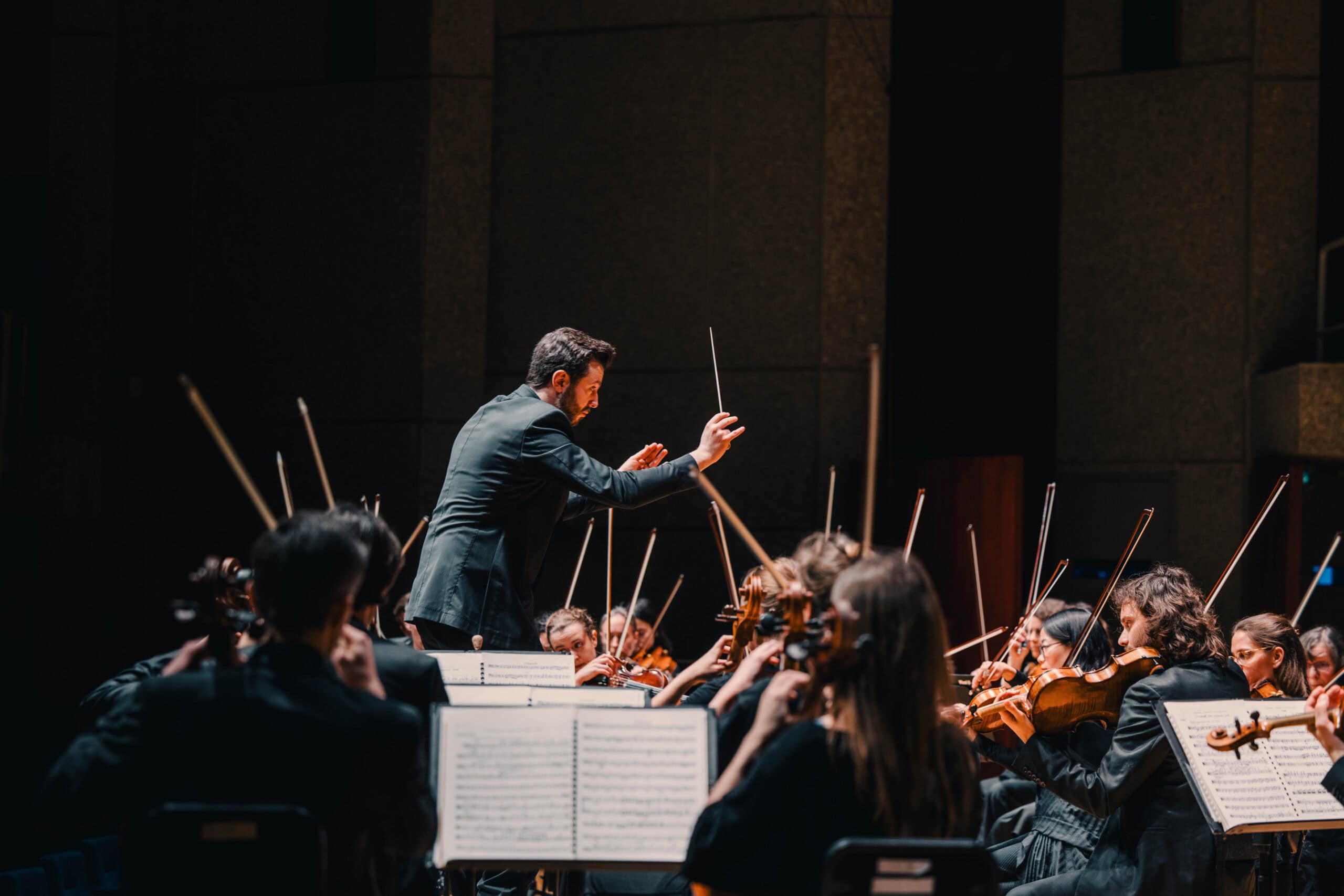 Under Dendievel's direction, the symphony unfolded with exceptional dramaturgical clarity. The dramatic arc was drawn tight from the beginning and only released with the fading of the final note. There was not a moment of slackness, no lack of conviction; each phrase flowed inevitably from the previous one. Dendievel here was not only an architect of form, but especially a guide through Tchaikovsky's inner storms.
The Symfonieorkest Vlaanderen played with intensity and precision that were impressive. Strings formed the beating heart of the performance: broad-breathed and warm in tone, but razor-sharp when the music hardened. Their phrasing gave the melancholic core of the work a tangible physicality. The woodwinds – with several crystal-clear, meaningful solos – functioned as carriers of introspection: fragments of hope, reverie, and melancholy wove like thin breath through the orchestra. The brass section was powerful, but never bombastic, giving the dramatic outbursts their inevitable weight. The percussion reinforced the emotional accents with refined control, without ever breaking the musical flow.
What made this performance exceptional was the way each orchestral section understood its role within the larger whole. Nothing stood alone; everything was part of a breathing organism. The various solos – each time crystal clear, precise and without effect-seeking – functioned not as individual profiling, but as necessary links in Tchaikovsky's narrative. It was that collective concentration that allowed the listener to become completely absorbed in the music.
Tchaikovsky's attempt to order his inner world within classical symphonic structures became audible here in all its tension and beauty. The emotional logic – sometimes downright dark, foreshadowing the existential depth of his later symphonies – took precedence over formal rigor, yet never spiraled out of control. Dendievel allowed that tension to exist, dared to let it chafe, and therein lay the strength of this performance.
Winter Dreams sounded here not as an immature work, but as a living organism discovering itself as it resonates. It is music of transition, of seeking and longing, of dreams that are both comforting and disturbing. The listener was drawn into that quest and only released when the final sound faded.
This was a performance that convinced not only through technical perfection, but through artistic dedication and collective awareness. A symphony that began as a winter dream and ended as an intense, deeply felt experience – a finale that did not conclude the concert, but sealed it.
Where sound gains meaning
What ultimately gave this concert its special weight was not only the quality of the individual performances, but especially the way the three works engaged in dialogue with one another. Not as separate programming, but as a slowly unfolding conversation. Brewaeys turned the ear toward memory and time, Mendelssohn brought the listener to a vulnerable inner space, Tchaikovsky let the searching itself sound – uncertain, groping, but unmistakably human. Together they formed not a closed narrative, but a poetic constellation in which past, emotion and expectation mutually illuminated each other.
 In this context, Martijn Dendievel played a crucial role. He functioned not merely as a coordinator of tempos and entries, but as a guide through different musical ways of thinking. His interpretations never sought effect, but meaning; never the surface, but the inner necessity of the music. What he laid bare was an underlying logic that connected the works to one another without denying their individual identity. Conducting became listening here – attentive, reflective, with trust in the power of music and in the audience's ability to receive it.
The Symfonieorkest Vlaanderen responded with remarkable intensity and engagement. Here you did not hear an orchestra playing under a conductor, but an orchestra thinking and breathing along with him. The precision, the concentration and the collective alertness created a tension that literally kept the listener on the edge of their seat. Something rare unfolded: a collaboration that visibly grew, that was not only technically refined, but also dared to deepen artistically.
When the final sounds had faded, no emptiness remained, but a moment of reflection in which music transforms into experience. The applause acknowledged not only virtuosity or commitment, but confirmed that something had been shared here: a living dialogue between composer, performers and audience. Martijn's Dream therefore felt less like a concluded concert than like a beginning, a first breath of an artistic journey that makes one curious about what follows.
That this collaboration raises expectations is no coincidence. What became audible here was a dream taking form – not as personal ambition, but as collective imagination. For the audience, that means equally a promise: concerts that do not reassure, but awaken; that not only sound, but continue to resonate. The next dates are already noted with a star. For if this is the beginning, then the road ahead promises to be rich, intense and meaningful.