

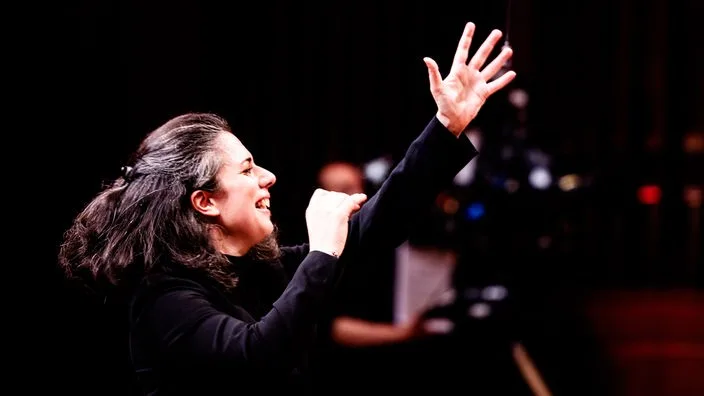
A year and a half ago, I saw Marie Jacquot at work several times with the Wiener Symphoniker. She convinced me immediately. When I learned that she was becoming chief conductor of the WDR Sinfonieorchester and discovered that Antwerp and Cologne are now directly connected by train, I didn't hesitate long: on Saturday, October 17, I hurried to the Kölner Philharmonie. The concert confirmed my high expectations.
Letting the story speak
Marie Jacquot performed the overture to Tannhäuser by Richard Wagner (1813–1883) at a brisk tempo, with a logical build-up of dramatic tension. She did not steer the music toward a colossal climax through extreme slowing down. With Sergiu Celibidache, the same overture lasted about five minutes longer. Those broader tempi gave the build-up of tension and the approach to the climax a very different weight.
Jacquot mainly let Wagner tell his story. That proved more than sufficient to make the music gripping. The horns and woodwinds stood out clearly from the start, the brass built an impressive sound toward the high point, and the agile strings kept the music constantly in motion. The orchestral sound was powerful, yet always transparent.
A viola in all its facets
With La nuit des chants by Thierry Escaich (b. 1965), the concert moved into a very different sound world. This viola concerto, written for Antoine Tamestit, is modern in its language yet remains accessible. The richly colored orchestration gives the work a constantly shifting sound palette. For the piece, Escaich drew loose inspiration from a Navajo ritual in which a long series of chants forms part of a purification ceremony. He does not translate this inspiration literally, but processes it into a chain of contrasting musical episodes, in which the viola each time reveals different expressive possibilities.
From the deep tones of the strings, the viola seemed to rise slowly at the opening and gradually find its own voice. Tamestit revealed the various facets of the instrument, from lyrical, almost singing passages to agile and rhythmically pronounced playing. That versatility gained extra relief in the interplay with the orchestra. Especially the passages in which the viola and harp, supported by the strings, became intertwined were intriguing. The encounters between viola and percussion also produced surprising turns. Tamestit played with visible pleasure.
Jacquot balanced the different layers of sound beautifully, so the soloist remained audible without crowding out the richness of the orchestra. The result was a concerto that held attention for well over half an hour. The audience responded enthusiastically, and the applause lasted a long time. I hope to hear this work in Belgium soon as well.
Momentum and color
After the interval came the Third Symphony by Camille Saint-Saëns (1835–1921), the Organ Symphony. Jacquot approached the work with momentum and dynamism. The music took on something lively and mobile: not a heavily accented musical confession, but a play of colors, rhythms and contrasts. She kept the momentum going and gave the various musical layers sufficient room to come into their own. At the same time, the performance sounded remarkably transparent. Even the soft horn entries in the finale, which easily get lost in a full orchestral sound, remained audible. The piano glissandi, too, were strikingly clear.
The organ stands in the hall to the left of the orchestra and thus occupies a very distinct place in the sound picture. Especially in the second movement, it was striking how delicately Iveta Apkalna let the instrument sound. The organ tone blended subtly with that of the orchestra. In the finale, the organ gained more weight and brilliance. Because of its separate position in the hall, the organ sometimes seemed acoustically to comment on what the orchestra was playing. Apkalna avoided any hint of bravura and let the sound grow without overloading the music. In the interplay between Jacquot and Apkalna, the finale kept all its momentum, while the organ received full resonance and the orchestral details remained audible.
A conductor worth following
Jacquot conducted with energy and precision, but never lost sight of the details. When the applause after the concert kept going, Jacquot stepped down among her orchestral musicians. It was a small, telling gesture after a concert in which soloists, conductor and orchestra had given each other every opportunity.
A year and a half ago, Marie Jacquot made an impression on me. In Cologne it became clear why. I count her among the most interesting conductors of her generation: she combines energy and precision with a fine ear for tonal color and detail. I will follow her further development with the WDR Sinfonieorchester with all the more interest.