

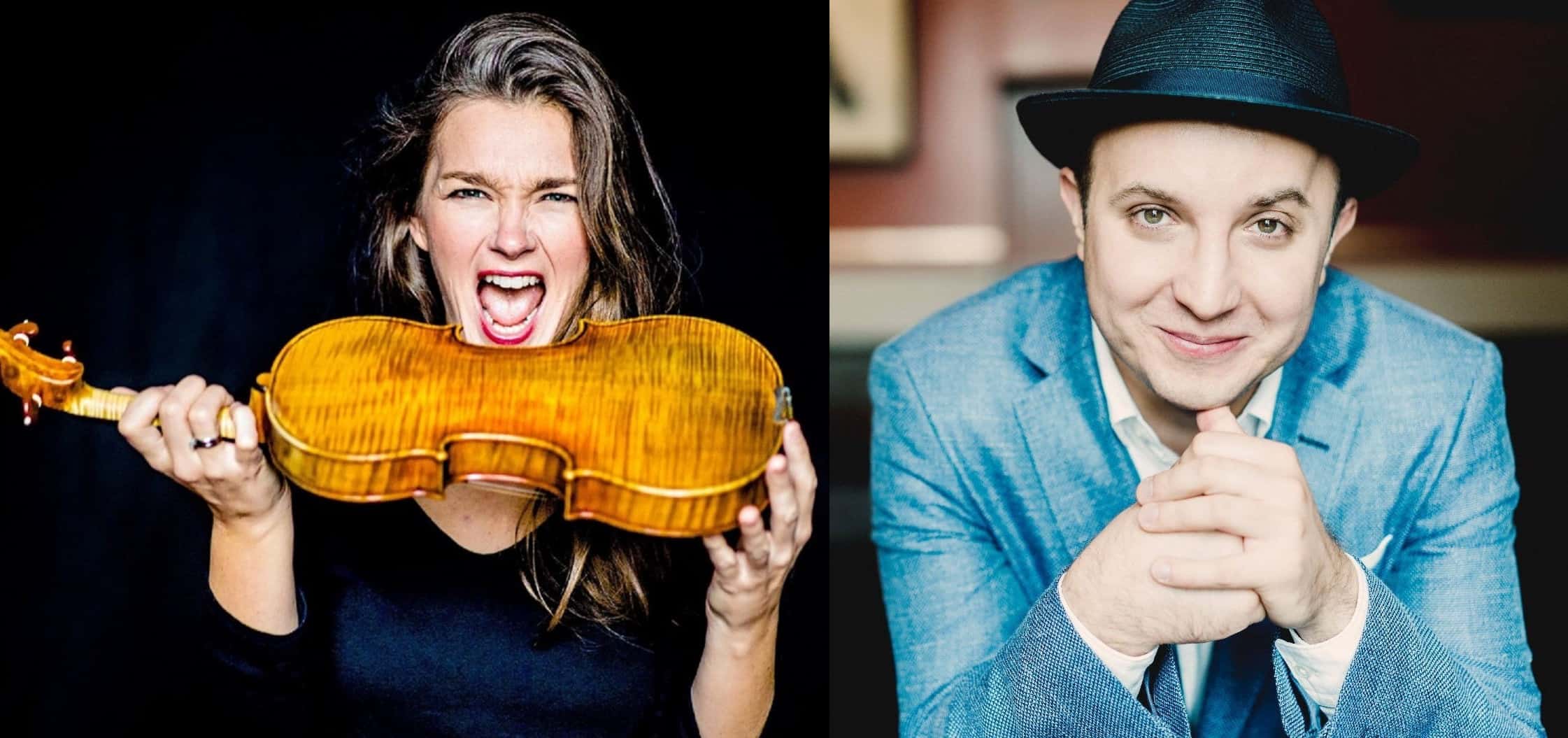
On the poster in BOZAR's consultation office hung the violinist alone. Because she is the crowd-puller, the star, but without any airs. Yet Janine Jansen did not come to Brussels alone. In her wake followed pianist Alexander Gavrylyuk. It was the prelude to a tour that is currently taking them through some of the most prestigious European halls …
"I work frequently with pianists, but Gavrylyuk is truly a favourite. He is absolutely in service of the music, is genuine, never polished." Janine Jansen does not spare the praise for her travelling companion, and that is more than just a promotional spiel. Gavrylyuk's career is reaching great heights these days anyway. First and foremost as a soloist, the Ukrainian-Australian thirty-something is making a great impression in virtually all four corners of the world. Alexander, 'Sasha' to his intimates, "is easily the most compelling pianist of his generation", as the frequently heard catchphrase sounds from his second homeland. But the Dutch grande dame of the violin could equally well have said this on the website of Concertgebouw Amsterdam, where the duo will also make a stop mid-next week, about herself. She too is (world)renowned as an upright musician, one who defends the classical repertoire with passionate and equally idiosyncratic and generous conviction. "I only give, it is completely natural. There is no other way. And I want that too",
. That promised well for tonight's concert.We'd sink into our seats …
Jansen is a major crowd-puller, also in Brussels. The people at BOZAR flock in, the Henry Le Boeuf hall fills up quite nicely. The seductive programme certainly had a hand in this: with four works from the second half of the 19th century, it strings together the highlights of the Romantic violin repertoire. It is always lovely to reunite the couple Schumann and Brahms in this way. And so, before the interval, after Robert's first violin sonata came the second by Johannes, with Clara's Drei Romanzen nicely interspersed. Their muse, support and mainstay was born two hundred years ago. This tribute by means of a trio of character pieces, written in 1853, was an appropriate gift. The first romance (Andante molto) moreover winks at the sonata her husband composed two years earlier, but with which he was dissatisfied: a critical note for which his music-loving descendants can be particularly grateful, because Schumann completed a second violin sonata in 1851. To underscore that this tonal poet had other fruitful chamber music years besides 1842. Good friend Brahms too threw himself into his creative life with great diligence on more intimate work. In the summer of 1886, during a long holiday at the Swiss Thunersee, both a cello sonata (opus 99), a piano trio (opus 101) and the second violin sonata (opus 100) flowed from his pen. To underscore that sunny water mirrors and pure mountain air can inspire beautiful deeds. The pièce de résistance on the playlist was another sonata dedicated that same year to Belgian violinist Eugène Ysaÿe (1858-1931). The best-known wedding gift in our region from classical music history came from César Franck, that other native of Liège. Franck thus pulled off a crowdpleaser, which subsequently conquered the world together with Ysaÿe. According to many musicians, this canonized piece undoubtedly ranks among one of the finest feats in the genre. To underscore that our country also counts its stars in the musical firmament. Notable finally was the close tonal affinity between the sonatas, which are all set in A. A journey through La La Land as it were, but with Jansen and Gavrylyuk in the leading roles.
The musical film that was screened was of an extraordinarily captivating and deeply felt expressivity. Particularly with Mr. and Mrs. Schumann, the duo struck exceptionally high notes. If the serious opening of Robert's violin sonata sounded somewhat veiled at first, a dynamic duel soon unfolded – mit leidenschaftlichem Ausdruck – on the sharpest of edges. The (most) excellent interplay between both musicians was one of give and take. Gavrylyuk emerged at appropriate moments from his sometimes subordinate role, while Jansen at times performed miracles with the bow to respond to him in a meaningful way – no, this is far from the most user-friendly violin part in the book. Both phrased the subsequent Allegretto with equal sovereignty: a curious mixture of slow movement and pointed scherzo. The contrast between soft lamentation and unexpectedly playful prancing came off very well. The spirited finale too was nothing less than a demonstration, a sublime masterclass in articulation (Lebhaft). If the piano part was cleverly accented, then Jansen occasionally played in vigorously. Or how grit plays a decisive role not only in sport but also during concerts. Wilhelm Joseph von Wasielewski (1822-1896), the man who brought Schumann to Düsseldorf as concertmaster in 1850, and became his first biographer two years after his death, reportedly had difficulty with the brusque tone of this movement when he first encountered this violin sonata. A concern that the duo Jansen-Gavrylyuk certainly did not have, as evidenced by their temperamental performance. For the three short Romanzen of his wife Clara, the tandem drew from a different, much more charming, but still equally convincing well. These lyrical interludes were most to the taste of my company. The ever-refined and harmonious ensemble playing indeed crept repeatedly under the skin. Particularly the brilliantly intoned Allegretto – mit zartem Vortrage – left a devastating impression: what a relief, so went the paradox here! , Ryan Gosling might ask while singing … Fortunately, there were many other witnesses to this sparkling performance alongside me. Even before the intermission, Brahms finally appeared at the podium. Despite a carefree pastoral feeling and an Allegro amabile that sets a predominantly melancholic tone for this entire triptych, his second violin sonata also has more extroverted episodes. The hybrid middle section is exemplary, brilliantly navigating between a gentle Andante tranquillo and a graceful Vivace. But in this work, the evening was dominated by an inward gaze. A deliberate choice? The result certainly sounded artless, but failed to resonate more than usual. And the meager finale – Allegretto grazioso – also failed to truly inspire. Surprisingly, the musicians found each other less in this movement. That at times it seemed as though the piece was being recited without punctuation certainly played a role here. More and clearer rest points would certainly have benefited the flowing stream of notes.
A lovely night …
It is not difficult to fall in love with Franck's only 'real' violin sonata. This composition indeed gives voice to the bumpy, yet at the same time so valuable journey that is called love. Or at least that is the common interpretation. In the opening movement, passion thus unfolds. Or as Ysaÿe delicately described the Allegro ben moderato "[…] un bienfaisant réveil en un matin d'été". It was indeed a delicate awakening in both parts. But once passion was kindled, it was pure enjoyment of the intensity with which they first courted each other musically, only to find themselves in downright tumultuous waters in the following Allegro. Jansen and Gavrylyuk effortlessly got everything out of the cabinet (of sound) and out of the score: whirling dialogues, nimble tempo changes and great dynamic tension. And all without losing a shred of transparency. It might be called a miracle that, in contrast to Schumann and Brahms, there was no mid-performance applause this time. Thank goodness, for the very best was yet to come: what Ysaÿe called "la plus empoignante partie de l'œuvre". And how the Recitativo fantasia (Ben moderato) knew how to move. It began immediately with the way Jansen entered. The colors she created there and later in this movement were enchanting. Musician became magician, helped by her magnificent Stradivarius. But as grand her tone is, so small is this violinist's ego. That led to some poignant passages in which Gavrylyuk too showed both his most dramatic and phlegmatic sides. Timing is an important key to the success of the canonic finale, and the excellent interweaving of both instruments showed that things were clearly in order on that point. Violin and piano pursued each other with great enthusiasm. Rhythmic panache at the keys received an equally apt response, causing the alternately lively, then turbulent character of this Allegro poco mosso to continue resonating delightfully for a long time. No, it was not difficult at all to fall head over heels for this music and its performers.
With their magical journey through La La Land, Jansen and Gavrylyuk are currently traveling through Europe's most prestigious concert halls. After Berlin and Stockholm, among others, they can look forward to Zurich, London, Amsterdam and Vienna. the audience should expect nothing less. And perhaps the Andante from Prokofiev's second violin sonata as an encore.
- WHAT: Robert Schumann (1810-1856) – Sonata for violin and piano no. 1 in a (opus 105) | Clara Schumann (1819-1896) – Drei Romanzen (opus 22) | Johannes Brahms (1833-1897) – Sonata for violin and piano no. 2 in A (opus 100) | César Franck (1822-1890) – Sonata for violin and piano in A (FWV 8)
- WHO: Janine Jansen (violin) & Alexander Gavrylyuk (piano)
- WHERE: Henry Le Boeufzaal, BOZAR, Brussel
- WHEN: Tuesday 26 February 2019
- PHOTOS: © Andreas Terlaak | Marco Borggreve