The originally American musical 'Man of la Mancha' dates from 1965 and is based on Cervantes' novel 'The Ingenious Gentleman Don Quixote of La Mancha'. This first great novel of world literature is at once a retrospective and parody of the chivalric novel as a preview and the coming rage of picaresque novels.
The production has since been performed more than 2000 times on virtually all continents. A first Dutch-language production premiered in 1968. The première took place on 23 December 1968 in theater Carré with Guus Hermes, Carry Tefsen and Lex Goudsmid in the leading roles. The Koninklijk Ballet van Vlaanderen also ventured into this musical in 1993, in a translation by Stef Bos, and kept it on the repertoire for two seasons. Cervantes was played by Ramses Shaffy, Dulcinea by Frouke Dekker and Sancho Pancha by Werther Van der Sarren. Brel too fell under the spell of this shrewd fool and made a French adaptation of it. Brussels is commemorating this year with numerous events the fortieth anniversary of the death of this unique singer/songwriter and performer. Brel never sang the work of others, except in the musical L'Homme de la Mancha with which he performed 170 times on stages in Brussels and Paris. Who better than Filip Jordens, the finest Brel interpreter, can step into the shoes of Don Quixote. KVS and De Munt open their season with the Broadway musical that Brel translated and performed exactly fifty years ago in the Brussels opera house.
Direction
Michael De Cock and Junior Mthombeni put their heads together to give the production a new and contemporary élan. Despite Brel's renown, the musical was at the time criticized severely by various critics. An exceptional and committed singer/songwriter is therefore not necessarily a credible actor. A couple of films in which he appeared were also not such a great success. It was thus quite a challenge to turn the tide and make the dreamy character with his powerful metaphors palatable. This character is not entirely far-fetched. It is not exclusively about fantasies and castles in the air but about a subtle resistance to hypocrisy and petty-bourgeois mentality and the inability of many people to let their imagination run free. The duo of directors distilled a theatrical mixture of music, theater, live video and film fragments.
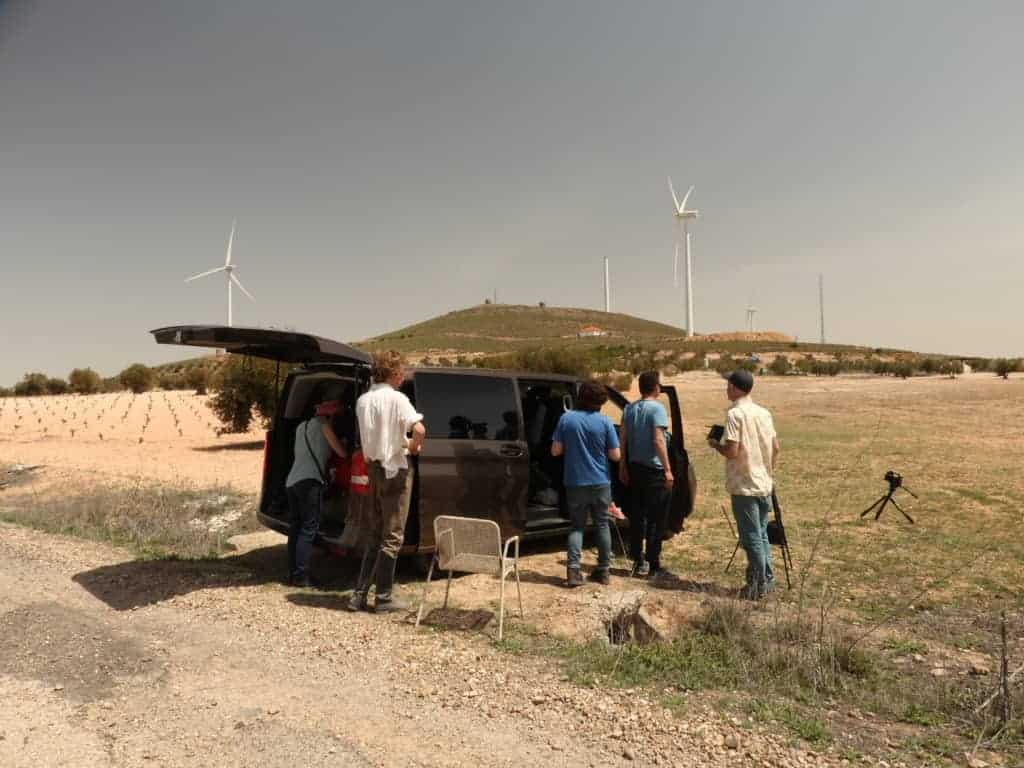
Mindful of KVS's mission to be an open house for a multicultural capital, an internationally composed cast was chosen: white, brown, black is represented. Upon entering, a projection plays. Everyone working on the production gets the chance to introduce themselves and express their ultimate dream. The set is rudimentary. Just as every reader colors a book with their own thoughts and fantasy, this is also expected of the viewer. To the right of the stage, the musicians, the fine chamber music ensemble of De Munt under the direction of Bassem Akiki, have their place under a billboard. To the left, a motley collection of actors/singers dressed in the most diverse outfits. This mixing of styles, the fragmentation throughout the performance is disturbing. Also building sandcastles and walking around with a toy windmill. The audience is not senile! Old films of Don Quixote are shown, alongside images of Filip Jordens in the authentic landscape during a working visit. The attempt to transpose a metaphorical tale from 400 years ago to today is sought in images of a decaying city, the dilapidated skeletons of buildings being torn down. Futuristic images of Superman. How do you tie all that together?
Cast
The most difficult role is and remains that of Don Quixote, the man who fights against windmills, transforms an inn in his boundless imagination into a castle, a tin bowl into a golden helmet and the street cat and prostitute Aldonza into his chosen one Dulcinea.
Where is the line between madness and wit? Filip Jordens pours his heart and soul into the role but it is truly fighting windmills. The title song 'Rêver un impossible rêve' in which he sings out his existential despair and hope certainly gives goosebumps. In his wake, as a portly Sancha Panza, the animated and down to earth Junior Akwety. The ideal counterweight to his often ecstatic master. Aldonza/Dulcinea is tailor-made for Ana Naqe, the classically trained and expressive soprano with Albanian roots. A young woman with stage presence. She sings with beautiful accents, raw, fierce or soft, depending on the tone of the story. Where there is first suspicion, rejection and disdain for Don Quixote's advances, she who is always the plaything of men, slowly thaws for the charismatic knight who puts her on a pedestal. The young tenor who also makes an impression takes on various roles: including the clergyman. Performing him as a barber with a Follies de Bergère headdress, as a kind of drag queen is a misstep again.
Furthermore the beautiful trained voices of soprano Gwendoline Blondeel, mezzo soprano Raphaëlle Green (a pity she didn't get more to do) who are part of the MM Academy.
François Beukelaers as captain and the old Cervantes is well cast. With his eighty years and more, his tall frail figure, he is the fragile old man personified. L'Homme de la Mancha is about love as passion but also sublime love and the fate of the seeking human being who dares to color outside the lines.
During the finale, the title song 'Rêver un impossible rêve' was sung with the complete cast on the forestage. What a mass of sound, produced by beautiful and powerful voices.
All in all a hybrid spectacle where you leave hungry and that's not due to the actors and musicians but mainly due to the directors who let the whole thing get out of hand.
- WHAT: Musical L'Homme de la Mancha, Jacques Brel recording
- ORGANIZATION: KVS Brussel in collaboration with DeMunt
- WHERE & WHEN: KVS Brussel, 14 September 2018
- PHOTOS: @ Eugenio Szwarcer / KVS, © Studio Daoudi / KVS, © Danny Willems / KVS, © Lien De Trogh / KVSEugenio Szwarcer
[embed]https://youtu.be/7SUfKkM63L0[/embed]