

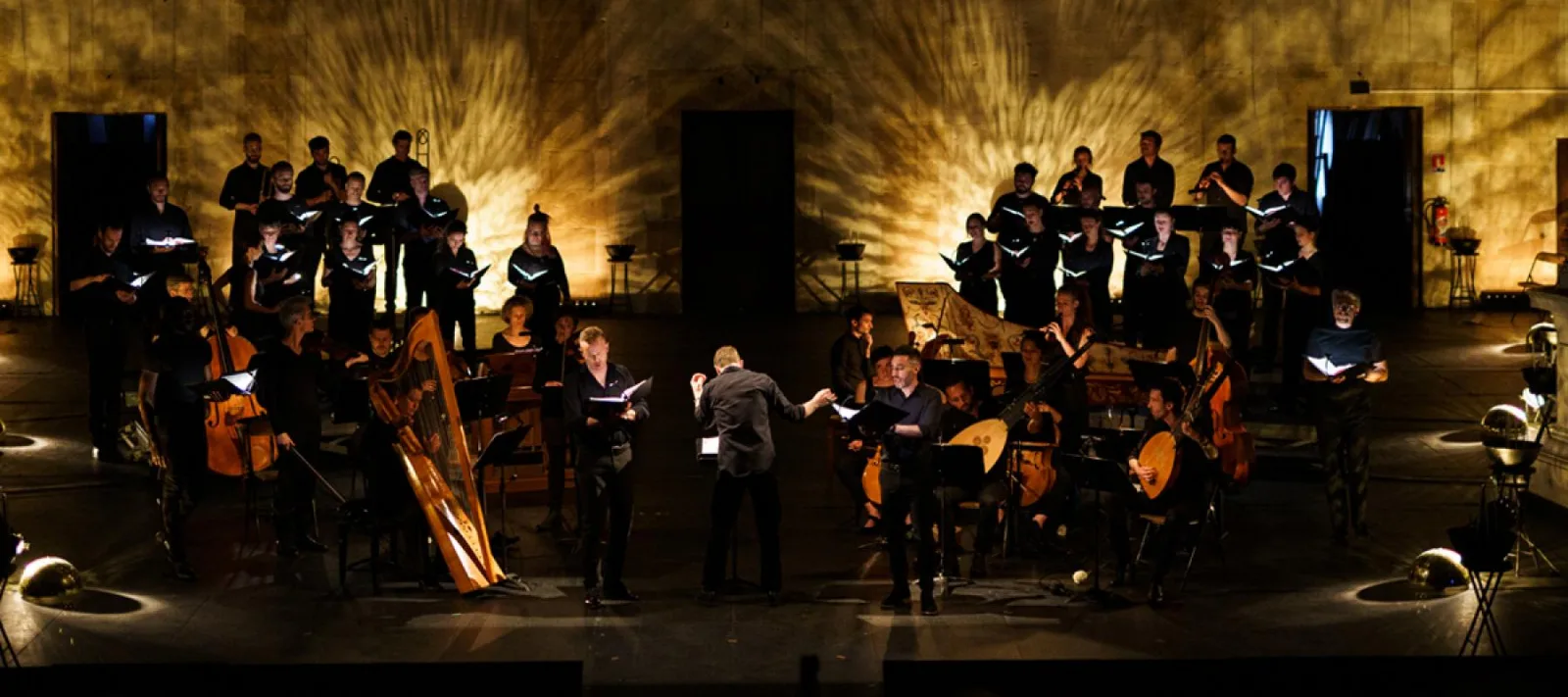
The concert of 2 October in the Henry Le Boeufzaal was one of those evenings on which analysing almost seems inappropriate. The sense of wonder was too great.
But then, a row in front of me, a lady spontaneously puts her hand to her mouth at the magnificent entry of Sicut locutus in Dixit Dominus. Beside me, someone brushes away a tear during Ave maris stella. And suddenly you realise that keeping silent would be a pity after all.
Because those two reactions tell you something fundamental about what La Tempête was doing that evening. They didn't simply give a concert. Something happened to the people in the hall.
That has everything to do with what I experienced that evening as an enormous respect for the audience on the part of La Tempête.
Not respect in the sense of playing neatly, taking the repertoire seriously or trying not to offend anyone. On the contrary. La Tempête shows respect by giving its audience everything. By not doing anything by halves. By assuming that whoever sits in that hall is willing to surrender to another world and then to do everything, but really everything, to create that world.
For a while I was somewhere else.
Perhaps in Venice, perhaps in a church, perhaps in a theatre, and probably in none of those three. It is a world that exists only during those 130 minutes and that Bestion conjures up for us together with his singers and musicians.
La Tempête does not simply perform Monteverdi. The ensemble is what it does during that evening.
Or, more simply still: La Tempête was Monteverdi.
Two Vespers for the price of one
That by no means implies that Bestion positions himself as a humble servant of the score. He bends Monteverdi considerably to his will. That is allowed. That is what we call baroque.
Between Monteverdi's movements he places Gregorian antiphons and faux-bourdons from a seventeenth-century manuscript from Carpentras. La Tempête itself describes it as an encounter between Monteverdi's Venetian polychorality and a much older, Mediterranean tradition of orally transmitted polyphony.
Those archaic chants formed one of the red threads of the evening and ensured that Monteverdi could be reborn from the silence time and again.
A crucial role in this was reserved for Eugénie de Mey, who sang the Gregorian antiphons. What an achievement. Not only vocally, but above all in presence and persuasiveness. When she began to sing, something changed in the space. Her voice also created the natural transitions needed to turn this long evening into a whole. Partly thanks to that, those 130 minutes flew by.
And however sober those moments sometimes were, these Vespers certainly lacked no force.
Power. That is perhaps one of the words I could have written most often in my notes.
At times the theorbo was used almost as a percussion instrument. Cornetts and trombones were given all the room they needed. Strings, viols, harps, organ, harpsichord, dulcian and serpent created a palette of colours that constantly shifted.
And what a blessing to hear Monteverdi once again with such a large vocal ensemble. Twenty-four singers, coupled to a rich and double-choir instrumental ensemble: Monteverdi in all his grandeur.
Afterwards I am incidentally glad that I had missed the recording La Tempête made of this project earlier. And also a little surprised: how could that have happened? The production has existed since 2019 and was also released on CD.
But because of that I could, unprepared, pass from one astonishment into the next at Bozar. And I even felt, quite unexpectedly, something of the sensation with which I first heard Monteverdi's Vespers long ago, still in the last century.
Monteverdi dances
In Laetatus sum Bestion found a tempo at which sitting still became almost counterproductive. The music invited dancing, and the singers did so too. Moving forward in small steps, that movement through the space, made the music physical.
The staging remained remarkably minimal. Light, a few movements, different positions in the hall: never enough to turn the concert into music theatre, but precisely enough to change the space each time anew.
And that brings me back to that respect for the audience.
Bestion does not dictate to you what you must see or feel. He creates circumstances in which you gradually find yourself ever deeper in his musical world. When you gradually begin to realise that, you also notice how carefully everything has been built up. Where a voice comes from. Where an instrumentalist stands. When the light changes. When the enormous ensemble bursts forth.
You are not overwhelmed for the sake of overwhelming. You are carried along.
Duo seraphim was a splendid example of this. Two singers began back to back. Then the seraphim split and two voices become three. A musical image of the Trinity that arises visibly and audibly.
Without doubt it ranks among the most beautiful Duo seraphims I have ever heard live.
Another high point was the double-choir Nisi Dominus. Left and right, high in the balconies of Bozar, arose the spatiality we associate with the Venetian cori spezzati. For a brief moment at the entry there was a slight decalage among the wind players on the right.
And you know what? I was almost glad of it. Because suddenly the people were there again.
A barely noticeable crack, probably born of enthusiasm, and seconds later that double-choir singing lifted us up again. To the gods, so to speak.
Rarely have I been so often impressed during a concert in recent years. And at certain moments Bestion himself seemed almost to float while conducting. Without a score the whole evening, too. He stood like a pillar in the middle of his own musical edifice.
René Ramos-Premier
For me personally the discovery of the evening.
It is not only his voice or his range. The word I noted down for him was grace.
His posture, his smile, the contact with the audience, but also that remarkable combination of modesty and virtuosity. He does not need to make himself important to have an enormous presence.
In Audi caelum everything came together. And then that one moment in which he introduces omnes and the choir answers.
Goosebumps.
Seemingly a detail. But it is precisely for such seconds that you go to a concert. You may have the best installation in the world at home, but that moment, that voice in that place in that space and the answer that comes from elsewhere, exists only once.
FINALLY: Lauda!
Finally another ensemble that dares to make of Lauda truly lauda: praise, jubilation, movement.
What a tempo. What virtuosity. And above all: what fun! The only drawback was that it was over so quickly.
The Sonata sopra Sancta Maria, often a point of rest or caesura in the Vespers, also received a very personal interpretation. Bestion did not opt for one static tempo, but let the music constantly breathe and move. And once again the hall itself became an instrument, with that phalanx of sopranos high above us.
I deliberately use the word phalanx. For at last this part was not approached in a quasi-soloistic way. Here a collective voice stood against and above the instrumental ensemble. A divine sound from on high.
And when you then think: well, now we have surely had the highlights...
No, not at all.
Ave maris stella
The choir spreads through the hall, high above the balconies.
Ave maris stella.
After all the rhythmic energy and the spatial spectacle, something wonderful happens. Everything slows down. The a cappella singing acquires an incredible calm. You hear the individual vocal details and at the same time it becomes almost impossible to determine where the music still comes from.
And then each time that final bar, in which the tenor voice so delicately changes the colour and mood.
Ethereal. Next to me that lady quietly wipes away a tear. And I must be honest: it moved me too.
Perhaps at that moment I understood even better what I meant by respect for the audience. This ensemble does not want to impress you by showing what it can all do. It invests all its ability in what happens to you as a listener.
That is an essential difference.
A great concert can dazzle. You admire voices, instrumentalists, conductor. You go home and think: how good they were.
Here something else happened. La Tempête used voices, instruments, movement, distance, light, silence and the architecture of the hall to gradually make the boundary between stage and audience less important.
At a certain moment you are no longer listening to a performance of Monteverdi's world. You are inside it.
Three echoes
About the closing Magnificat I can actually be brief.
Powerful.
It thundered on like a rollercoaster in which you were constantly thrown from one astonishment to the next and from one colour world into another. Large against small, massive against intimate, near against far.
And then the Gloria Patri.
The echo. Or rather: the echoes. Not one, but three.
In hindsight, perhaps the whole evening is contained there for me. At La Tempête you do not get one Monteverdi. Everything seems to multiply. Renaissance and baroque. Church and theatre. Individual and community. Intimacy and exuberance. Silence and power. The sacred and the physical. The human being and something that briefly transcends that human being.
Bestion gives no history lesson about this. He lets it happen. Perhaps that also explains the two reactions I saw close by that evening.
A hand over the mouth. … A tear.
Those are not reactions to historical performance practice. No judgement on articulation, intonation, tempi or instrumentation. Those are people on whom the music has had an effect.
When, after the minutes-long, rhythmic standing ovation, I stepped outside, I thought: La Tempête did not perform Monteverdi. La Tempête WAS Monteverdi.
Not because this is the only way the Vespro della Beata Vergine should sound. Not because every choice of Bestion suddenly represents historical truth. But because for 130 minutes performers, music, space and audience could no longer be separated from one another.
And four centuries after Claudio Monteverdi wrote this music, that seems to me perhaps the greatest compliment one can give performers.
So I end this long review with the word that sums it all up: WOW!