

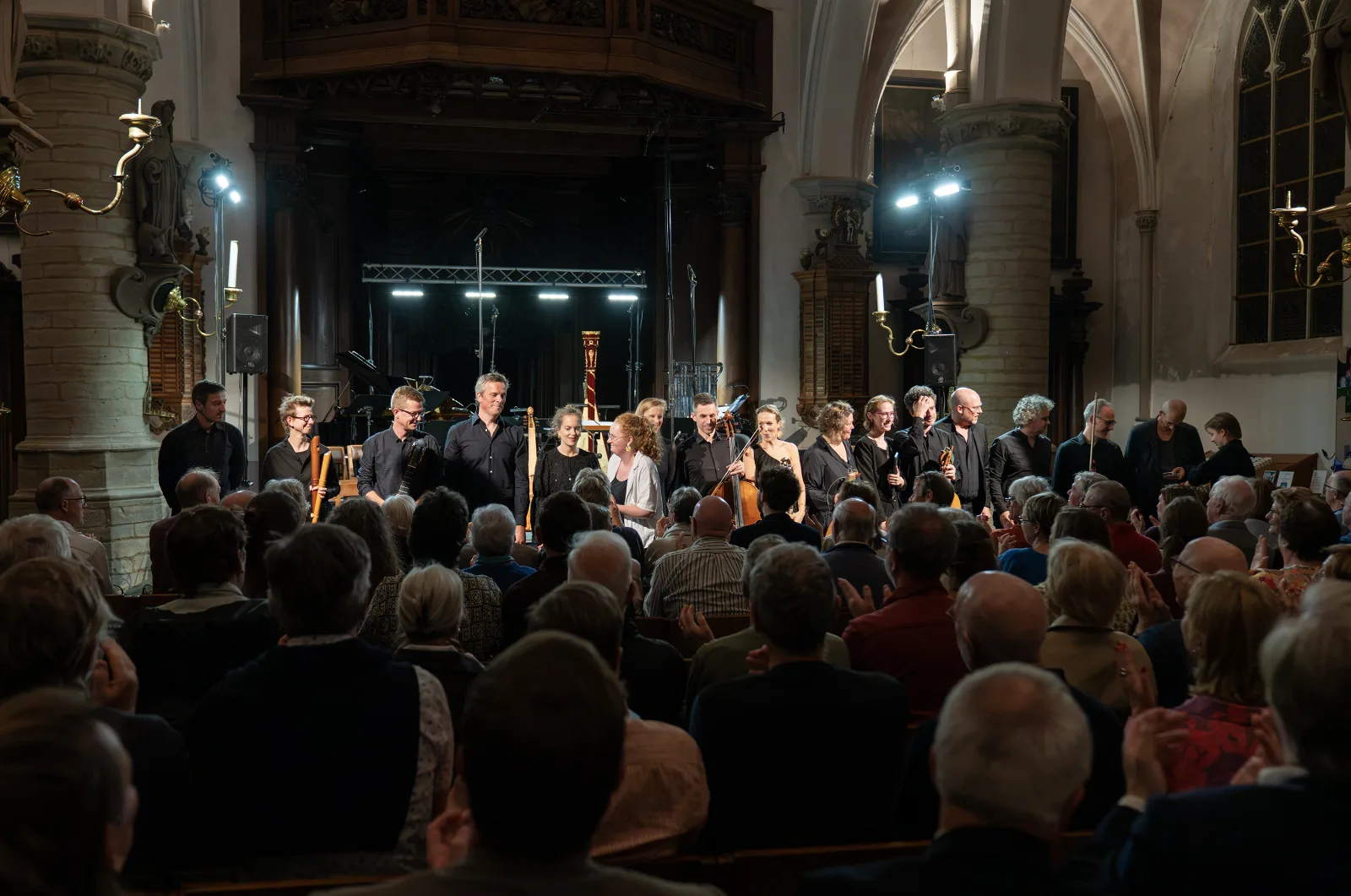
The concert La nuict froide et sombre, presented by ClubMediéval and SPECTRA in the Sint-Pieter en Pauwelkerk in Mol, attempted something ambitious: it let past and present flow into one another. What on paper could have been an intellectual concept about time, memory and musical truth proved, in practice, to be above all a remarkably convincing listening experience.
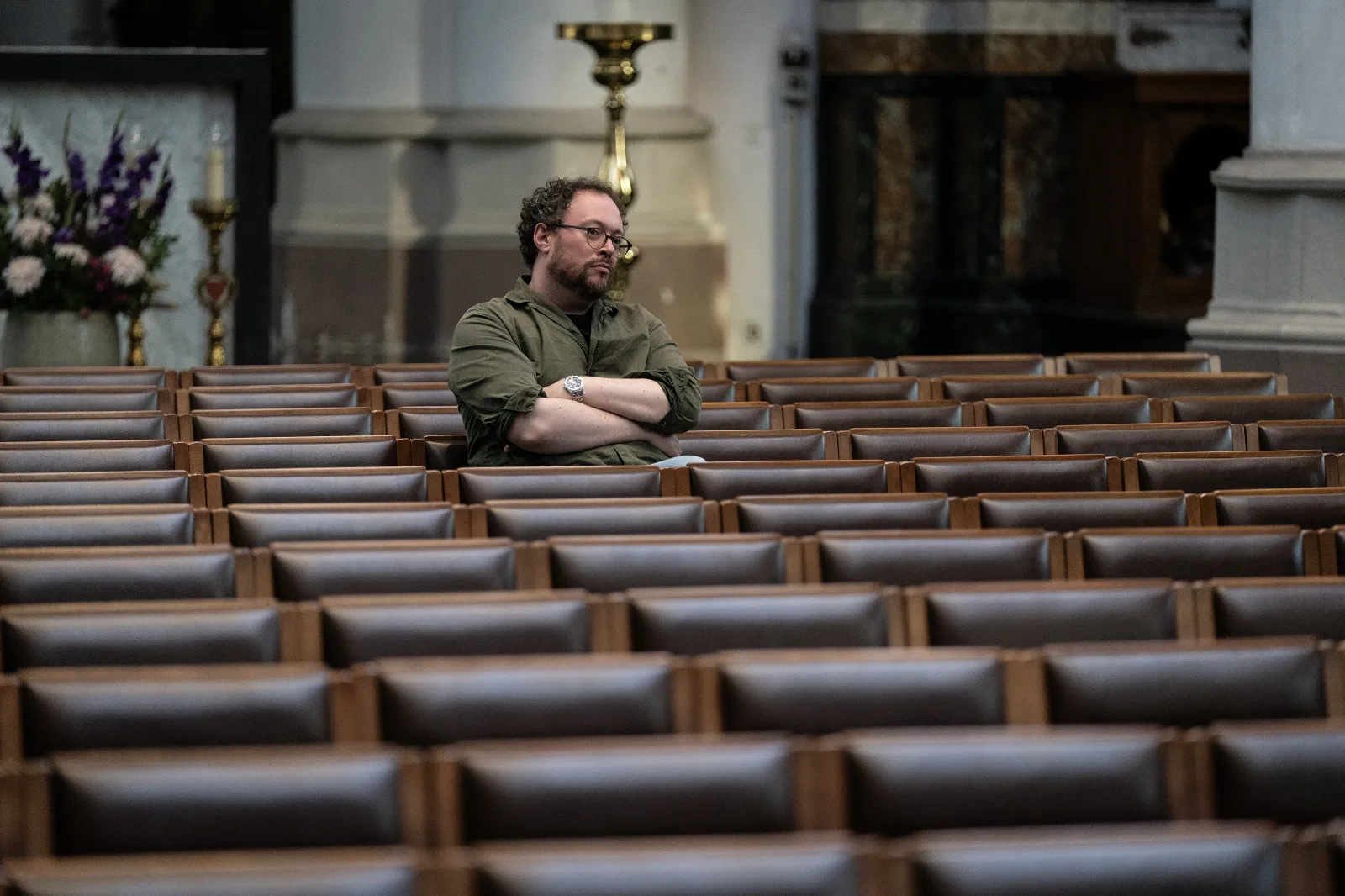
Beforehand, Katelijne Boone outlined the concept behind the programme. She spoke of "moments of truth", of old music in a new context, and of the question of how truth itself changes across the centuries. Early music was not treated as a museum piece but as living material that contemporary composers still find inspiring. Notably, Noah Senden (1998), present in the church, was introduced as the very first festival composer of Musica Divina. His commissioned work was not coincidentally the starting point of the evening.
With before we begin…, Senden immediately placed the listener in a different state of attention. In the work, the young Antwerp composer explores the moment before the first note, the expectation and the silence that precede music. The composition largely came into being during a residency in Averbode and departs from symbolic material: a melodic stream that moves through the piece like life, and a motif around truth, built from a major and a minor triad. Truth here is not necessarily good or bad, but can take on different forms.
Anyone who expected only philosophical reflection, however, was in for a surprise. The piece worked for me above all because it became a strongly sensory experience. Out of an almost elusive sound-mist, mysterious textures emerged, built up with great precision by the excellent strings of SPECTRA. In the distance, bells seemed to ring. At first diffusely, then increasingly as points of orientation in a landscape of sounds. As if order slowly arose out of a primordial state.
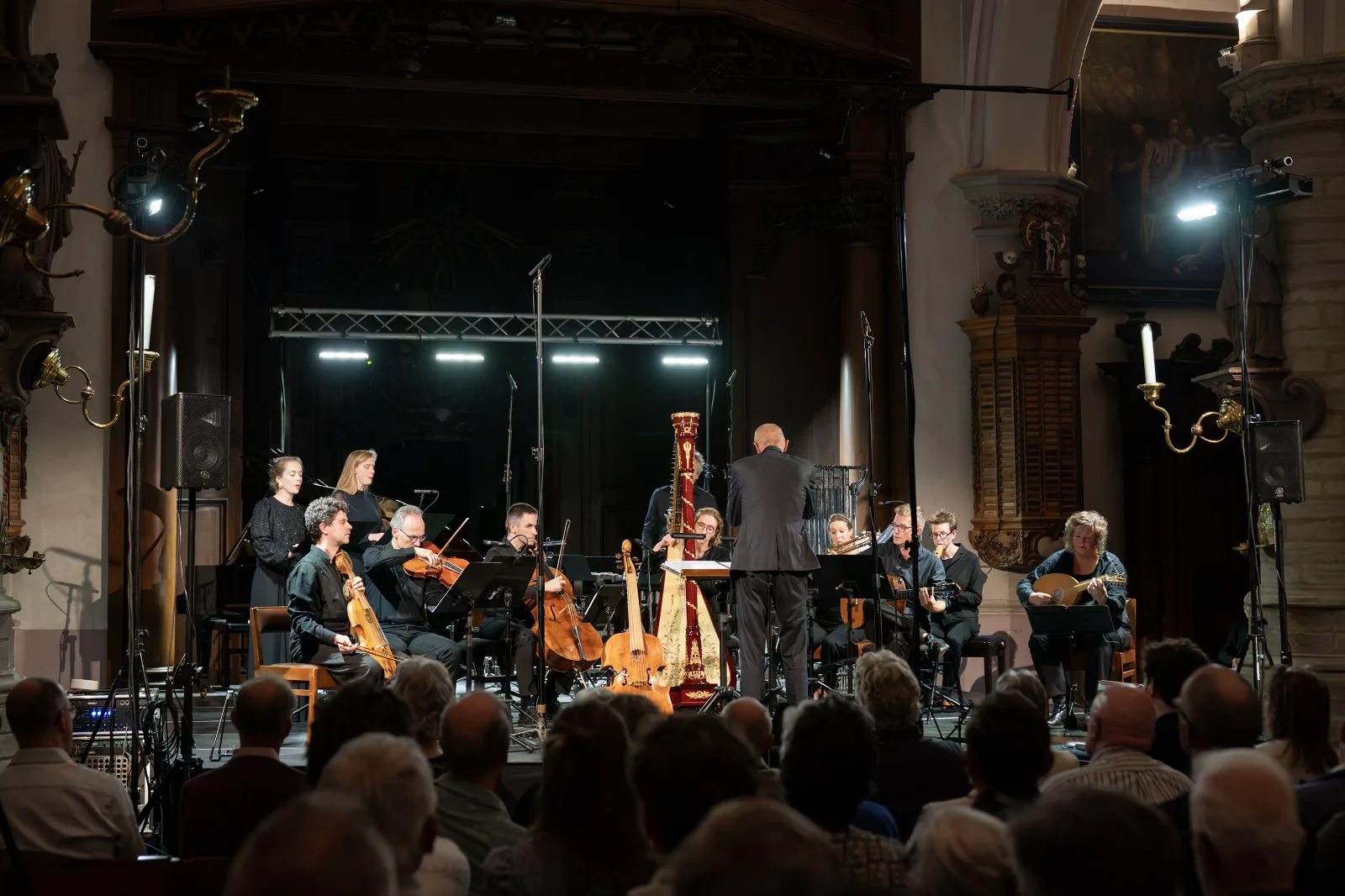 Along the way one heard natural sounds, birdlike figures and an awakening world. It was as if a giant were slowly stretching after a long sleep. At a crucial moment the flute took the lead with a melodic line that suddenly gave direction to the whole. What had seemed organic and floating now acquired form. That line was then taken over by the strings, after which the sound-image again assumed darker colours. The role of the bell-like motifs remained beautifully ambiguous: did they mark the progress of time, or did they refer precisely to something timeless? Or simply: Averbode? SPECTRA maintained that tension convincingly with a playing that was at once powerful, clear and sure-footed.
The transition to Ut heremita solus, the motet attributed to Ockeghem, felt almost self-evident. Suddenly we were five centuries back in time, yet strangely the distance seemed limited. ClubMediéval performed the work soberly and with concentration. The individual lines remained beautifully legible and the contemplative mood of the singing came fully into its own.
This was followed by Harrison Birtwistle's instrumental response to the same material, and here it became clear how well the programme had been constructed. Birtwistle opens up Ockeghem's melodic and polyphonic idea completely. The ancient spirit remains present but is viewed through a modern lens. What lies enclosed in the historical work is magnified, fragmented and spread out spatially.
Yet this was no "destruction" of the original. On the contrary. The kinship remained constantly audible. SPECTRA played the work with remarkable transparency, so that the various instrumental lines genuinely functioned as voices within a polyphonic ensemble. The piano moreover added a colour of its own to the palette. It was a performance that made, as it were, "the breath of polyphonic song" audible.
In Obrecht's Weet ghij wat mijnder jongher herten deert the logic of the programme also held firm. The song received a warm, colourful performance in which the singer's emotional involvement stood out in particular. Her singing was soulful and full of feeling. At times this came somewhat at the expense of the intelligibility of the text, so that the narrative landed slightly less directly than it might have.
With Lassus Echo I and Lassus Echo II by Daan Janssens, the programme then demonstrated that the concept was more than an intellectual peg. The question was whether the original Lassus would truly remain audible. This was clearly the case. Janssens retains the contours of the historical model but projects them into a contemporary sound-landscape full of shadows, colours and shifting perspectives.
Here too the polyphonic lines remained strikingly present. In Lassus Echo I they were spun out in refined detail, while Echo II took on a far more threatening character. The music became pictorial, at times even ominous. Once again SPECTRA made an impression with a powerful and committed playing in which the individual timbres remained sharply delineated. The abrupt ending of the second part therefore worked all the more strongly.
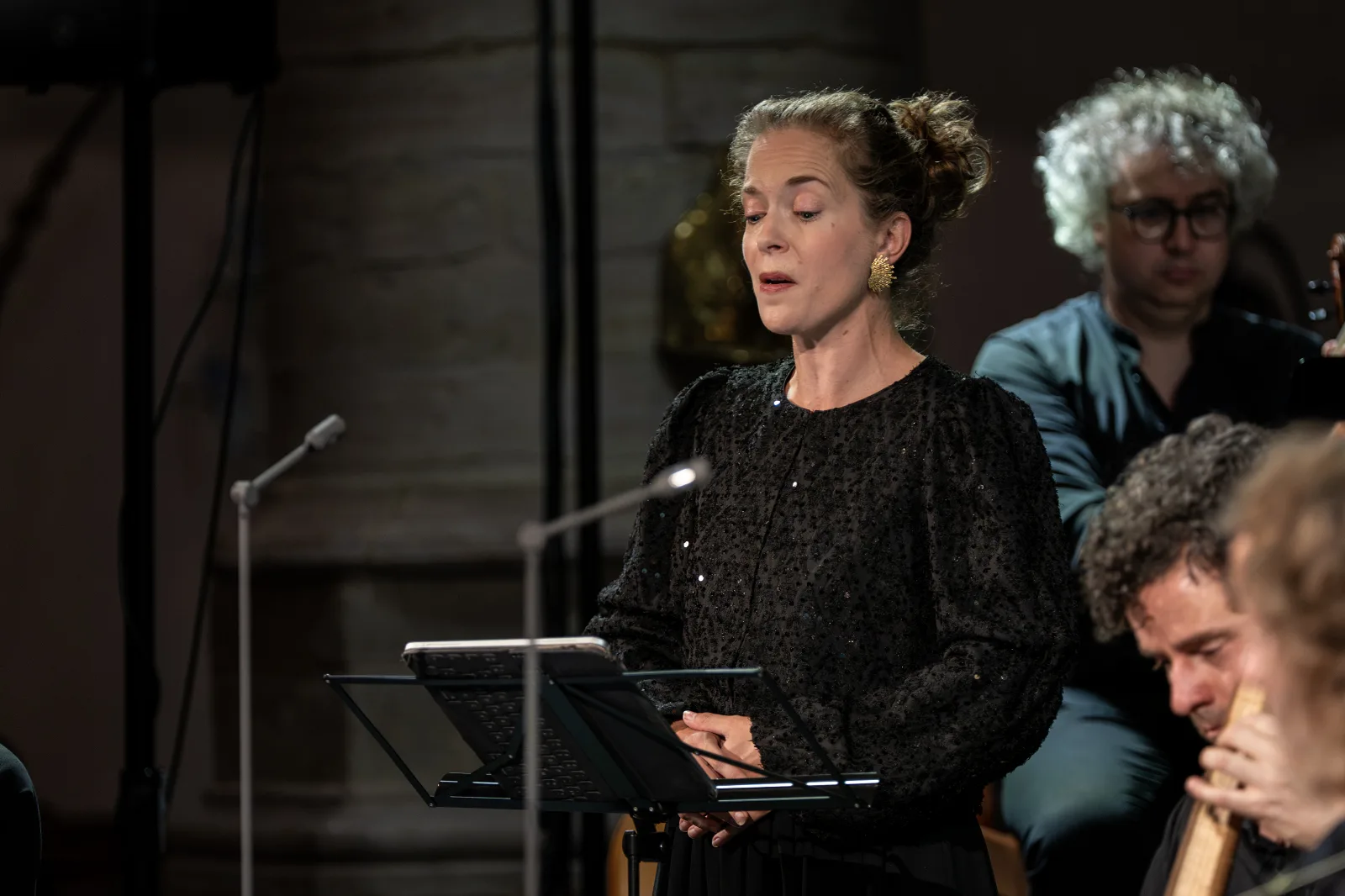 With Bedyngham's O rosa bella, it again became clear how different the sound cultures of both ensembles are. Where SPECTRA often works from sharply defined contours and contemporary tone colours, ClubMediéval opts for a softer, more organically flowing sonority. Yet both worlds connected remarkably well. The homogeneous strings and recorder formed a warm foundation for the soprano, who brought the work convincingly to life.
The closing piece, Memling Echo by Frederik Neyrinck, ultimately brought both ensembles together. Immediately the great concentration with which the musicians devoted themselves to this complex score was striking. No one played on autopilot. Every movement and breath was anchored in the music. Meanwhile, conductor Filip Rathé held all the lines together with remarkably sober yet highly efficient gestures. He did not conduct big, but precisely. With hands, fingers and small movements he steered expression and direction, and this worked excellently.
Neyrinck's composition unfolded for me as a series of waves. An energetic opening made it immediately clear that this would not be a nostalgic look back. Then a more harmonic episode emerged in which the two singers stood strongly in the foreground. Their parts were far from simple, but they performed them with admirable certainty and musicality.
 Afterwards followed episodes in which percussion, vielle, flutes, harp and lute each opened new perspectives. Sometimes the vielle had something elemental about it, as if it represented the primal voice of the whole. At other times harp and lute provided moments of rest within a constantly moving landscape. Regularly the voices cut through the instrumental fabric like a kind of cantus firmus. Here and there I even thought I heard subtle Eastern influences emerging.
Striking was how Neyrinck continually played with build-up and release. The music breathed. Arcs of tension grew, dissolved and returned. Towards the end, ethereal sound fields, fragile dissonances and gentler solo moments reappeared. Eventually the birdsong and distant bells also returned, as if the concert had reached its starting point again. The ending, I believe a softly spoken "amen", therefore did not feel like an ending, but like the completion of a circle.
And with that, Senden's before we begin… also became audible again. What began at the start of the evening with the question of what happens before the first note sounds, ended with bells, birds and silence. Between those two moments the music had bridged five centuries. Not as a straight line from past to present, but as a series of echoes in which old material repeatedly acquired new meaning.
ClubMediéval and SPECTRA succeeded in not simply placing old and new music side by side, but in genuinely letting them listen to each other. No single work stood in isolation. Ockeghem became a starting point for Birtwistle, Lassus a breeding ground for Janssens, and the music of Bedyngham and Obrecht a foundation for Neyrinck's contemporary sound world. Everything seemed to be part of one larger story about time, memory, truth and human imagination.
Musica Divina thereby shows courage. Where some festivals still present new music as a kind of intermezzo alongside heritage, or put it forward as a unique curiosity, this programme makes it a full-fledged conversation partner of early music. This yields not only interesting concepts, but also music that truly does something to the listener. The quality of the new compositions performed here certainly makes one long for more.
The completely filled church seemed to share that experience. Afterwards came a long, warm ovation, which might have lasted even longer had a reception not been waiting.
Those who were not there get a second chance on 13 October to hear the concert via Klara. Perhaps you will discover then what the audience in Mol discovered: that some truths indeed continue to evolve, while good music effortlessly spans the centuries.