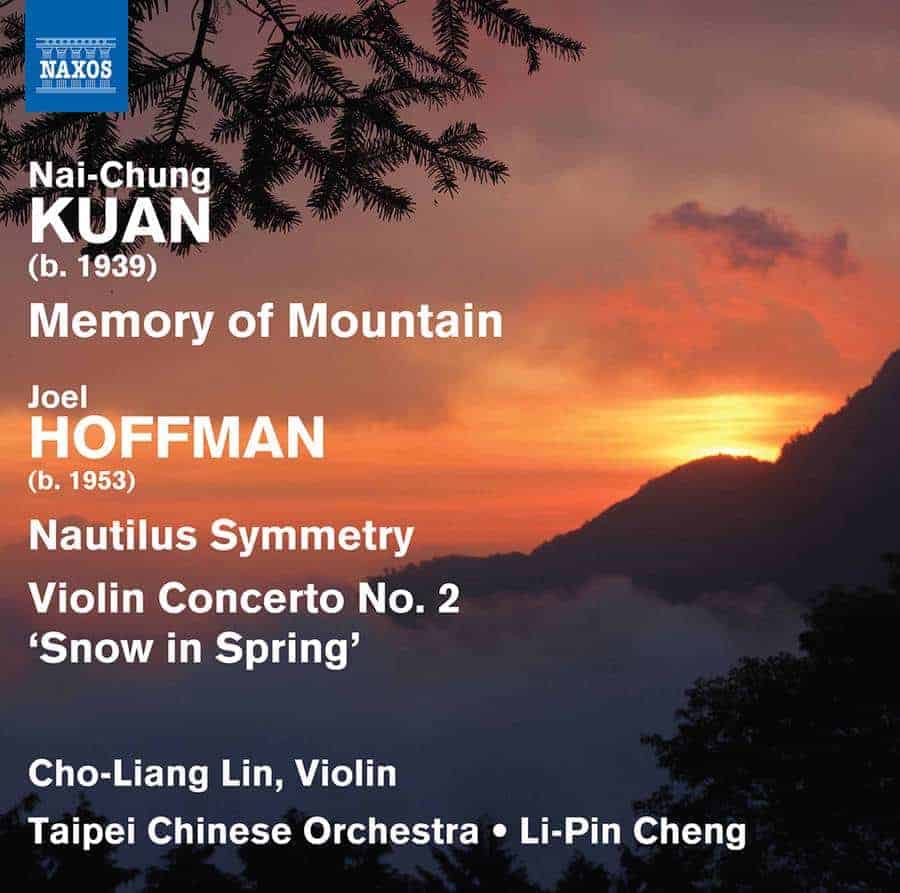
Composing for a Western solo instrument accompanied by a Chinese orchestra... that is the concept of this cd. Two pairs of eyes, those of a Chinese and a Canadian composer, each translate their perspective into music and find the violin concerto reinvented in the process. The Taipei Chinese Orchestra translates their complementary visions and brings them into musical dialogue with each other.
Nai-Chung Kuan: impressive oeuvre
Nai-Chung Kuan (°1939) graduated in 1961 from the Central Conservatory of Music in Beijing. Since then, he has held various prestigious positions including conductor of the China Oriental Song and Dance Troupe and the Kaohsiung City Chinese Orchestra. He was also music director of the Hong Kong Chinese Orchestra and laureate conductor of Hua Xia Chinese Orchestra of the China. As a composer, Kuan has composed an impressive oeuvre spread across various genres and for different types of instruments of both Chinese and Western origin. His works, including the symphonic suite Journey to Lhasa, Festive Lanterns and Bumper Harvest, won various prizes. His symphonic poem The Peacock was judged by the Hong Kong Chinese Orchestra to be a Chinese music classic of the 20th century.
Joel Hoffman (°1953): diverse compositional style
Canadian Joel Hoffman (°1953) studied music at The Juilliard School of Music in New York. Hoffman has been a professor of composition at the College-Conservatory of Music at the University of Cincinnati for 36 years. In addition, he spends 4 months a year in Beijing, where he is an adjunct professor at the China Conservatory of Music. Hoffman was composer-in-residence with the Buffalo Philharmonic Orchestra and the National Philharmonic in Washington. His compositional style is diverse. He draws inspiration from different sources to merge them into a new aesthetic. Eastern European folk music, Chinese traditional music and American bebop form the basis of Hoffman's sense of lyricism and rhythmic vitality.
Chinese orchestra
Music has played an important role in Chinese society since ancient China. The oldest known Chinese orchestra dates from the Zhou dynasty (ca. 1111-222 BCE) and performed so-called yanyue (燕樂, music for the court) and later also yayue (雅樂, music for Confucian rituals). Over the centuries, the genre underwent various changes, but the modern Chinese orchestra as we know it today (and as heard on the cd) is a twentieth-century invention. The musical revolution began in 1911 with the 'Movement for New Culture'. The fledgling Republic of China (1912-1949) showed interest in foreign influences and Western classical music was one of its sources of inspiration. Symphonic orchestras were established in major Chinese cities and symphonic music was popular in concert halls and on the radio. The modern Chinese orchestra reinvented itself and used the newly discovered Western symphonic orchestra's setup as a blueprint. They replaced the Western instruments with their Chinese counterparts and supplemented the orchestra with an additional section of plucked instruments (mainly pipa's and yangqins). So instead of a battalion of first and second violins, erhu's, banhu's, zhonghu's and gaohu's now fill the strings section. Suona's, dixi's, gaunzi's and xiao's now represent the woodwinds while the percussion section is supplemented with various gongs, cymbals and drums.
Not only is the structure based on a classical symphonic orchestra. Most of the repertoire for Chinese orchestra consists of transcriptions and arrangements. However, this has changed. Newly composed music for this ensemble is increasingly encouraged and orchestras hold composition competitions. The majority of participating composers are Chinese or culturally familiar with Chinese society. Kuan is a fine example here. He is a composer who writes equally easily for symphonic and Chinese orchestra since he grew up with both. Hoffman, on the other hand, comes from a North American background and learned about the unique Chinese sound. This juxtaposition of the two composers results in an interesting musical dialogue.
Musical synthesis
Kuan originally composed the solo part of Memory of Mountain for banhu (a traditional Chinese two-stringed bowed instrument). In 2016 he reworked it into a version for violin and Chinese orchestra. The composer found inspiration after a visit to the Taiwanese mountain range Alishan. Kuan divided the concerto into three movements, each with its own programmatic content. The opening movement is unconventionally slow and depicts mist slipping past the sacred tree. The alternation of lyrical phrases with faster notes in the violin's lower register evoke an esoteric atmosphere. In the second movement, a train rushes through the forest and past the mountains. With this, Kuan places himself in the Western tradition of orchestral trains. Think of works such as "Reislied" from Farewell to St. Petersburg (1840, Glinka), Pacific 231 (1923, Honegger) and Night Mail (1936, Britten). The solo part encompasses all typical playing techniques of the banhu and violinist Cho-Liang Lin manages to bring these fast bow movements and glissandi to life in impressive virtuosity. The thundering force of the train contrasts with the serenity of the forest. In this section, both soloist and orchestra bring the lyricism back to the fore, which is ultimately interrupted by the train's whistle signal. After a slow first movement and a scherzo-like second movement comes a joyful finale. This movement is in a socio-political feel-good style that was very popular among Chinese composers in the '90s: the glorious use of plucked instruments and hammering percussion (although the percussion is not as explosive as is customary in other works).
Hoffman was inspired for Nautilus Symmetry by the shells of nautiluses (which immediately explains the title of this work). The Nautilus shell is primarily known for its visual representation of the so-called golden ratio. Hoffman chose not this characteristic but the idea that a spiral constantly changes direction. Experimentation is thus the key to this composition. In search of an idea of "East meets West", Hoffman repeatedly develops a musical idea but before he completes it, he breaks it off and searches for the next one. It is the first work he composed for Chinese orchestra. Without falling into typical Chinese clichés, Hoffman embarks on an exploratory journey in which he learns the possibilities and limitations of the various instruments.
In his second work, the violin concerto no. 2 Snow in Spring, Hoffman takes a more subtle approach. His style remains as abstract as in Nautilus but this time he does not avoid typical Chinese music. He integrates a single Chinese melody (which shares its title with this composition). After Hoffman learned to know the Chinese orchestra in the previous work, he knows perfectly what tonal color he wants from the orchestra. The first movement (Andante) begins with a noise-killer before the soloist starts a lyrical melody. The tonal color of the plucked instrument-dominated orchestra is soft and delicate. The contrasting second movement (Allegro) has a more rhythmic character. The violin part is technically demanding and requires agility from the soloist. Cho-Liang Lin visibly enjoys this challenge and manages to maintain the same elegance and sensitivity as in the lyrical first movement. It shows that as an experienced violinist he is familiar with the sound balance of a Chinese orchestra. This is clearly evident in the pleasant interaction between soloist and orchestra.
Information
WHO: Cho-Liang Lin [violin], Taipei Chinese Orchestra cond. Li-Pin Cheng
WHAT: Nai-Chung Kuan: Memory of Mountain; Hoffman: Nautilus Symmetry; Violin Concerto No. 2 "Snow in Spring"
RELEASE: Naxos 8.574180
PHOTOS: © Sophie Zhai
Spotify: https://open.spotify.com/album/1pXjlFFFq9inJ5sH0XDMUz?si=S6BkDMgWTGCnBzS91zqqYw
Order: https://www.jpc.de/jpcng/classic/detail/-/art/memory-of-mountain-nautilus-symmetry/hnum/10274268