The concert hall as a laboratory of ideas: the Concertgebouw Brugge hires a “season thinker”. Cultural institutions have long made a habit of inviting artists in residence, but a “season thinker” is an innovation that the Concertgebouw Brugge introduced. For their “cosmic season” they brought in a cosmologist, Thomas Hertog, and paired him with an artist who has for years been fascinated by what sound does in space, Arne Deforce.
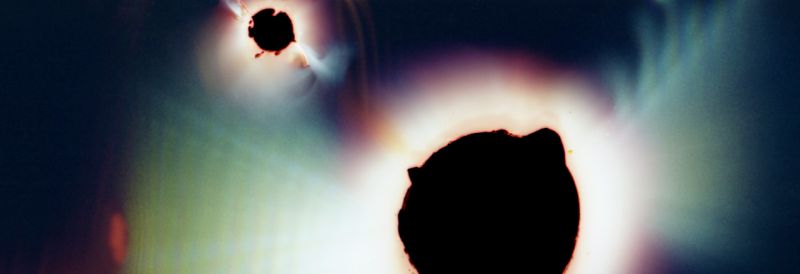
In a “lecture performance” the two explored the parallels and turning points in the discovery of space and in the development of music. With a dizzying score by the Catalan composer Hector Parra, Deforce gave voice on his cello to the last kiss that vanishing black holes can still give each other in the multiverse. The concert and the lecture were two highlights of that Kosmos Festival.
Out of the mist of the cosmos on stage Arne Deforce emerges and explains how Arnold Schönberg, with his Drei Klavierstücke of 1909, freed sound from its classical chains and brought about the emancipation of the dissonant. Thomas Hertog takes over and sketches how Albert Einstein, in that same period, wanted to capture the universe in a formula and freed it from the laws of Newton. Both performers continue, highlighting and illustrating parallels between developments in our new understanding of the cosmos and of music. Hertog traces the path of the Leuven astronomer Georges Lemaître, the Darwin of the cosmos, the man of the Big Bang and the expanding universe, and in doing so buries Einstein’s static and stable image of the cosmos. Deforce follows and tells how the sound spectrum from then on also spreads out over an infinite continuum, and lets us hear his favourite composers: Edgard Varèse and Iannis Xenakis. It continues like this up to the very latest insights about the cosmos: the string theory that Hertog tries to explain, and the strings of his cello that Deforce lets sound in every key. They seem, though in a serious presentation, like a duo of stand-up comedians, now stumbling, now seamlessly playing into each other. You could happily send them on tour with their instructive “Lecture Performance”. Two experts on the history of their fields, cosmology and music, and how at turning points these cross and propel each other.
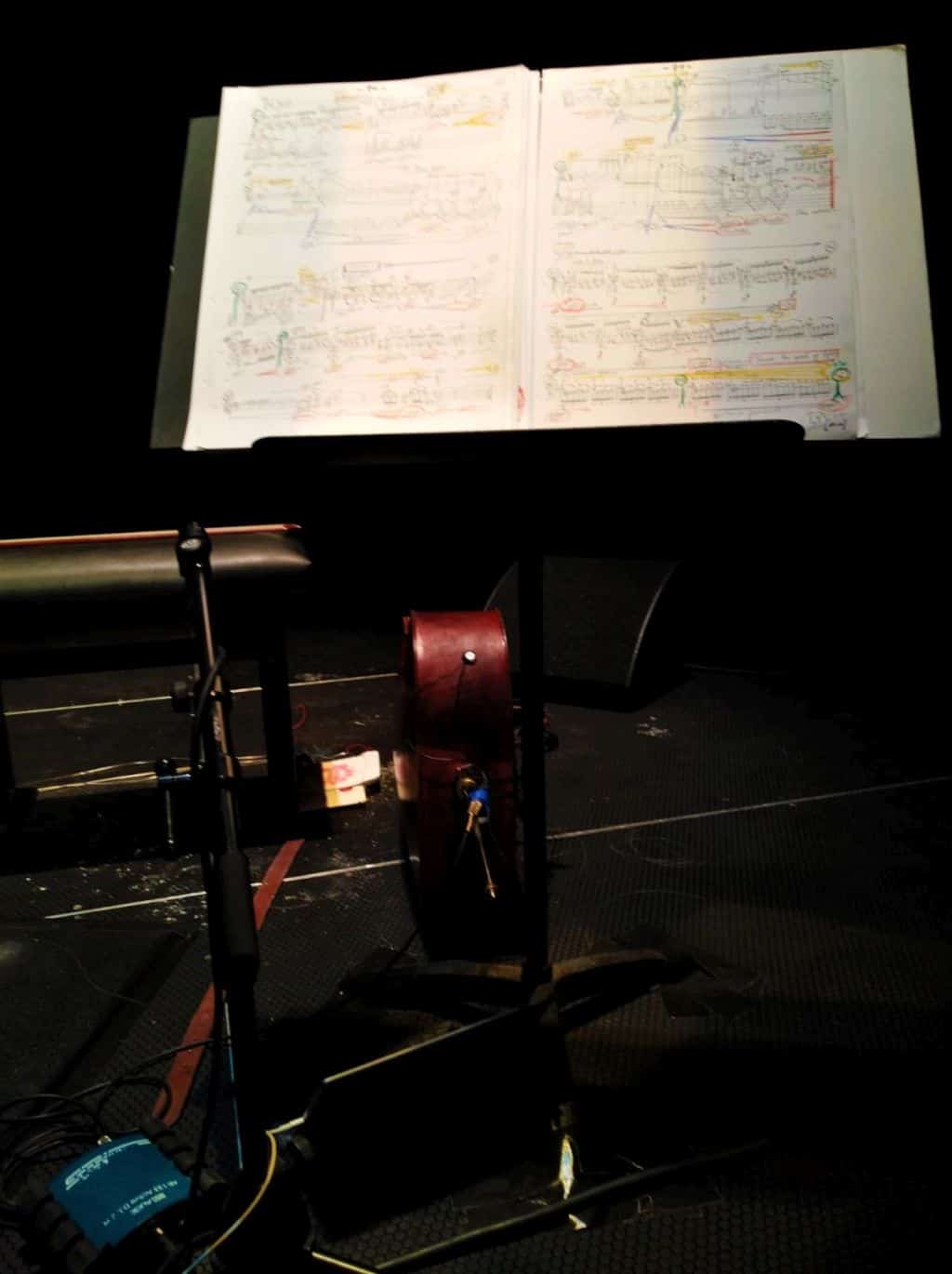
How that sounds at this moment in music history we should have heard in the work Hector Parra composed on commission from the Concertgebouw: “…limites les rêves au-delà”. The subtitle tells what it is about: “A journey into a black hole”. It is music that must take us into that world of black holes and the expanding universe. It became a remarkable concert. More than an hour of cello and “6-channel surround live electronics”, with Deforce at the front on a small platform and the audience on the stage. With loudspeakers in every corner. I thought it would be intense. But the earplugs you could get were not needed. Even though the sweat of a labouring Deforce splashed into the hall. Together with his cello and the score, one lump of energy. Actually I even missed sound reinforcement under my seat and above my head, to be able to revel even more in all that multi-dimensionality and experience it more intensely. The concert began with the deep fundamental tone of life on earth, expanding and varying across all the strings of the cello. And you are immediately far away from every form of “traditional” contemporary music, far from the atonal music of its great inventors and certainly miles from the airy cosmic music industry. Whoever measures themselves against the cosmos must burst with energy. No problem for Deforce, for whom one word from the programme booklet is uncommonly fitting: “driven”. “During such a concert my score comes straight out of the body, the limbs and the cello of Deforce,” Parra said in the introduction. But controlled energy, too, far from musicians who smash piano or guitar to pieces. Here respect for the beloved instrument stands firm. He plays it furiously, recklessly, restlessly and at times also motionlessly. In that surround sound experience of a journey to and through the universe, black holes, bottomlessness and return to earth, you ask yourself: “Are there limits to the cosmos, are there limits to music?” Here, at any rate, they were pushed back. The millisecond of sound of the gravitational waves observed by scientists, produced when black holes collide, Parra stretched into an hours-long galactic clash. With all that trembling vibration of the cello strings, you no longer need string theory to understand music or the cosmos. You have enough with the power-and-beauty achievement of performer, composer and sound designers.
- WHAT: Lecture Performance, “Music and the cosmos: resonance”
- WHO: Thomas Hertog (prof. dr. KU Leuven), speaker, and Arne Deforce, speaker and cello, Filip Standaert, direction
- WHERE: Concertgebouw Brugge
- WHEN: 26 March 2019
- WHAT: « … limite les rêves au-delà. A journey into a black hole » by Hèctor Parra for cello and 6-channel surround live electronics (commissioned by Concertgebouw Brugge & Grame for Ruhrtriennale)
- WHO: Arne Deforce, cello, Martin Antiphon (Music Unit), Thomas Goepfer (Grame-Lyon) and Hèctor Parra, sound design
- WHERE: Concertgebouw Brugge
- WHEN: 30 March 2019