For five years now, Klankdomein has been turning the spotlight on Flemish music, and to do so it brings aboard the finest performers: think of the Izumi Pianoduo, cellist Pierre Fontenelle, violinist Yuki Horo, clarinettist Hannelore Vermeir and the Desguin Quartet. Top musicians in everyday concert life.
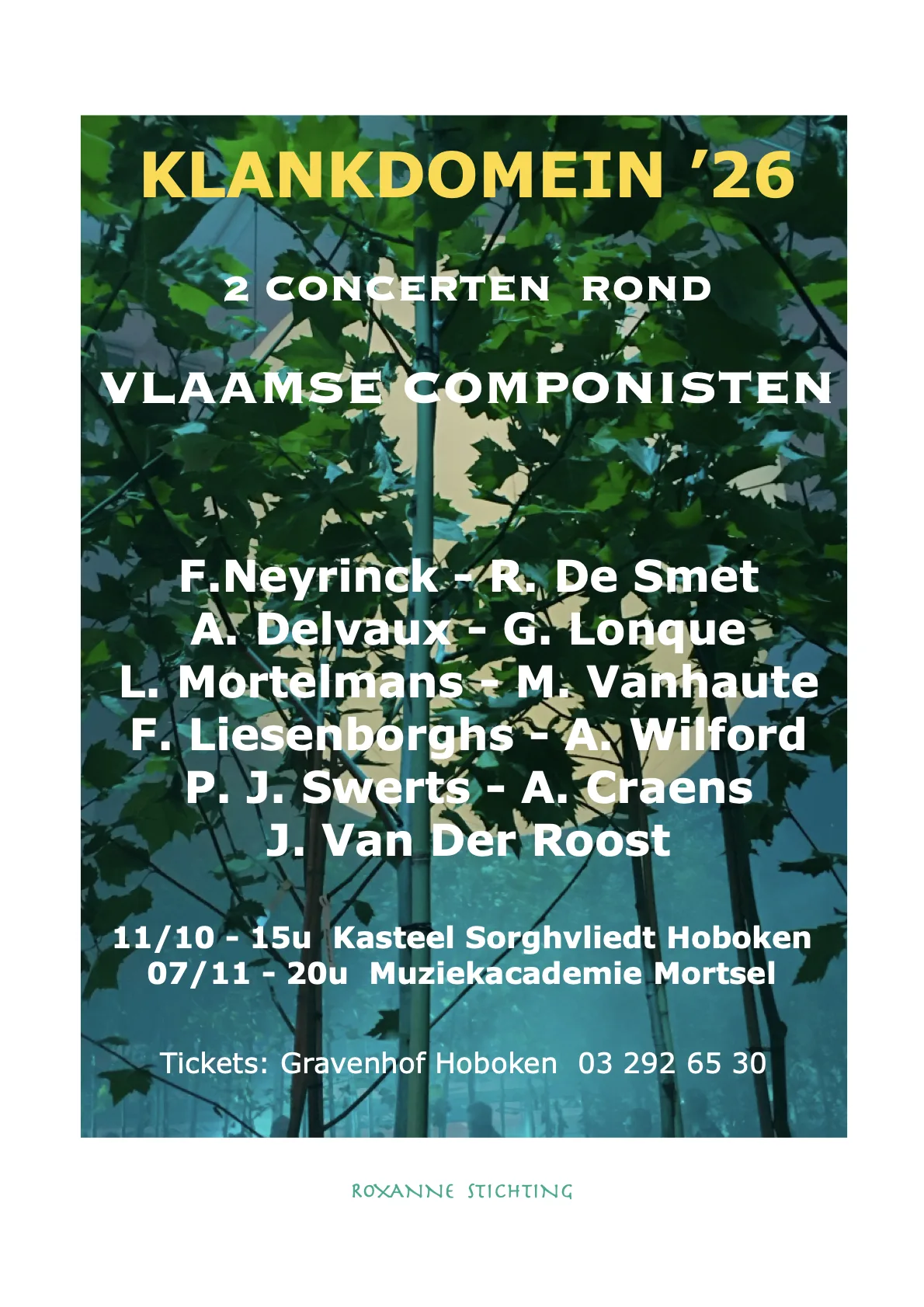
This year too, organiser Wilfried Westerlinck and his team invite us to two concerts on 11 October and 7 November 2026, with a series of premieres by Mieke van Haute, Frederik Neyrinck, Piet Swerts, Alain Craens and Raoul De Smet (whose ninetieth birthday we are celebrating). The programme also includes works by Albert Delvaux, Lodewijk Mortelmans, Georges Lonque and Arthur Wilford – composers who certainly carry weight.
Music and words, for Joanna Van der Heyden and Jean-Pierre Rondas (both Radio 3 stalwarts now 'retired') each give a fascinating lecture.
Dear Wilfried, what does Klankdomein stand for? What is the aim, the focus?
From the very beginning, all attention has gone to chamber music by Flemish composers. How sad it is to note that this aspect has almost entirely disappeared from the concert circuit. The concerts are composed in a very varied way, so that many aspects can be addressed: instrumentation, styles, and a mix of compositions written between 1830 and today. In this way, each concert is like a fan.
This year's concerts continue the line of previous (very interesting) editions. Highlights of this edition? Special performers? Composers to discover?
Each edition starts from the possibilities that certain instrumentations offer me and the combinations we can develop with them.
But there is equally the question: which performers can I approach for this? For example, Frederik Neyrinck has been waiting for many years for the premiere of his work Klankstudies for flute and harp. Tille Van Gastel was willing to take this on and found a good ally in Marjolein Vernimmen. In this way we arrived at the work of Albert Delvaux. For he wrote a Duo for that very same combination in 1985, which has never been performed since. Or the revival of a small piece by the modest composer Franz Liesenborghs, paired with a charming composition by Arthur Wilford – once a formidable piano virtuoso, and the man who set up the first Flemish music school in Brussels.
Of course I still try to bring some premieres. The Izumi Pianoduo had been looking for a stage on which to perform a work that Alain Craens wrote for them. In addition, I asked Jan Van Der Roost to make a four-hands version of his popular Rikudim Dansen.
I always enjoy the lectures in Mortsel, this time by Joanna Vanderheyden on music magazines…
I am not very fond of intervals during concerts. I can imagine the audience needs a moment to change their thoughts. That is why you will find these lectures in the middle of each concert. This year I went knocking on the doors of my former colleagues at BRT3 and Radio 3. Joanna Van der Heyden has delved into the history of music magazines in our country, and I asked Jean-Pierre Rondas to shed his light on music and the world. Can music save the world, he asks himself… Something I myself have never really pondered, and it can only be very engaging when an erudite man like Jean-Pierre airs his ideas on it, don't you think?
What are the reactions of the Belgian composers who appear on the Klankdomein programme?
Many colleagues find it a valuable initiative and are delighted when one of their works appears on the programme again. Because that is often the problem: performers like to premiere a new work. It looks good in their biography. But keeping that same piece in their repertoire proves difficult. Obviously not every work is a masterpiece. But a concert consisting solely of masterpieces would strike me as soporific. That is why I like to quote Stijn Streuvels: There must be a bit of adventure, movement, unrest, urgency and drive in the life of everyday, otherwise time passes in grey monotony!
Until now you have done absolutely everything yourself for these concerts – right down to printing the flyers and tickets. Have you received some reinforcement for these practical matters in the meantime?
I still do most things myself. In recent years the tickets have been outsourced to Cultureel Centrum Gravenhof in Hoboken. Until last year I also received a lot of support from the Algemeen Nederlands Zangverbond. But the bookings, arrangements with the printer, communication, compiling and correcting the programme booklets, budget management and so on – I do all of that myself. It is and remains a quasi one-man activity. That is why this year will probably be the last time I organise this. Over the past five years around a hundred works by our composers have been performed. Often they were wonderful discoveries, and I think of Poëma for violin and piano by Henry Sarly, or the Flute Sonata by Stephan vande Ginste, songs by Franck Van Der Stucken, and the Piano Quartet by Victor Legley… (And I could go on like this for quite a while…)
How is Belgian classical music doing? Are trends noticeable among younger composers? As a lyricist par excellence, do you have a close connection with contemporary talent?
Let me be clear: I am a composer of the old guard! And that music by young composers sounds different is good – very good, even! Other insights have emerged, and our young composers also connect well with international trends! They increasingly seek inspiration in the major centers or from composers of international renown. The step in that direction has also become much easier. I myself would have liked to study with a composer like Boris Blacher. For some reason, I never took that step. I still regret that, although I have always been very grateful for the other fine teachers I had: Vic Legley, August Verbesselt and Daniël Sternefeld, composers with an impressive record. Talent that deserves more attention in our symphonic concerts.
When will you call Klankdomein 2026 a success?
When there is a bustling turnout of interested listeners, and we are able to experience beautiful, moving music.
Furthermore, I have confidence in our musicians, such as the Desguin Kwartet, Hannelore Vermeir, Yuki Horo, Pierre Fontenelle, Urbain Boodts and the Pianoduo Izumi, that they will give their very best.
Then I will be happy and content, and I will allow myself a good glass of wine! Absolutely.
Thank you, Wilfried Westerlinck. And that Kasteel Sorghvliedt is a unique location, surrounded by greenery and space to let all that music breathe fully, that too. A concert to look forward to!
Practical information:
Klankdomein concert Sunday 11 October 2026 at 3 p.m.
Kasteel Sorghvliedt – Marneflaan 3 in 2660 Hoboken
Hannelore Vermeir (clarinet), Tille Van Gastel (flute), Marjolein Vernimmen (harp)
& Desguin Kwartet play music by F. Neyrinck, R. De Smet, A. Delvaux, G. Lonque and W. Westerlinck
Tickets €15 pp via t 03 292 65 30 or www.gravenhof.antwerpen.be/klankdomein
Klankdomein concert Saturday 7 November 2026 at 8 p.m.
Auditorium Muziekacademie Mortsel – Eggestraat 13 in 2640 Mortsel
Pianoduo Izumi, Yuki Horo (violin), Urbain Boodts (piano), Pierre Fontenelle (cello)
Play music by L. Mortelmans, M. Van Haute, F. Liesenborghs, P.J. Swerts, A. Craens, J. Van Der Roost and Jean-Pierre Rondas, and give a lecture 'Can music save the world?'
Admission free with a voluntary contribution, but reservations are strongly recommended: westerlinck.wilfried@gmail.com