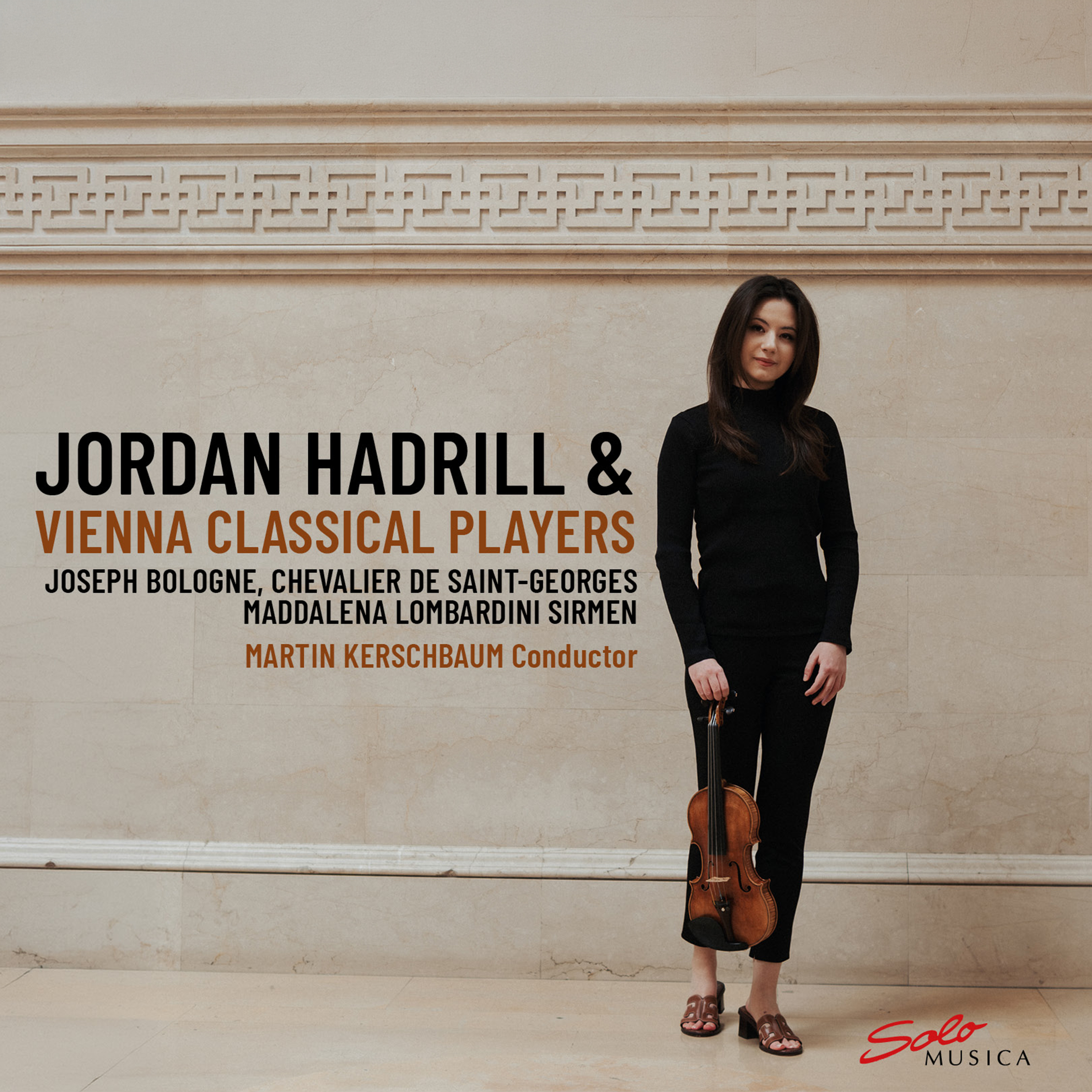
This debut album, titled Forgotten Voices, Rediscovered, by British-Australian violinist Jordan Hadrill is more than a visiting card – it is a statement. With the Vienna Classical Players under the direction of Martin Kerschbaum, she brings together two composers who seem to have little in common except their birth year – 1745 – and the fate that befell them both: a place in oblivion, not for musical reasons, but for who they were.
Joseph Bologne (1745-1799), Chevalier de Saint-Georges, was born in Guadeloupe as the son of a French plantation owner and an enslaved woman. As a talented all-rounder, he made a name for himself in the Paris of the Ancien Régime on multiple fronts simultaneously: as a fencer of exceptional level, as the leader of one of the more renowned orchestras of his time, and as a composer and violinist who had effortless access to the highest circles. Yet his career reveals how fragile that recognition actually was: his appointment as director of the Paris Opera did not go through after a number of singers refused to work under the leadership of a man with dark skin. Even with his exceptional talent and standing, he remained vulnerable to the racism of his time.
The Violin Concerto No. 1 in G major, op. 2/1 from 1773, opens like the first ray of sun on a clear spring day: the orchestra builds up the soloist's entrance nicely, and Hadrill picks up on it lovingly. The balance between soloist and orchestra is good, but as the work progresses, it becomes apparent how tightly everything is thought through – what seemed spontaneous at the beginning turns out to be primarily a well-calculated direction. Some orchestral passages could have done with more punch, or at least as much as the soloist; they sound clear and supportive, but also somewhat flat. Especially in the Largo, the orchestral introduction could have had more drama. It is certainly there in the music, but comes across somewhat timidly here. A soloist with more years of experience might have asserted her own weight more emphatically against the orchestra.
The second discovery on the album is Maddalena Lombardini Sirmen (1745-1818), trained in one of the Venetian ospedali and later a composer who built a remarkable European reputation. The fact that her scores were reprinted five times speaks volumes about the interest her music enjoyed at the time. From her Sei Duetti op. 5 (1775), the Duetto No. 2 in D major is heard here, performed together with violinist Dominika Witowicz. Two violins without accompaniment leave little room to hide behind another: every intonation, every phrasing, and every response to the other voice is immediately exposed. There is no leading and following voice in this piece – Hadrill and Witowicz keep each other constantly sharp, taking turns probing and insistent, without either of them ever truly becoming the upper part. The result is lyrical rather than virtuosic-exuberant, with a warmth that reveals that both musicians approach the score not as a curiosity, but as living repertoire.
What distinguishes this album from many a 'rediscovery' project is that it never sounds like dutiful rehabilitation. Hadrill avoids the museum tone; she plays this music with a directness as if it were just written. What I particularly like about this cd is not only the chosen repertoire, but also the programming itself: after a violin concerto with orchestra, deliberately choosing such an intimate piece with another violinist is far from the obvious debut recipe. It testifies to an idiosyncrasy that extends beyond the repertoire alone.
The only real reservation is the playing time. With only one violin concerto and a duetto, the whole remains modest (approximately 30 minutes), and those who hoped for a more comprehensive overview of Bologne's violin concertos or Sirmen's complete Sei Duetti will remain hungry for more.
That we will hear from Jordan Hadrill again is beyond doubt after this recording. Those who get the chance to hear her live should seize it. I especially hope she retains that idiosyncrasy: precisely that combination of curiosity, musical directness, and willingness not to take the safest route, makes this album, despite its limited scope, more than merely promising.