Sometimes you're lucky enough to be present at an extraordinary event. Jeanne d'Arc au bûcher by Arthur Honegger and Paul Claudel directed by Romeo Castellucci is one of them.
Performances of Honegger's dramatic oratorio are rare because of the enormous cast: you need not only an extensive orchestra in which saxophones, an ondes martenot and pianos play a prominent role, but also a large choir, a children's choir, two speaking voices and five soloists. Usually the work is therefore performed in a concert version, which is quite an undertaking in itself.
De Munt is now treating the audience to a staging by Romeo Castellucci that has already been awarded three times, one of the leading directors of our time. An excellent opportunity to witness this moving work in a masterful performance.
Of course, where Castellucci is, scandal is never far away. That's the case with Jeanne d'Arc as well. He simply searches for the boundaries of theatre and sometimes goes beyond them. He is a provocateur who enjoys kicking against sacred cows. But isn't that challenging quality precisely a characteristic of a genius? And let's be honest: what harm is there in performing Jeanne d'Arc naked as a transgender person? A woman in men's clothes or naked, is that a disgrace to the Maid of Orléans as the narrow-minded Federation Pro Europa Christiana wants us to believe? Doesn't it show a healthy artistic vision to finally strip Jeanne d'Arc of the ballast of centuries and reduce her to what she is: a naked human being?
Martyr, saint, fighter against injustice and so on, Jeanne d'Arc has been the symbol of everything and anything. Castellucci does justice to Jeanne by 'demythologizing' her. And in doing so he finds Honegger and Claudel on his side.
For they saw in the story of the young woman who played a decisive role in the Hundred Years' War in the unification of France certainly not a saint's life but an allegory of their own time.
Now, after more than eighty years, one can say that this subject matter is just as topical as it was then. And also that this allegory is still not understood by everyone, as evidenced by the 10,349 signatures that the aforementioned reactionary Christian organization managed to collect. In vain, the show must go on.
For timeless is the theme of the individual who is crushed by the machinery of spiritual and religious power. Timeless is the theme of the bloodthirsty mob that allows itself to be incited by its leaders. Timeless finally is the theme of populism. One can still easily identify with it now.
The idea for the work came from Ida Rubinstein, a dancer, actress and, above all, a wealthy patron of Russian descent. Her influence on the cultural life of her time was great. Among others, Debussy, Stravinsky and Ravel dedicated works to her. She was the one who brought Honegger and Claudel together in a collaboration that resulted in a dramatic oratorio based on the life of Jeanne d'Arc. The world premiere took place in Basel in 1938. A year later, the French premiere took place in Orléans.
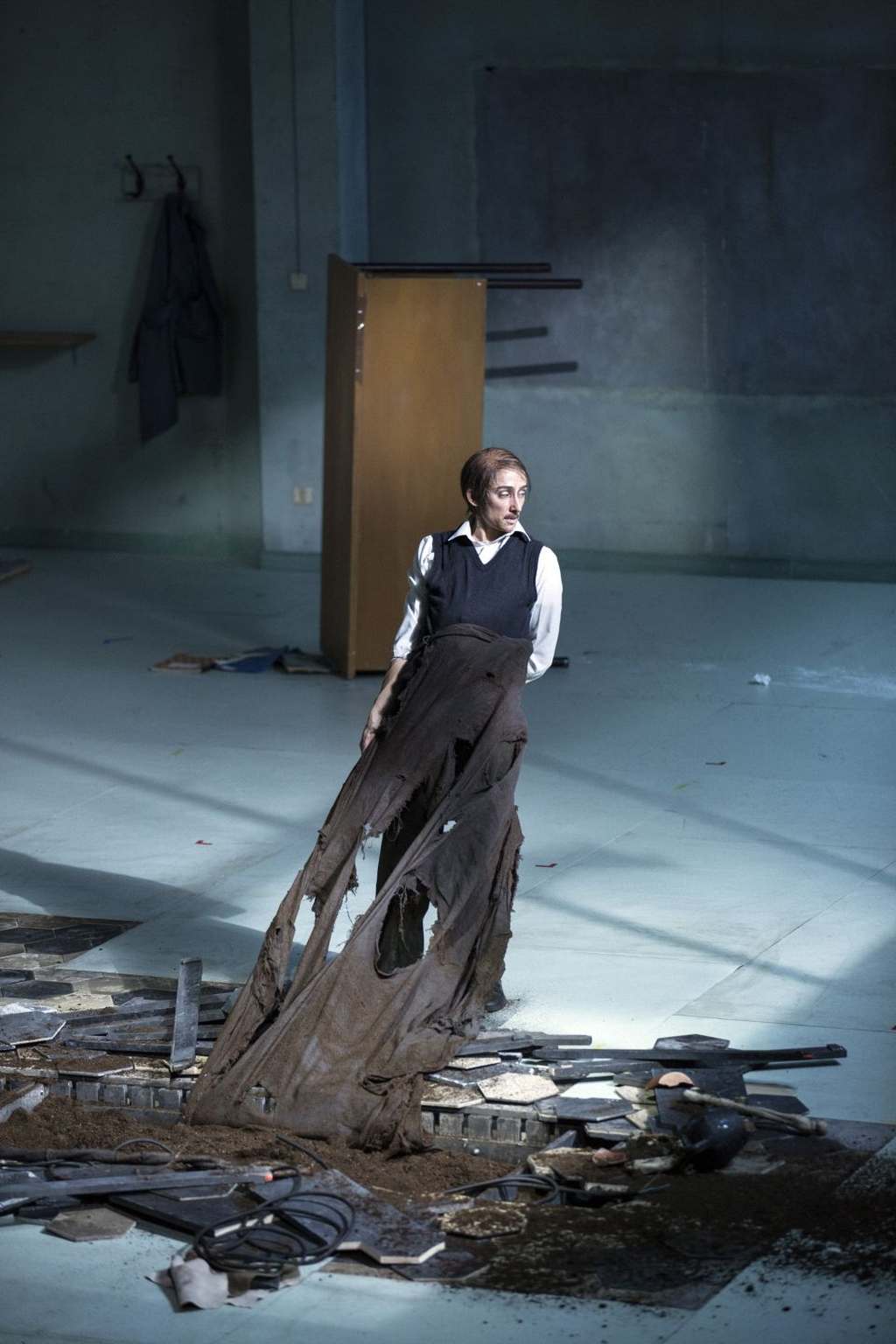
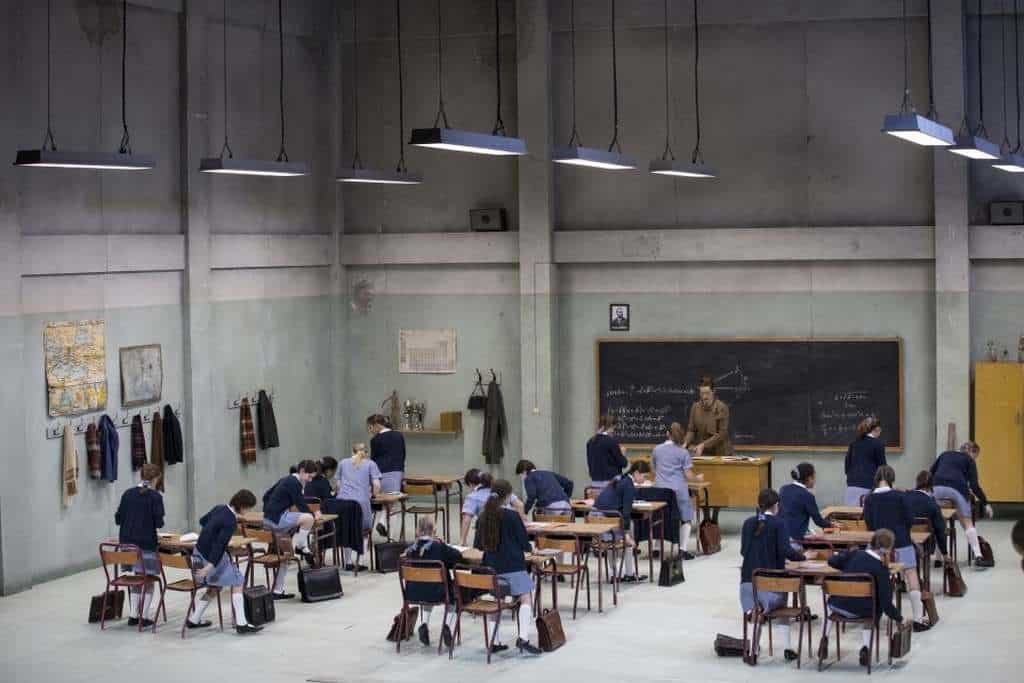
Castellucci's approach is revolutionary. He immediately misleads the spectator by moving the action to an extremely realistically depicted classroom. A symbol for the place where people are indoctrinated with lies and half-truths.
The bell rings, the girls in uniform leave the classroom under the supervision of their teacher. A cleaner enters with his mop cart and, in a fit of rage, throws the entire contents into the corridor, locks himself in...
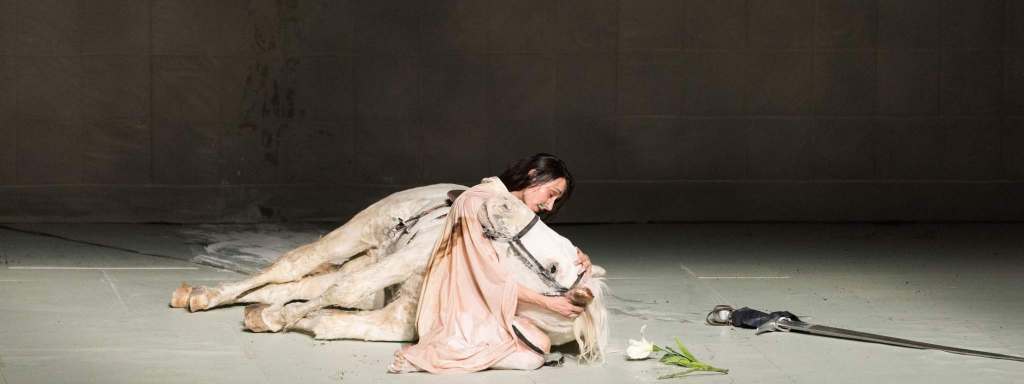
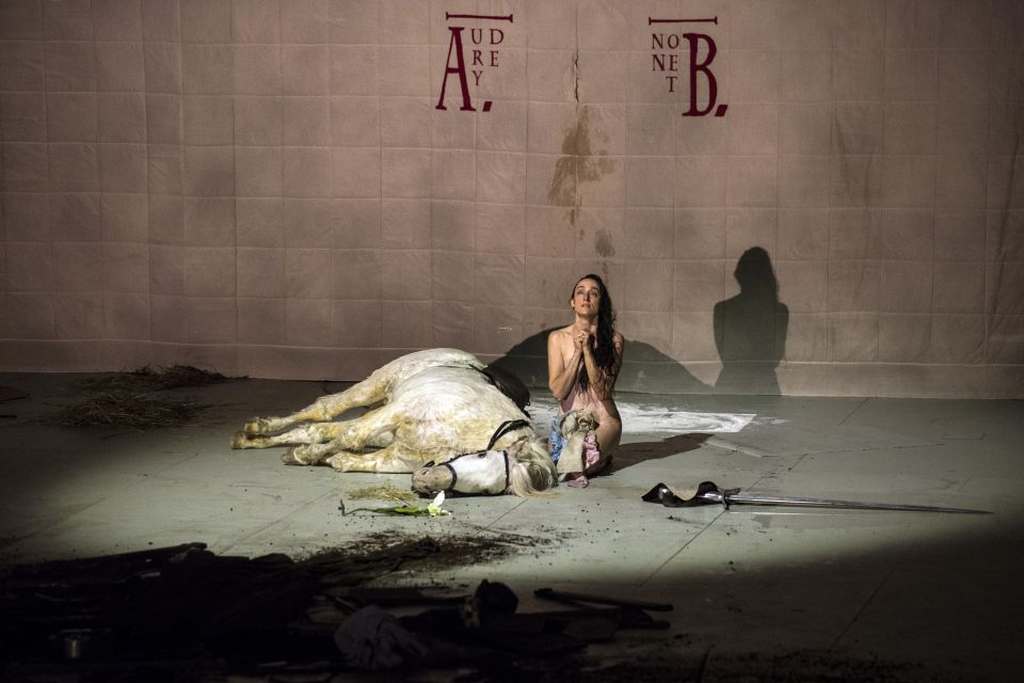
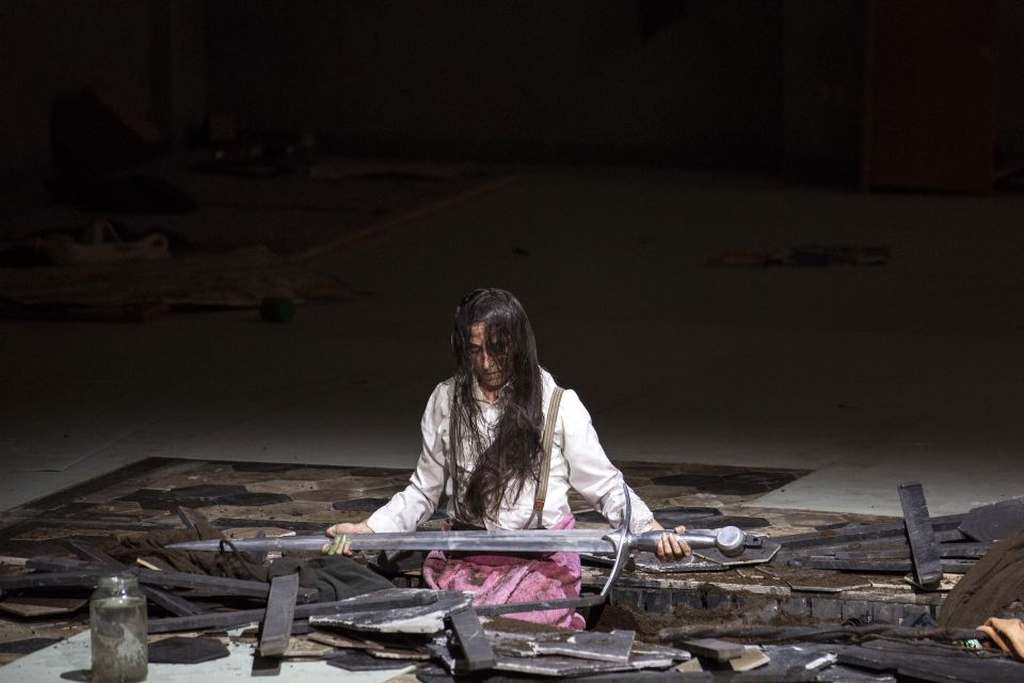
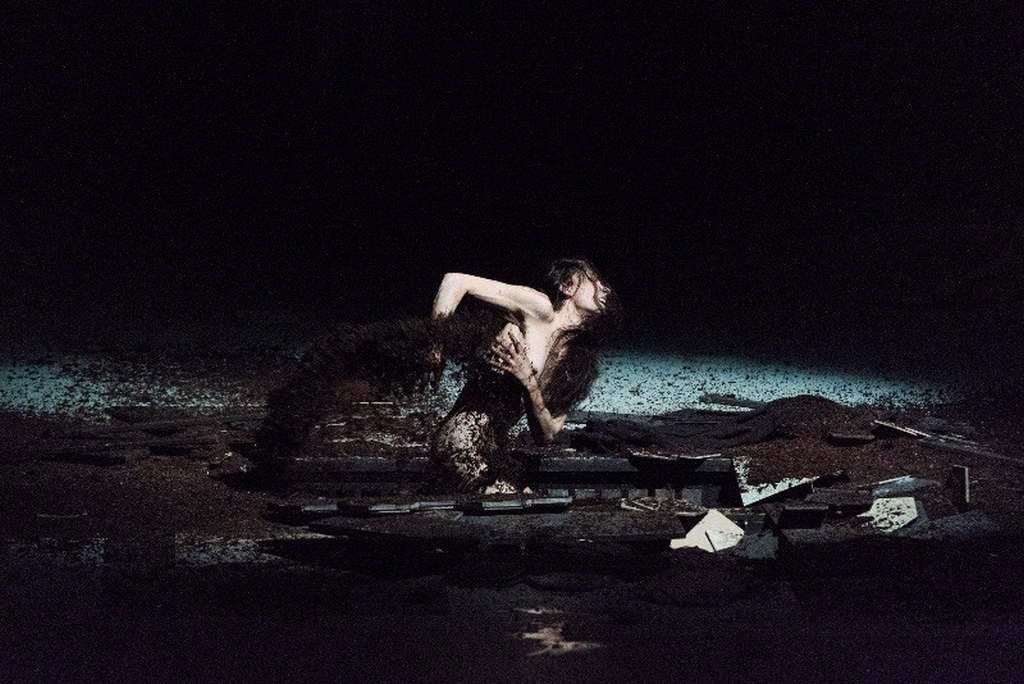
Only then – we're about ten minutes further – the orchestra sets in with a dark, ominous prologue and the drama unfolds. It is from this 'wrong' body of the cleaner in this 'wrong' place, a classroom, that Jeanne emerges. First in men's clothes as concierge-Jeanne, but ultimately transformed into a naked, vulnerable, but also powerful woman. Jeanne d'Arc stripped of all symbols and myths. It creates breathtaking images.
The story tells how Jeanne, while awaiting the execution of the sentence, relives her life in eleven flashbacks, in reverse order. There is a Brother Dominique who functions from the wings as a messenger sent by God. He helps Jeanne understand and accept the avalanche of events that have brought her to this place.
Choir and soloists are stationed invisibly in the upper regions and boxes of the hall. They take no part in the action. They perform the voices in Jeanne's head, reminding her of the crucial events in her life that led her to the stake.
Through this intervention, Castellucci shifts the focus of the production entirely to the sober actions on stage, where the naked Jeanne learns to reconcile herself with her fate, assisted by her divine coach Brother Dominique. It creates impressive theatre.
The spectator is swept along by the dizzying pace at which the scenes follow one another. Moments of satire are alternated with despair and meditative stillness.
Gripping is the scene in which Jeanne relives her trial. The jury consists of beasts. The chairman is Porcus the pig, the bishop of Beauvais Cauchon (what's in a name), cheered on by the bloodthirsty choir as pig of pigs. It is a mock trial. When asked whether she defeated the English with the help of the devil, she answers 'non'. The clerk records 'oui' and with that her fate is sealed.
Also Jeanne's memory of the card game in which she must watch helplessly as the powers involved divide the spoils provides a gripping scene. Set to a light court music to further emphasize its satirical character.
The spoken dialogues between Jeanne and Brother Dominic bring peace and reflection.
Honegger displays enormous versatility in his score. Here is a master at work who controls the orchestral palette down to the finest details and is also able to unite the most disparate musical styles into a whole.
Particularly effective is also his choice of an actress in the role of Jeanne and an actor in the role of Brother Dominique.
Elements of jazz, folk music, medieval chants cabaret and neo-classicism are used interchangeably. They ensure that the listener moves from one surprise to the next and the conductor has his hands full doing justice to every detail.
That Kazushi Ona managed to maintain that unity during this technically complicated performance deserves great credit. An orchestra in the pit, choir and children's choir spread over the highest galleries, soloists in the lower boxes and of course the soloists on stage. It must be a logistical nightmare to keep it all together. But he succeeded effortlessly.
The Munt orchestra was in top form. Despite the exceptionally unusual cast, everything seemed to run smoothly. Beautiful dark sounds from the winds, surprising saxophones and of course here and there the blood-curdling screams of the ondes martenot. Delicious!
The choir was also unsurpassed, at times overwhelming in populist hate-mongering and bloodlust, with of course an extra feather in the cap for the children!
The soloists perhaps had a thankless task, because they were invisible, but they delivered without exception excellent work with Jean-Noël Briend as a hilarious bishop Cauchon, pig of pigs. Ilse Eerens was the only soloist we got to see on stage as Vierge.
But all attention of course went to the formidable Audrey Bonnet, who, as if she were Jeanne herself, more than convincingly portrayed all the emotions her main character went through. And then stand on stage for an hour and a half (almost) naked. A performance of magnitude.
Her counterpart Sébastien Dutrieux as Brother Dominique managed, despite his inconspicuous place in the wings, to draw attention with his beautiful sonorous voice.
But the greatest credit must of course go to Romeo Castellucci, who has effectively and movingly stripped Jeanne d'Arc of the burden of centuries and reduced her to what she was, a vulnerable naked human being. Ecce homo!
Not all performances are sold out yet. Go see it!
- WHAT: Jeanne d'Arc au bûcher – Arthur Honegger (1892-1955)
- MUSICAL DIRECTION: Kazushi Ono
- DIRECTION: Romeo Castellucci
- CAST: Jeanne d'Arc: Audrey Bonnet - Frère Dominique: Sébastien Dutrieux - La Vierge: Ilse Eerens – Marguerite: Tineke Van Ingelgem – Catherine: Aude Extrémo - Une Voix, Porcus, Héraut I, Le Clerc: JEAN-NOËL BRIEND - Une Voix, Héraut II, Paysan: Jérôme Varnier - Héraut III, L'Ane, Bedford, Jean de Luxembourg, Un paysan: Louka Petit-Taborelli - L'Appariteur, Regnault de Chartres, Guillaume de Flavy, Perrot, Un prêtre: Geoffrey Boissy - Soprano Solo: Gwendoline Blondeel - Une Voix d'Enfant: Siobhan Mathiak
- MUSICIANS: Symphony Orchestra and Choir of De Munt, Children's and Youth Choir of De Munt conducted by Benoît Giaux
- WHERE & WHEN: De Munt, Brussels, premiere, 5 November 2019
- PHOTOS: © Stofleth and © B. Uhlig
[embed]https://youtu.be/M__U10kk_jc[/embed]