


With Zoroastre Jean-Philippe Rameau (1683-1764) composed a tragédie lyrique that excels in both content and musical grandeur. The overwhelming nature of the work requires an excellent cast, not only vocally but also instrumentally. In that sense, the recently released recording on Alpha is a bull's eye. Alexis Kossenko conducts Les Ambassadeurs- La Grande Ecurie, Choeur de Chambre de Namur and a host of top singers.
The recording was made during the live performance in April of this year in the Grand Manège in Namur. It was also shown, among other places, at deSingel in Antwerp, a review of which appeared on Klassiek Centraal.
Yet let us reiterate the most important aspects of the work. Zoroastre is the fourth tragédie lyrique that Jean-Philippe Rameau wrote. The libretto is by Louis de Cahusac, a man who not only belonged to the higher circles in Clermont, but was also the Grand Master of "La Grande Loge de France". The sequence of fierce confrontations between Good and Evil, embodied by Zoroastre and Abramane, can be traced back to Masonic connotations. He is also said to have been one of the only collaborators of Rameau who could handle the composer's difficult character.
The main character Zoroaster (or Zarathoustra) is a Persian religious reformer from the seventh century before Christ. The core of his teaching is the duality between good and evil. In the libretto, this struggle is of course developed within the framework of a love affair, although the story comes across as somewhat forced as a result. Zoroastre is the representative of Oromasès, the Supreme Being and the god of Light. His counterpart is the sorcerer Abramane, servant of Arimane, the Spirit of Darkness. The work had hardly any success at its premiere in 1749, which led Rameau to present a second version in 1756. Characters were removed and added, but above all the love intrigues received more attention. The power struggle between Zoroastre and Abramane is accompanied by their rivalry in love for Amélite. The chances of success in love are thwarted by evil – or protected by good spirits. A key figure in the conflicts is Erinice, who is also in love with Amélite. There are also allegorical parts that embody Revenge, Fury, Hate, Despair. Ultimately, Zoroastre triumphs. When Abramane threatens to kill Amélite, he calls upon heaven and Abramane and his company are struck by lightning. In the temple of Light, Zoroastre and Amélite are united. Their victory is celebrated abundantly.
For this concert performance, conductor Alexis Kossenko returns to the still exceptionally rarely performed original version of 1749. He is indeed a specialist in this repertoire and continues the tradition of his predecessor Jean-Claude Malgoire of historically re-sourcing the performance practice of French Baroque and building on the research of musicologists of the past fifty years. The orchestra with which Kossenko works here, Les Ambassadeurs, is incidentally the successor to La Grande Ecurie of Jean-Claude Malgoire. Let us immediately sing the praises of this magnificent ensemble, which sparkles and bubbles in the numerous instrumental passages (rondeaus, sarabandes and all other typical French Baroque dance forms). But equally in the accompaniment of the arias, duets and vocal ensembles they are alert and full of life with beautiful passages from the traverso in the tender arias of Amélite. Conductor Alexis Kossenko masters the alternating palette between very dramatic pages and sublimely contemplative passages. Vibrant strings, rapidly descending and ascending scales in the woodwinds, alternating dynamics, the orchestra constantly sets the contrast between good and evil in sharp relief. It is a true sounding board of tenderness and melancholy set against passages of violent outbursts of rage, hatred and revenge. The orchestra brings the story to life together with the soloists.
The soloists are all cut from the right cloth. Remarkable is the virtuosity of the lovers, Amélite and Zoroastre, performed by – indeed – two Belgian top singers, Jodie Devos and Reinoud van Mechelen. Just recently Jodie Devos shone as an almost unsurpassed coloratura soprano in Lakmé at the Opéra Royal de Wallonie. This CD recording confirms her crystal-clear voice that effortlessly floats through the highest notes, bends and winds through syllables that remain comprehensible. In doing so, she does not sound mechanical, but makes you feel what she is singing about. This begins already in her first aria "Reviens, c'est l'amour qui t' appelle" and culminates in the final passage "Règne amour". As haute contre the voice of Reinoud Van Mechelen is ideal for this repertoire. His height also radiates warmth, his diction is perfect and his expressivity is irresistible. (e.g. beginning of the 2nd act "A mes tristes regards" to give just one example). The other roles are also perfectly cast with, among others, the well-known Véronique Gens in the smaller role of Erinice, but also the bass Tassis Christoyannis as the villain Abramane and Matthias Vidal and Gwendoline Blondeel in various roles, strike the right note.
Finally, the Choeur de Chambre de Namur fits perfectly into the positive picture. It plays a very large role and ties the whole thing together beautifully with its commentary interjections.
Anyone who loves French Baroque opera will treasure this recording of Rameau's Zoroastre as a golden listening piece, with a collection of performers that are rarely to be found together. Simply magnificent. For those who witnessed one of the live performances, also a lovely memento.
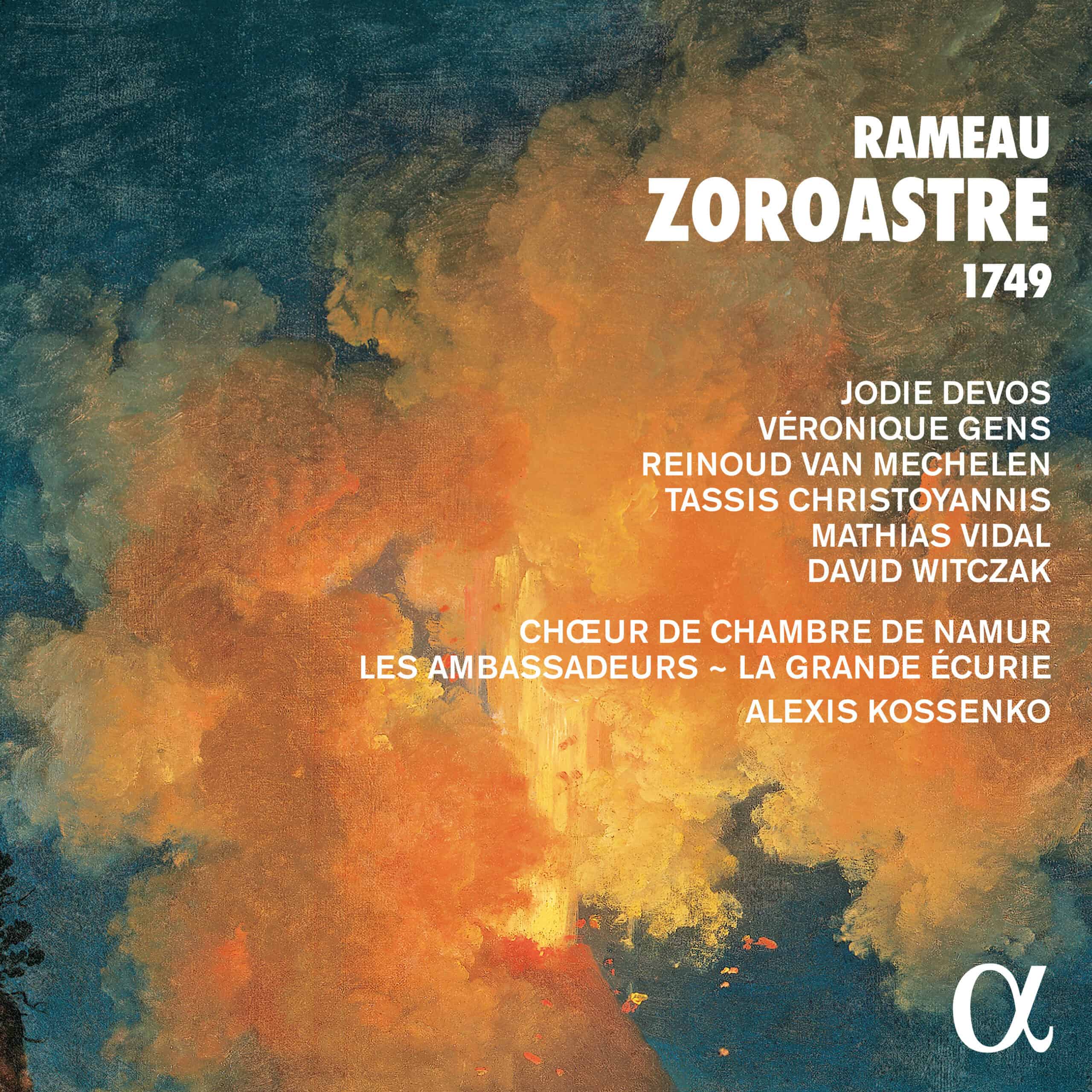
WHAT: Zoroastre, Tragédie lyrique by Jean-Philippe Rameau
WHO: Alexis Kossenko, conductor
Jodie Devos, Reinoud Van Mechelen, Véronique Gens, Tassis Christoyannis et al. Choeur de Chambre de Namur, Les Ambassadeurs- La Grande Ecurie
RELEASE: Alpha 891
ORDER: JPC