


The iconic chronicle A la recherche du temps perdu by Marcel Proust has received a contemporary interpretation in a beautifully crafted recital by pianist Jan Michiels, supplemented with live electronics (Juan Parra) and video art (Lise Bruyneel).
The concert, held last Saturday at deSingel in Antwerp, was announced as a cathedral of piano music, also to do justice to the poetic allures and grand vistas of Proust's renowned work. The program is built around several contemporaries of Proust (1871-1922). The main part consists of works by Claude Debussy (1862–1918) and the early-deceased—and therefore lesser-known—Gabriel Dupont. These two composers are flanked by the older Robert Schumann from the beginning of the 19th century and, on the other hand, György Ligeti and Luigi Nono from the 20th century. Proust's musical taste comes into its own in the choice of "Isoldens Liebestod" (from Tristan und Isolde) by Richard Wagner, in a transcription by Franz Liszt. Even Johann Sebastian Bach has his say, in an arrangement by Proust's contemporary Ferruccio Busoni. The program is divided according to the titles of the seven parts of Proust's novel cycle, but the compilers cleverly added an eighth part (ascolta…Menschen wie Blumen), a reference to the work of György Kurtág.
Well-balanced
Jan Michiels clearly shows that he feels completely at home with this playlist. The six pieces by Debussy fit like velvet gloves around his fingers. With Wagner, he lets his piano sound like a traditional symphony orchestra. And with Ligeti, he is the spectacular sound acrobat. In this kind of productions, much attention is required for the balance between the live instrument, electronics, and video art. This is especially necessary to optimize the listening experience, or conversely to avoid overkill. In the restrained Des pas sur la neige by Debussy, Jan Michiels' acoustic piano is electronically enriched with the chirping of a few early birds, the tinkling of thin icicles, and the rustling of aluminum foil. In other pieces, the piano is amplified, or Michiels plays quatre-mains with the electronics, or a piece for two or three pianos. Electronics also add value through sustained pedal tones and other effects that the acoustic instrument cannot produce. In the pieces where electronics approach the intensity of a string orchestra, the recital risks becoming a concerto, which then works less convincingly.
The video images are projected onto a pleated curtain, bringing mystery and mystique. This works very well in "Isoldens Liebestod" where the crescendos of this unendliche Melodie are perfectly matched with overwhelming waves on chalk cliffs. The scenes with hospital beds, however, are so comical that the listener risks losing attention to the music. But ultimately, the level of abstraction of the video art in this program proves high enough to remain aesthetically appealing.
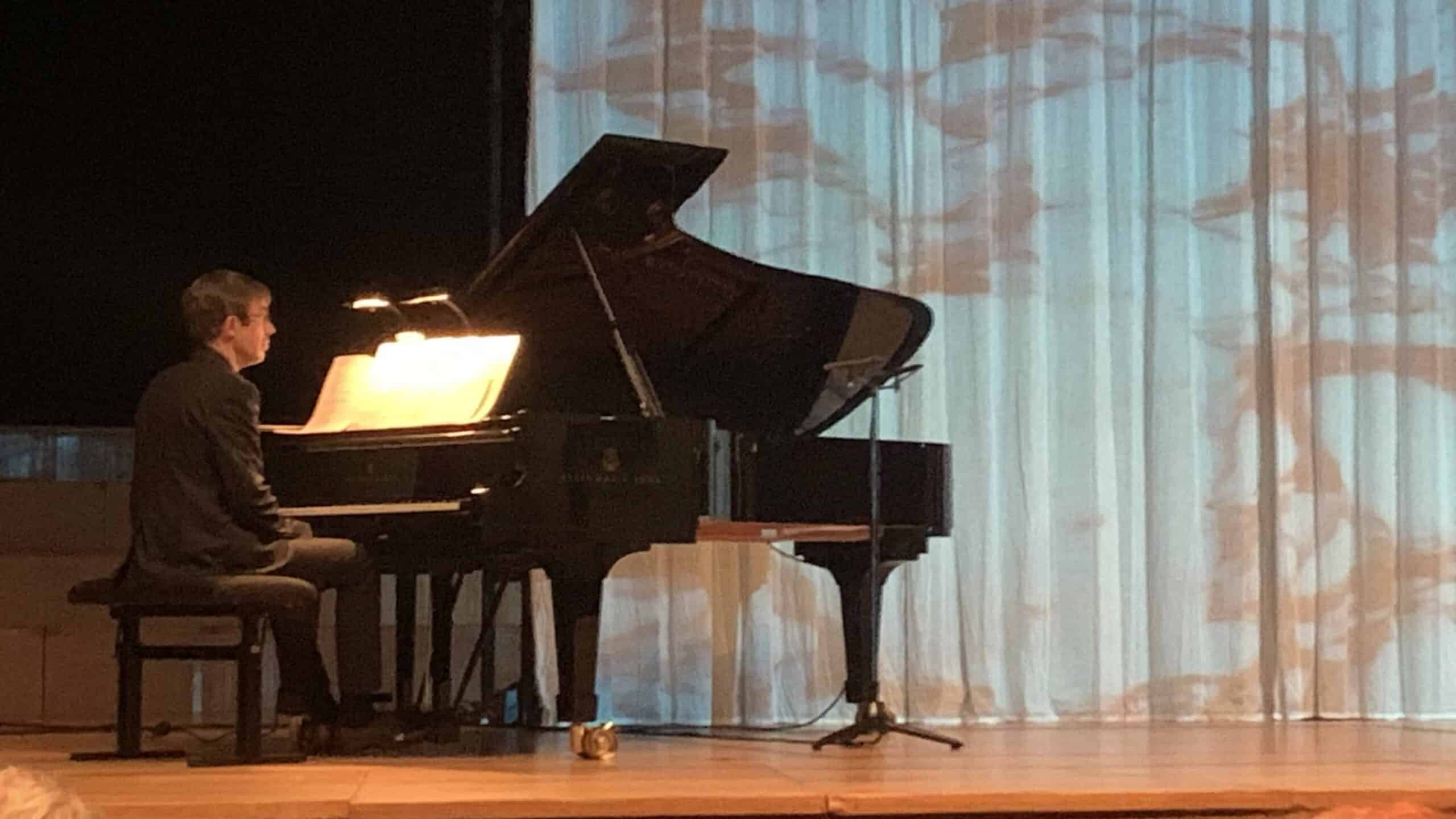
- SEEN: Saturday, February 5, 2022, De Singel, Antwerp
- AGENDA:
- Monday, February 21, 2022, Klara-Live, 8 p.m.
- Saturday, April 2, 2022, Concertgebouw Brugge, 8 p.m. Tickets: https://www.concertgebouw.be/nl/jan-michiels-juan-parra-lise-bruyneel
- PHOTOS: Koninklijk Conservatorium Brussel, Wynold Verweij