

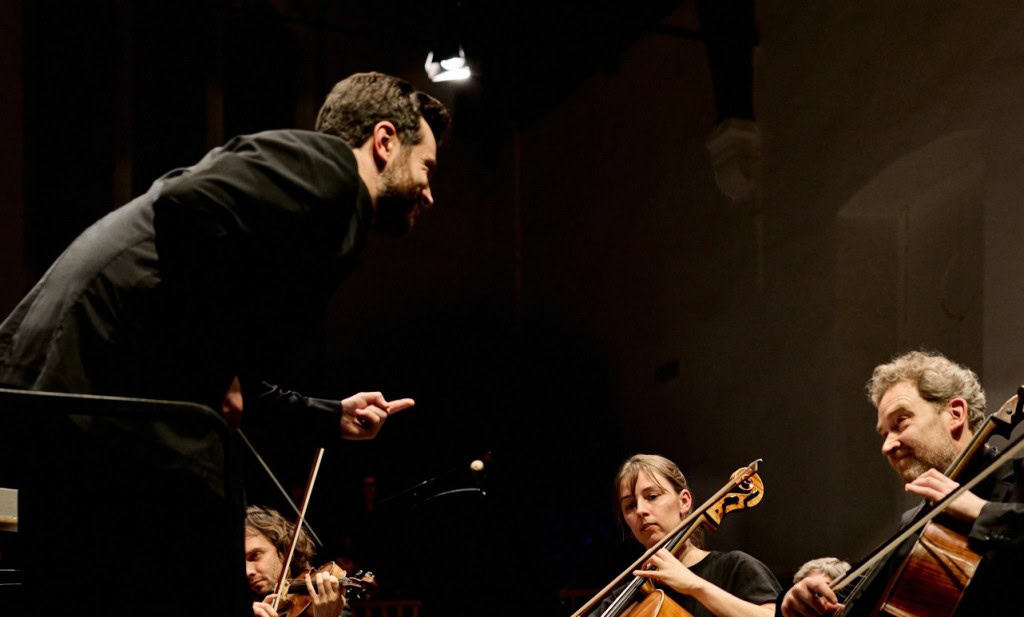
On January 17 and 18, the Symfonieorkest Vlaanderen performed at De Bijloke in Gent for the first time with Martijn Dendievel as chief conductor. He succeeds the Estonian conductor Kristiina Poska, who has caused the orchestra to evolve significantly in recent years.
This inauguration of the new chief conductor received considerable media attention. Dendievel is a Flemish cellist and conductor who, at thirty years old, already has considerable international experience. In 2021 he won the prestigious Deutsche Dirigentenpreis and last year the Flemish Ultima cultural prize. In addition to his position with the Symfonieorkest Vlaanderen, he has been chief conductor of the Hofer Symphoniker of the Bavarian city of Hof since last season.
Dream
Under the title "Martijn's Dream" they will perform the same programme in the coming weeks in Bruges and Antwerp as on January 17 in Gent. The title refers to young Martijn's dream of becoming a conductor and to Tchaikovsky's first symphony, titled "Winter Dreams". Tchaikovsky was twenty-six when he created his first symphonic work. Not yet the great pathos of his later symphonies, but you already hear the master throughout and how skilfully and clearly the structure is put together.
The programme also included Mendelssohn's violin concerto, with soloist Liya Petrova. There was also a short symphony by Luc Brewaeys on the programme, together with musicians from the Spectra ensemble, specialists in Brewaeys's spectral style. "Is that music?", I heard a listener remark during the interval. He said what many will have thought, but programming contemporary Flemish composers is of course bold and necessary, if only to get the audience accustomed to it.
On Sunday, January 18, they performed Tchaikovsky's first again, preceded by Mendelssohn's Hebrides Overture. This short concert was presented as De Bijloke's New Year concert, replacing the city of Gent's annual New Year concert, which was cancelled due to budget cuts.
Natural conductor

Twelve years ago, Flanders discovered the five musical Dendievel brothers in a Ketnet report. The eldest of the brothers, eighteen-year-old Martijn, already had an invitation to study conducting at the Curtis Institute in Philadelphia. "Cool," his younger brothers said, four of whom have since also become professional musicians. What is remarkable is that Dendievel not only has extensive international experience, he also grew up in this orchestra. As a young boy he even started as a volunteer in the cloakroom, so he could attend concerts for free.
I myself discovered Dendievel in a recording of a masterclass with conductor Ivan Fischer from 2021. Four selected young conductors had the opportunity to conduct the Concertgebouw Amsterdam, one of the best orchestras in the world. It often happens that young ambitious conductors with their youthful enthusiasm sometimes over-conduct, using too much unnecessary gesticulation to achieve their intended goal, as became clear from the masterclass.
Nevertheless, Martijn Dendievel is a natural conductor. He conducts with great energy, you feel how he sweeps the orchestra along. That is also attractive for the audience to see. His movements clarify the dynamics and verve of the motifs and musical phrases, with his hands and arms he shapes Mendelssohn's Hebrides Overture and Tchaikovsky's first symphony.
How pleasant that during a New Year concert we hear something other than the obligatory waltzes and polkas. "I am a happy man," Dendievel addressed the audience afterwards. "No traditional New Year concert with waltzes and polkas, but perhaps you heard the waltz in the third movement of Tchaikovsky's symphony. We'll play one more and stay with Tchaikovsky, the waltz from Swan Lake". Thus the concert still ended with a swinging waltz before toasting the new year with bubbles offered by De Bijloke.
Young and old
Children and young people are welcome at the open rehearsals, with which Dendievel wants to open the doors to a new audience. A nice initiative, but the hall is still mainly filled with an older audience. There is nothing wrong with that. Older people remain active longer and will become more important as cultural consumers in the future. Young people will become old themselves later, not the other way around, and will thus continue to fill concert halls in the future. Is classical music not a cultural form that is more suited to the experience of older people and less to youth culture?
We can take the term classical literally when we read the plans of Martijn Dendievel. After the Beethoven cycle under Poska, Dendievel will focus in the coming year on Schumann and Mendelssohn, symphonies that will undoubtedly appeal to the traditional audience. In addition, there is a focus on Slavic and Russian music from, among others, Tchaikovsky.