

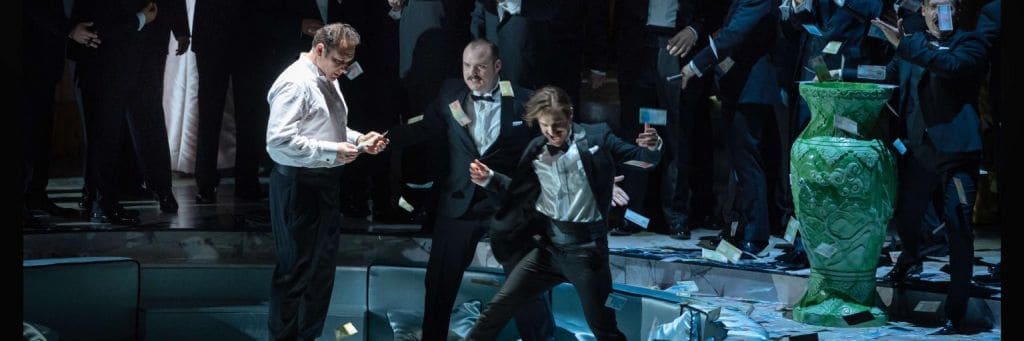
As a closing piece of stature, De Munt brought last Friday - for the first time since the seventies - Giacomo Puccini's legendary Turandot (1926). The ice princess, who sweeps away romance with a deadly hand, came to life in a production by Christophe Coppens. This under the direction of Ouri Bronchti.
The chosen path was a representation of modern matriarchy, a contemporary translation of a folk tragedy. And was it a successful choice? This reviewer certainly thinks so.
Nessun Dorma
"No one shall sleep," sings Calaf (tenor Stefano La Colla). Turandot (soprano Ewa Vesin) has until morning to guess his name, in order to retain her freedom. In the first half of the twentieth century, at the very late offshoots of romanticism, a conquered princess was still a dream image.
In De Munt's production, a choice is made for an interpretation with more distinctiveness. The emperor becomes an empress – a shadow empress à la the legendary dowager Cixi (1835-1908). She evokes in her costuming the image of a Hollywoodian Dragon Lady. The production brought a clash between glittering wealth and poor servants. It is a staging escaped from Dynasty, with a hint of Crazy Rich Asians alongside.
It is sometimes forgotten that China's past produced powerful - but sometimes cold and iron-strong - women such as Cixi and empress Wu Zetian (624-705). That princess Turandot appears from beginning to end as merciless is reinforced here with the idea of freedom and unboundedness. De Munt's legendary ice princess only breaks at the sacrificial death of a woman: the maidservant Liù (soprano Venera Gimadieva). This in contrast to her feelings towards the umpteenth longing man who fails at her riddle game.
In Puccini's story, the people become the plaything between the conquest struggle of Calaf and Turandot. De Munt brings a modern fairy tale through the addition of the conflict between rich and poor and between women's independence from men. You would almost pity Turandot, for history shows that a woman has often had to fight twice as hard for power and freedom. De Munt's Turandot is not only a frightening plot point in the story, but a tragic merciless woman of flesh and blood.
Popolo di Pekino!
[embed]https://www.youtube.com/watch?v=FGSDhrKmwbE[/embed]
I will readily say enthusiastically that this production must be seen. The way in which choir placements are played with in De Munt's staging lifts this performance far above the standard. Because make no mistake, although Nessun Dorma, Calaf's central aria – beloved worldwide and made legendary by star tenor Luciano Pavarotti (1935-2007) - was performed with feeling by La Colla during this production, Turandot remains an opera production of the people. The stars here are thus the choir singers.
This has its pros and cons. Choir pieces can quickly become monotonous. Tension can easily be lost if everyone stands on stage in the same way, but De Munt brings us the visible and invisible. They bring us sounds that arise right before our eyes and that seem to rise like spirits from a bottle hidden behind the scenes. We hear innocent children, we hear a frightened people who realize – floating on a beautiful romantic melody – that they must guess Calaf's name to survive. De Munt delivers beyond expectations the essence of Puccini's composition. Turandot was already legendary, but the standards are now set even higher.
Vesin as Turandot was a tour-de-force: a powerful and dominant sound, overwhelming and vocally clear. In contrast stood Gimadieva as Liù. She could easily have been a simple sacrifice, but here she was a sensitive contrast. Her sacrifice also brought considerable conflict to the hardened Turandot. This was the crux, and not an (unnecessary) final kiss between Calaf and the princess. Gimadieva was clear, her voice had something tragic. The perfect control between her dynamic transitions certainly had something to do with it. These two women carried, together with the choirs, this opera production.
Turandot... what a closing opera, and promising for the coming year. The opera houses within Belgium seem to be at their best. Can they surpass this? Who knows. This reviewer would certainly like to be surprised by similar quality spectacles in the future. Bravo, and until next season!


