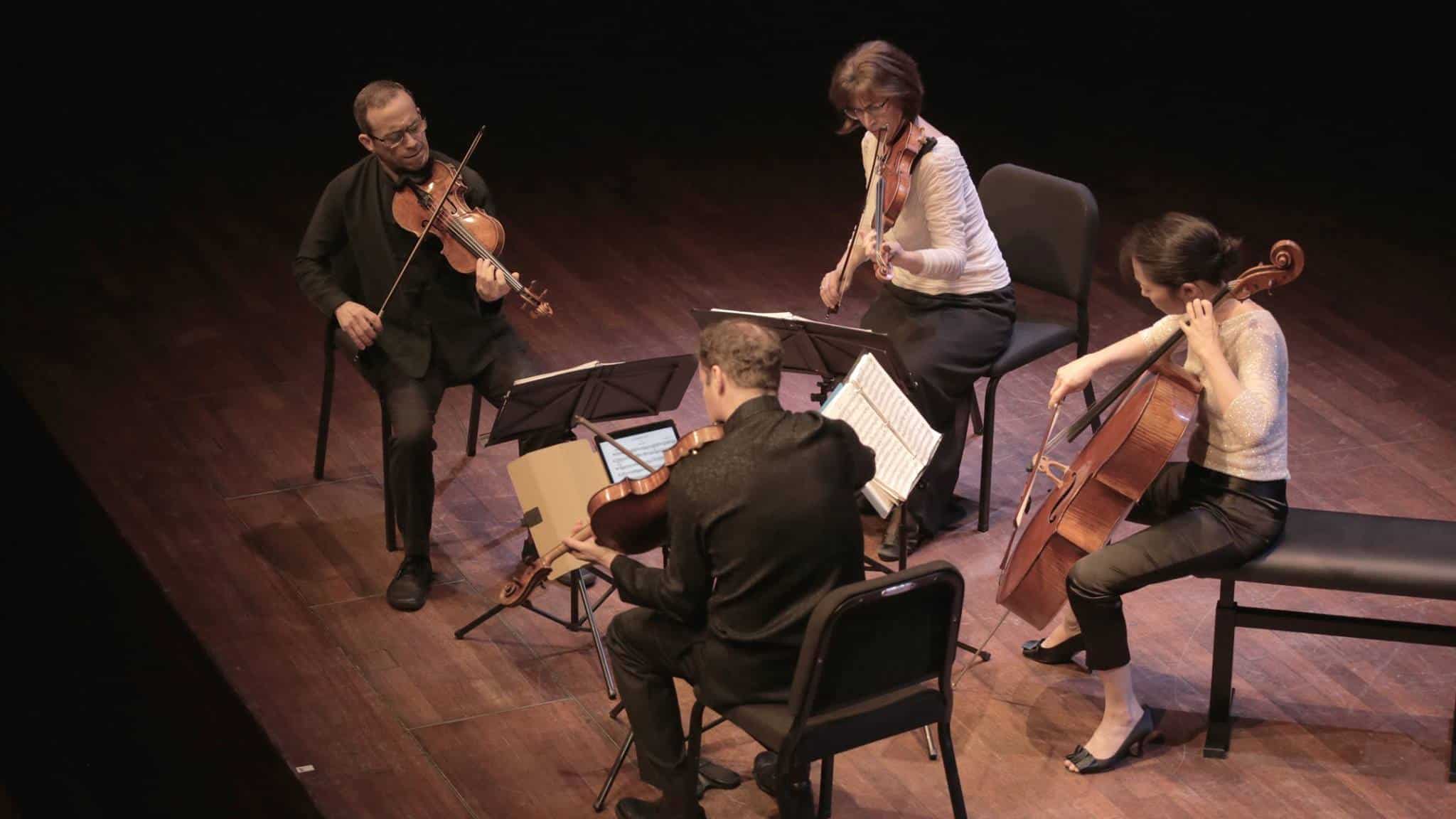
"You are free as a bird / because anything is possible." What Kris De Bruyne sang about Amsterdam, our northern neighbors put into practice with the String Quartet Biënnale. The largest festival of its kind in the world shone the spotlight for a week on the most intense and personal form of musical expression. The story of one day of delightful eavesdropping from the Muziekgebouw aan 't IJ.
It is a stunning example of Dutch audacity to set up an undertaking like this: for a week, from early morning to late evening, the string quartet was celebrated like nowhere else in the world. The very first edition of this String Quartet Biënnale brought together some twenty renowned and emerging string quartets in Amsterdam, and that for an ambitious program with more than thirty concerts, five masterclasses, a number of lectures, various world premieres, coffee talks and quite a few interesting fringe activities. These are inviting figures that capture the imagination. "Nowhere do you see and hear so many string quartets together", says artistic director Yasmin Hilberdink in the foreword to the hefty program book. "That is not only unique for us, the enthusiasts and listeners, but also for the string quartets themselves. They travel the world and rarely meet each other. […] Because it is precisely encounter, inspiration and cross-pollination that are necessary to offer new perspectives on this centuries-old genre, this forms the foundation on which the festival is built."
And there was light …
Monday morning, 29 January 2018: a Blue Monday that for once has struck gold. It is almost half past nine. In the Small Hall of the Muziekgebouw aan 't IJ, the first concert of the day is about to begin. The Dutch are early birds because the multipurpose space soon fills up. Yasmin Hilberdink is also present. We chat briefly about the creation of the festival. The Cello Biënnale, also in Amsterdam and reaching its seventh edition later this year (18-27 October), was in any case an important source of inspiration. But the main driving force is the "beauty of the craft" that will be central for a week. The programming was done in close consultation with the musicians and has – how could it be otherwise – the qualities of a good piece of music: excellent structure, plenty of variety and a brilliant climax. The thoughtful character became immediately apparent from the Early Haydn that kicked off each day. The choice of the six quartets from opus 20 was anything but random. For what music from the rich string quartet repertoire fits better with the break of dawn than the so-called 'Sun Quartets'. But there is more, as Cibrán Sierra Vazquez argues in the festival magazine. Under the title Und es ward Licht!, the second violinist of the Cuarteto Quiroga sings the praises of this extraordinary collection that "would become the symbolic lighthouse of Western instrumental music."
The Quartetto di Cremona shed its light on the first quartet from the series this morning (1772). A look at their concert archive shows that these heirs of the legendary Quartetto Italiano are a noble unknown in Belgium. And that is more than ever a shame. For the four gentlemen have been playing a unique set of instruments for some months now from none other than Antonio Stradivari. The 'Paganini Quartet', as viola player Simone Gramaglia explained during the coffee talk, unites four instruments that the Cremonese luthier built in different phases of his life, and which each belonged to the mythical violin virtuoso. Following earlier loans by the Nippon Music Foundation to world-renowned ensembles such as the Tokyo String Quartet and the Hagen Quartett, it is wonderful to see that these magnificent instruments are home again. And Haydn also benefited, as evidenced by the ardently colored Affettuoso e sostenuto. The outer movements were also handled with deliberation and attention to detail, resulting in a good balance, subtle dialogues and witty motifs. Add a cheerfully bouncing minuet in between (Allegretto) and we had just been served a tasteful musical breakfast.
The dessert was nothing less than a world premiere that Silvia Colasanti (Rome, °1975) composed especially for this Biënnale. The title of the piece – Ogni cosa ad ogni cosa ha detto addio – was taken by the Italian from a poetry collection by her late compatriot Valentino Zeichen. Fortunately, a farewell was far from the order of the day. The single-movement work was enthusiastically applauded after the performance. My sympathetic neighbor summed up the sentiment of the audience perfectly: "Well, I want to hear that again immediately." The threatening opening, with its trembling rhythm and striking harmonics, put you right on the edge of your seat. This tension contrasted sharply with the more contemplative, lyrical passages, where warmer sounds merged with thin overtones. "For this second idea I took some harmonies from Monteverdi's madrigal Darà la notte il sol. I worked with these using modern techniques, so the old material becomes audible in a different guise", testifies Colasanti on the website of Cultuurpers. Or how a contemporary view of our musical past can lead to a gripping new result. It was therefore such a pity that Colasanti could not witness this creation herself due to illness – stage fright?
"Just speak one note"
Immediately after Early Haydn the audience descended to the first foyer deck. While ships on the IJ sailed past, two altos were having coffee with Radio 4 presenter Lex Bohlmeijer to unravel the string quartet phenomenon. Together with Simone Gramaglia, they put their finger on what is so difficult about Haydn. And it never gets easier. Playing in a string quartet is often grueling, it sounds frankly. The quote from a colleague that Jonathan Brown of the Cuarteto Casals recalled in this regard speaks volumes: it takes twenty years to learn to play together, and just as many years to do that apart. But against all that hard work stands a great enrichment and immense pleasure, as becomes clear when talking about the magic of the genre. The depth you can achieve with a string quartet is unmatched, according to Brown. Sometimes you reach a point where the music plays itself and we as an ensemble simply have to follow. That's something truly unique, Gramaglia tells us. Asked about the role of the middle voices, words like movement and connection fall. And do the gentlemen know any nice jokes about the violist? After the three other group members had wished themselves a more prominent role as a great soloist or concertmaster, it was the violist's turn to make a wish … With the winged words "Bring them back!" he brings his fellow players back down to earth. Hilarity all around.
With a smile on their faces, they then headed to the Atrium Hall on the other side of the building. There a masterclass on improvisation began with the Cuarteto Casals and Italian-Canadian (jazz) cellist and composer Lucio Franco Amanti. Just before, Brown had explained the occasion for this experiment: the Spanish quartet had asked Amanti to compose a piece for their "Beethoven Illuminated Anew" cycle. The goal? To get closer to the improvisational heart of his music. Yes, you read that correctly … For Beethoven was not only the mastermind behind brilliant musical structures, but as a pianist equally the finest improviser of his time. Today classical music and improvisation have grown apart. Certainly for a string quartet it is unfamiliar and thus uncharted territory. High time then for a (re)discovery. The quintet was flanked and especially inspired by four young competition winners: first the Quatuor Akilone and the Maxwell Quartet, then the Noga Quartet and the Rolston String Quartet. Each of the ensembles handed over a musical building block, ranging from pitch to timbre and intensity to rhythm. "Just speak one note", Amanti requested, and the play began. What started hesitantly swelled into a diffuse wall of sound. An exciting learning moment for all musicians, who positioned themselves so vulnerably. But why weren't the roles reversed, with the veterans as providers? Improvisation, Amanti summed it up, "is another way to read music." How different the Cuarteto Casals would demonstrate with verve during the evening concert.
Erotic experience
In the afternoon the experiment at the String Quartet Biënnale continued. And how! Under the banner Extending String Quartet the organizers created a free space where the boundaries of the venerable genre are explored, and adventurous musicians and contemporary composers treat the audience to a solid 'earopener'. The Dutch violinist Diamanda Dramm (°1991) was given carte blanche in this way and, together with three fellow string players, put together a remarkable out of the box program in which a number of well-chosen solo pieces served as stepping stones to a performance of the string quartet by Garth Knox (°1956), the former violist of the Arditti Quartet. Dramm worked with Knox as a teacher on a series of eight etudes written especially for her, loosely based on his innovative Viola Spaces,
. It was with three of these Spaces, which mainly have a pedagogical aspect and deal with all sorts of modern violin playing techniques, that the concert began. What followed were intriguing performances with sound as a multifaceted object of study. Between a challenging stroke by violinist Sarah Saviet and Lachenmann's original Aktionspartitur Pression by cellist Marie Schmidt, violist Wenting Kang and the classically drawn beauty of Ligeti paradoxically stood out. The culmination of all these technical achievements was the three-part Satellites, the string quartet that Knox wrote for the Kronos Quartet (2015) and which this unpublished quartet gave a moving interpretation. More than the different types of pizzicato from the lively first movement (Geostationary) or the harmonic ingenuities that followed (Spectral Sunrise), the eccentric finale left an unforgettable impression (Dimensions). Or what would you say to a bow suddenly being wielded as a whip …What would Amsterdam bow maker Andreas Grütter think of this? In any case, it is a visual way to bring the bow out of the shadow of the instrument. And that is also what Grütter aims for with his film about the craft. In Hout, Zweet & Haren – a clear nod to the title of the documentary series about the Royal Concertgebouw Orchestra – the Swiss-born craftsman shows what goes into the manufacture and assembly of such an apparently simple stick. From the octagonal button to the many processes on the frog and the stick itself to the secret of the right amount of hair: every component is thought through to the last detail. And yet, according to the designer, "true beauty must be natural and self-evident." It is not the only confession in this entertaining portrait. Images of the fibers being heated to make the wood more pliable cause the temperature to rise figuratively as well. "It is almost an erotic experience to feel as the stick gives way." I leave the cinema with flushed cheeks.
We slowly move towards evening and the Muziekgebouw is buzzing more than ever with activity. As peaceful as the expansive view over the water, so animated things were meanwhile inside. Although the extensive repertoire for string quartet contains many pearls, there is no definitive list of essential, beautiful, grand or groundbreaking works that together form the canon of the genre. This observation formed the basis of Selected by, a program section in which a string quartet sets a number of works against each other and thereby adds to the canon of the Biënnale. The Brentano String Quartet was allowed to lead the way in this series. The American ensemble, less known in Europe than their compatriots from the Emerson String Quartet, but nevertheless also active for more than twenty-five years and currently quartet in residence at Yale School of Music, placed Mozart's 'Dissonance Quartet' (1785) against Brahms' first opus (1865-1873): two works with the same key, but in a completely opposite mood. Especially the canonization of Brahms was forcefully supported by the quartet with a deeply felt and insightful plea. The precisely timed elaboration of the agitated opening section was one chunk of sultry energy (Allegro). The same intensity made the turbulent finale a fiery and then downright frightening polyphonic audio play (Allegro). Between them sounded an excellently articulated Romanze (Poco adagio), while the syncopated middle voices in the ambivalent Allegretto molto moderato e comodo guaranteed a sometimes sultry intermezzo. Less exciting, but equally sound and brilliant, was the approach to Mozart. The ominously dissonant music of the future with which he begins his quartet continues to fascinate, and in itself is more than sufficient to legitimize a place in the pantheon of string quartets. But what followed was an academic reading that above all had to sound flawless and did not really get under the skin. Notable exceptions were an enthusiastic Trio and the stormy passages from the bustling final movement (Allegro). The late Robert Mann (1920-2018), former concertmaster of the Juilliard String Quartet to whom the concert was dedicated, would certainly have enjoyed hearing it.
Improvised Mediterranean square
The evening program was devoted almost entirely to Ludwig Van Beethoven. The introduction to these final two concerts once again held a remarkable surprise in store, thanks to a certain Jean-Paul Ditmarsch. As an avid collector, this man possesses a fantastic lp collection of around a thousand records featuring exclusively string quartet music. The selection of listening examples for the introduction was thus historically informed and presented performances from the 1950s and 1960s by both well-known (The Hungarian Quartet) and forgotten ensembles (Drolic Quartet). Meanwhile, the Eiris Quartet on the ground floor had already begun the opening program. The young people, students at the Amsterdam Conservatory, played with panache from Dvořák's 'American' quartet: a small treat for our already spoiled ears. And you should know that in the Great Hall the renowned Cuarteto Casals was waiting. The Spanish quartet, flagship of the prestigious Harmonia Mundi, is known for its changing seating on the first violin. Sacrilege according to some, but in fact this simply shows how well-rounded Vera Martínez and Abel Tomàs are. To celebrate their twenty years together, the quartet started an intensive Beethoven cycle earlier this season. The ripe fruits of this in-depth study were heard in extremely fascinating interpretations of first the fifth quartet from opus 18 (1800) and then the quartet nicknamed 'Harp' (1809) – not by chance two works con variazioni. It was precisely in these inventive sections that the string ensemble dreamed aloud within the boundaries of the score. Case in point? The delightfully inspired way in which the cellist in the first variation of the Andante cantabile began each time with a different flourish. And so each variation, including those from the contrasting finale of opus 74 (Allegretto), contained at times daring and imaginative phrasings, then again subtle dynamic nuances or striking accents. Also in the six other movements, the Cuarteto Casals fully lived up to its name as headliner, from the pungent interplay in the finale Allegro of opus 18 via the silky-soft conclusion of a fragile and intimate Adagio ma non troppo to the energetic Presto. But enough reading! Via this link you can simply enjoy such compelling mastery yourself.
'Beethoven on a Mediterranean square', that was the somewhat mysterious title of this evening concert. The square in question was filled with improvised sounds by Lucio Franco Amanti (Montreal, °1977). The result was ReSolUtIo, an eleven-minute work that the composer describes on the Biënnale website as follows: "A theatre lying lazily on a square in a warm summer sunset light; street musicians playing multicoloured tunes while, from an open window, we hear somebody rehearsing a Beethoven string quartet. Melodies and rhythms start to counterpoint, growing into something so captivating that the quartet can't resist joining the improvised dance of the street musicians, out in the open. Suddenly, a gentle rain starts to fall. It is time for the quartet members to run back to safety, to briefly dust off their concert clothes and go on stage to perform Beethoven's 'Harp Quartet'." The second world premiere of today began tentatively, with musicians shuffling onto the square as it were, but quickly gaining vigor and sensuality in their playing. The modern piece readily quotes from Beethoven, but thematically also strongly evokes Boccherini's Musica notturna delle strade di Madrid. And that is precisely a sound that the Cuarteto Casals knows by heart. Rest points were scarce. Playfulness and joy in playing all the more so. And some tickling of the wood to finish with. The Dutch are generous with standing ovations – it is standard practice, so I was told – but Amanti and Casals had absolutely earned this one.
Beethoven the dwarf
"In his late quartets he brought the genre to truly unsurpassed and unsurpassable heights, thanks to exceptional creative innovations and an enormous variety of styles and emotions […]." The British professor Barry Cooper, THE world authority on Beethoven's compositional processes, leaves no doubt in the program booklet: with his late string quartet oeuvre, Beethoven—the dwarf initially still indebted to Haydn and Mozart—became a giant himself. It is these five boundary-pushing magna opera and the Große Fuge that served as a lullaby during the Late Beethoven, even though sleep-inducing is precisely the last thing this music can be associated with. Extremely demanding it certainly is, as Nina Lee testifies, the cellist of the Brentano Quartet who happens to be sitting next to me in the hall. She is full of praise for the fine "vibe" that prevails at the festival – not a showcase like at the biennial in Paris earlier this month – and speaks of the camaraderie among the quartets. Beautiful words before the Ruysdael Kwartet took the big stage and the lights went out. On the music stands was opus 131 (1826). The Dutch ensemble switched adeptly between the numerous tempi and maintained the tension over seven movements, from the most profound inner contemplation to the most exuberant expressivity. Magical was the moment when the score of first violin Joris van Rijn briefly left the ground and the music – mindful of Simone Gramaglia's words – seemed to simply play itself. "Playing in a string quartet […] is comparable to climbing a mountain: having the courage, encountering difficult moments, but also experiencing victory when you reach the summit", said violist Gijs Kramers. That victory came with a particularly enthusiastic apotheosis (Allegro).
Back in the festival hotel. Jonathan Brown and the members of the Rolston String Quartet are still playing cards in the lobby. The spirit of encounter, inspiration and cross-pollination that the organizers aimed for truly hangs everywhere. Their mission on this first edition of the String Quartet Biennial Amsterdam has succeeded brilliantly. The decidedly wonderful concept brings the string quartet not only up to date, but also gives the genre a more than promising future. Or to paraphrase Amsterdam by Kris De Bruyne: "In the Muziekgebouw / there is very often celebration." And so it was on this Monday to be cherished. See you at the next festival from 25 January to 1 February 2020.
- WHAT: String Quartet Biennial Amsterdam (27 January – 3 February 2018)
- WHO: Quartetto di Cremona, Quatuor Akilone, Maxwell String Quartet, Noga Quartett, Rolston String Quartet, Diamanda Dramm, Sarah Saviet, Wenting Kang, Marie Schmidt, Brentano String Quartet, Eiris Quartet, Cuarteto Casals, Lucio Franco Amanti, Ruysdael Kwartet
- WHERE: Muziekgebouw aan 't IJ, Amsterdam
- WHEN: Monday 29 January 2018
- WEBSITE: http://www.sqba.nl/
- PHOTO CREDITS: © Klassiek Centraal, Ben Bonouvrier & Komeda Films