Referring to the richly visual character of their productions, the founders describe Laika's work as 'theatre of the senses'. Since its founding in 1991, the company has built a strong reputation at home and abroad. Theater Froefroe makes performances in a cross-over of puppets, actors, video and live music. For De Meester en Margarita the two companies joined forces.
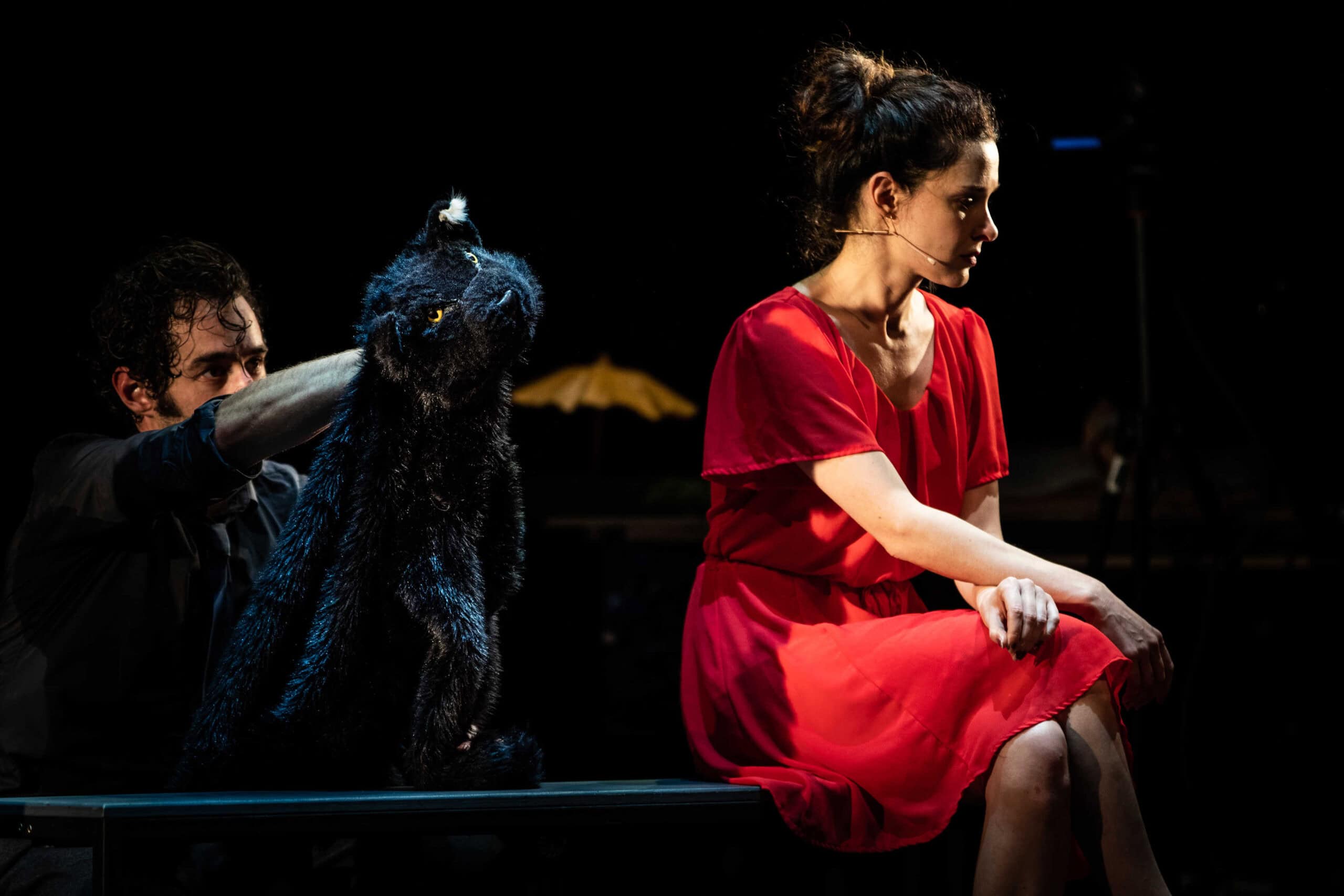
The production De Meester en Margarita is accordingly a mix of puppets, figures, maquettes, video, actors and atmospheric music. Because it seeks to merge all these elements into one consistent whole, the stage is often teeming with activity. The dynamism and fragmentation result in a certain ambivalence. The story sometimes stumbles along due to the constant switching between puppets, camera, video and acting.
The author
Mikhail Bulgakov studied medicine and for a time practised this noble profession in a village near Smolensk. But blood will out. His intelligent mind picked up on things that were not kosher. Writing and expressing impressions and ideas: with that he could serve society better. It also gave him more satisfaction. He began as a journalist and developed into a writer. His first publications appeared in 1919, followed in 1925 by a collection of stories and his first novel The White Guard. This was preceded by his first play The Days of the Turbins, of which the novel is an adaptation. In hindsight, the play probably saved Bulgakov, like so many writers of the Soviet period, from perishing in the extermination camps of dictator Stalin. Stalin was so enthusiastic about the play that he attended many performances of it. That is presumably also the reason he spared Bulgakov. But the author's path was not smooth sailing throughout. As a sharp observer he wrote satires on Soviet society and played a dangerous cat-and-mouse game. Shortly before his death he completed his great novel The Master and Margarita, on which he had worked for twelve years. In it he brilliantly interwove the tragedy of his tormented homeland with the silenced writer. The first publication of the work in Western Europe in 1966 made him world-famous overnight.
Laika and Theater Froefroe have distilled the book into a production that carries the audience into the labyrinth and dark recesses of the great ruler, and into Bulgakov's wider oeuvre. The work has lost none of its relevance. Today too, journalists who expose malpractice are removed from the way or locked behind bars. Money meant for the needy disappears without scruple into the pockets of those in power, and so on… The points of contact lie ready to hand.
What people don't want to hear
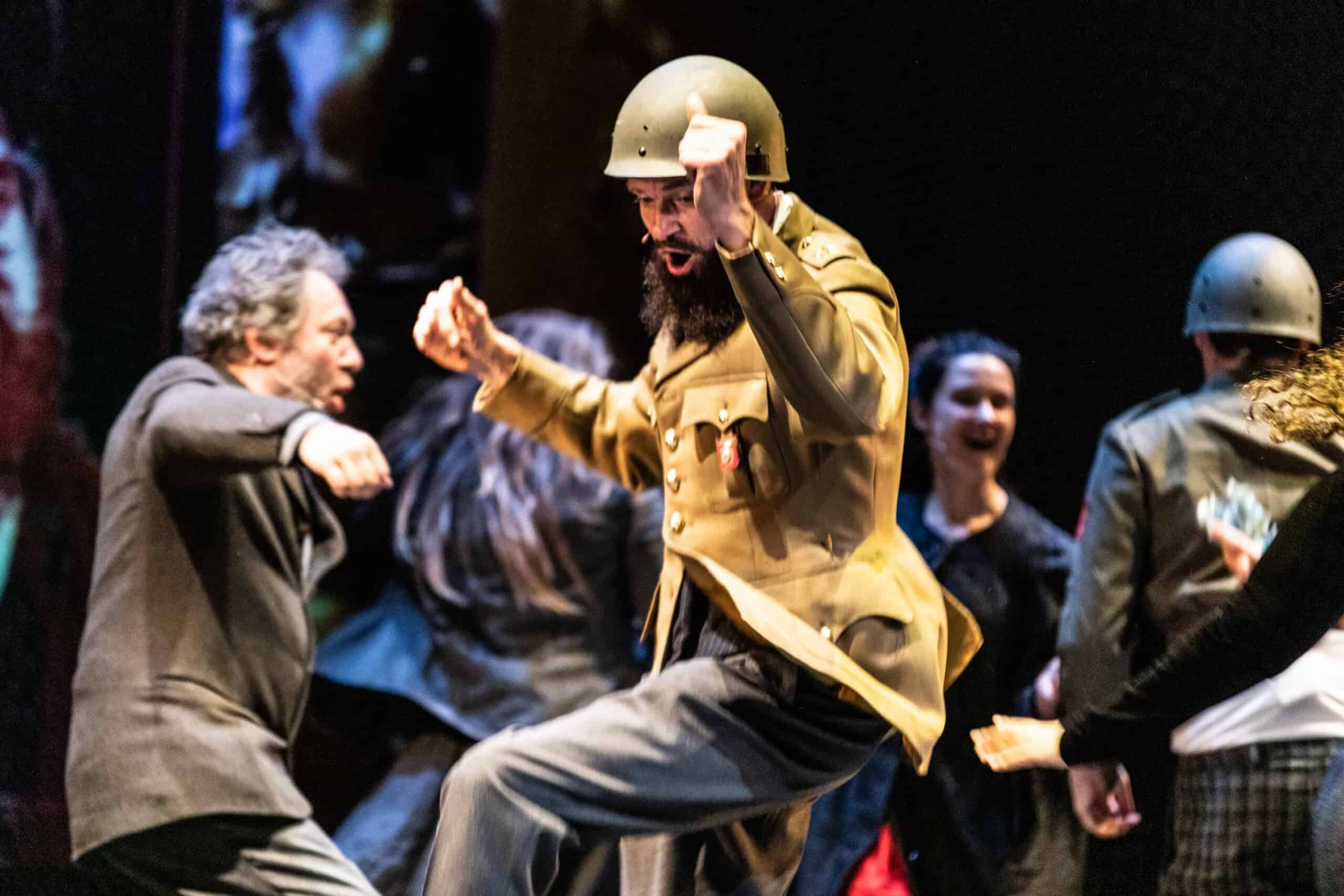
To the sonorous tones of his double bass, Bert Bernaerts opens the way for the actors. Dressed in grey, uncomfortably fitting suits, in keeping with the Eastern Bloc dictatorship, they make their entrance. Indoctrinated and manipulated people. The secret police and spies are everywhere. The story focuses on a committed writer and a dreamy poet. The poet states: "I write to please the reader." To which the writer retorts: "Stop that! You must write what people don't want to hear," not uncritical acceptance of everything. In doing so, however, he ventures into dangerous waters. He wrote a book about Pontius Pilate who had to judge whether Jesus was guilty or not of the charges levelled against him. That leans too close to the regime and is seen by the secret police as insubordination. The handheld camera zooms in on various settings with small puppets.
There is love in the play too. The writer meets Margarita. Crossing lives in the pool of existence. She has taken off her grey coat and bursts out in a red dress and boots. Love is the only glowing sentiment. There is a doubling, a Verfremdungs-effect: the characters acquire an alter ego in a puppet. Margarita is pure admiration. But they are caught like insects in a web. The secret police break in. His work is branded dangerous. He is arrested and tortured. To spare his beloved and divert all attention away from her, he has himself interned.
Clever tricks
What remains nicely intact is the music by multi-instrumentalist Bert Bernaerts: double bass, trumpet, synthesizer. The actors do not have trained operatic voices. But what they lack in high notes they compensate with clever tricks. They know how to make the most of their limitations by turning them into a gimmick.
The black magician, a life-size puppet and in this case the ruler who steers and controls everything, lacks the spark, the demonic glint. It does not quite succeed in using imagination, agility of mind and body and tremendous skill to connect seemingly contradictory elements and create order out of chaos.
De Meester en Margarita is on the whole an entertaining production that nevertheless lacks a firm directorial hand, although two people signed for the direction: Marc Maillard and Jo Roets. A sincere congratulations, finally, to actress Tanya Zabarylo, who had to step in two days before the premiere for an ill colleague, Lien De Graeve. She did so perfectly and was fully inside her role.
De Meester en Margarita is touring until 30 November. For performance dates and venues see: www.laika.be or www.froefroe.be.
- WHAT: The Master and Margarita, after the eponymous novel by Mikhail Bulgakov
- WHO: Benny Ceupens, Tanya Zabarylo, Dries De Win, Gert Jochems, Adina Macpherson, Filip Peeters and Annelore Stubbe
- WHERE: Arenbergschouwburg, Antwerp
- WHEN: Friday 20 October 2018 (premiere)
- PRODUCTION: Laika and Theater Froefroe
- MUSIC: Bert Bernaerts
- CHOREOGRAPHY: Iris Bouche
- PHOTOS: © Kathleen Michiels