

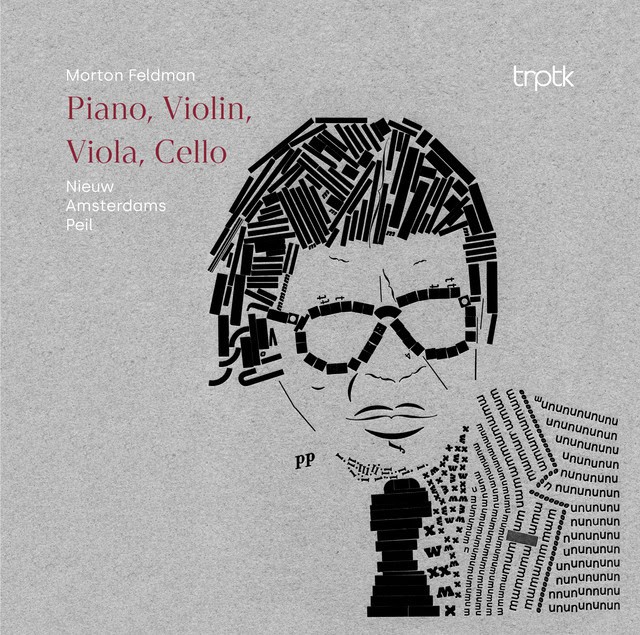
Morton Feldman's Piano, Violin, Viola, Cello (the austere title of this piano quartet, also his final work) was heard last year on 17 September at the Muziekgebouw in Amsterdam and on 3 November at the Lutherse Kerk in Groningen, performed by the ensemble Nieuw Amsterdams Peil (the name is a find in itself for multiple reasons, if one thinks about it for a moment). The (live) recording released by TRPTK was made in Groningen, but an editor (Hans Erblich) was involved, which means I actually assume a priori that some (post) editing took place (of which nothing is noticeable anyway). It's possible that a recording was also made in Amsterdam on 17 September, in order to correct any potential 'mishaps' afterwards. However, it doesn't matter much to the listener, because ultimately only the (audible) result counts.
Feldman dedicated the Piano Quartet to Ad van 't Veer, programmer of the MMF, the Mostly Modern Festival that takes place annually in Middelburg in Zeeland and over which Robert Paterson holds artistic sway. Composers from all over the world are given the opportunity in Zeeland to have their latest creations heard. We already knew this progressively designed concept from the famous festival in Donaueschingen, entirely devoted to new(est) music.
Feldman was a regular guest at the MMF (including from 1985 to 1987 with well-attended masterclasses), as can also be seen in the one-and-a-half hour film Een meteoriet op Walcheren, whose title is derived from a description by Dutch composer Daan Manneke, when the festival took shape towards the end of the 1960s. And what no one expected then happened: the MMF quickly grew into an international reputation, an important 'stopover' that managed to bind many composers, including the most influential, to itself. Countless world premieres were heard, with improvised jazz also given ample room to assert itself.
Feldman's Piano Quartet had its premiere on 4 July 1987, thus both shortly after its completion (28 May) and shortly before his death (3 September, in his home town Buffalo, New York, at age 61), in Middelburg during the eleventh MMF, in the presence of Feldman, who was undergoing chemotherapy. Unlike the 1983 Second String Quartet, which lasted a full six hours, and the Crippled Symmetry completed that same year, lasting five hours, for bass flute, percussion (glockenspiel, vibraphone) and piano (celesta), it will not have taken a toll on spirit or bottom, although the extremely slowly progressing, half-note setting and roughly eighty-minute-long Piano, Violin, Viola, Cello asks the listener to stay focused. Typically Feldman, then.
 At the end of May, Feldman was still completely unaware of his imminent end. However, during the standard treatment that followed shortly thereafter for a stomach ulcer, it came to light that the composer suffered from an aggressive form of pancreatic cancer. But this did not prevent him from shortly afterwards – this time for the fifth time – making the journey to Middelburg. There he mingled, lively as always and as usual in public discussions with colleagues (some of which can be found on YouTube). Such as – in the words of musicologist Elmer Schönberger – the 'labyrinthine improvisations, the infinitely branching thoughts about music, art, history, humanity and the world'. Those who want to better understand his music cannot do better than turn to his documented monologues.
Some remarks by Feldman picked from the CD booklet: '…something that is beautiful is made in isolation'. 'I'm very into acoustical reality. For me there is no such thing as compositional reality.' 'I think the piece dies a natural death. It dies of old age.' 'Beyond an hour length becomes scale.' 'For me at least sound was the hero, and it still is.' The last remark more in connection with 'Let sounds be themselves' by John Cage, Feldman's 'hero' in the 1950s (the Projections composed by Feldman at that time is strongly influenced by Cage's music).
Nieuw Amsterdams Peil is one of the few Dutch ensembles that has chosen innovation. Founded in 2005, the focus lies with modern and contemporary music in the most
[caption id="attachment_42746" align="alignright" width="300"]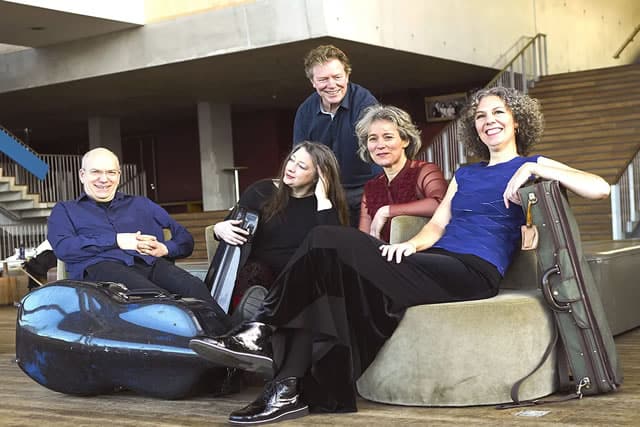 nieuw amsterdams peil[/caption]
diverse genres and styles. This also includes – it sounds self-evident – collaboration with composers, which gives the performances a certain authority from that perspective alone. Furthermore, Nieuw Amsterdams Peil has distinguished itself through educational projects including workshops and involving the audience in the music-making.
No wonder then that with Nieuw Amsterdams Peil on stage, a performance of Feldman's Piano Quartet has come about that continuously shines and from which – one thing flows from the other – the great affinity with this such unique oeuvre becomes apparent. The enchantment so essential in this music flows from the captivating engagement in which evocation and expression continuously lend each other a hand. This is without any doubt one of the best performances of Feldman's Piano, Violin, Viola, Cello, and it should be added that the recording made by Brendon Heinst and Antal van Nie may be called exemplary.
There is no better way to gain a good understanding of Feldman's Piano Quartet than to follow both the music and the score. That can be done on , in a performance by the Quartetto Klimt.