

In the intimate context of the Werner-Otto-Saal at Konzerthaus Berlin, the so-called Espresso concerts unfold a formula that derives its effectiveness precisely from limitation: no evening solemnity, no elaborate dramaturgy, but a concentrated listening experience in the middle of the day. Music as condensed time, as a moment of heightened attention. As the name suggests: musical "shots" – compact and direct.
On 15 April there hung a specific afternoon tension in the sold-out hall, where a mixture of chance visitors, regular attendees and curious listeners came together.
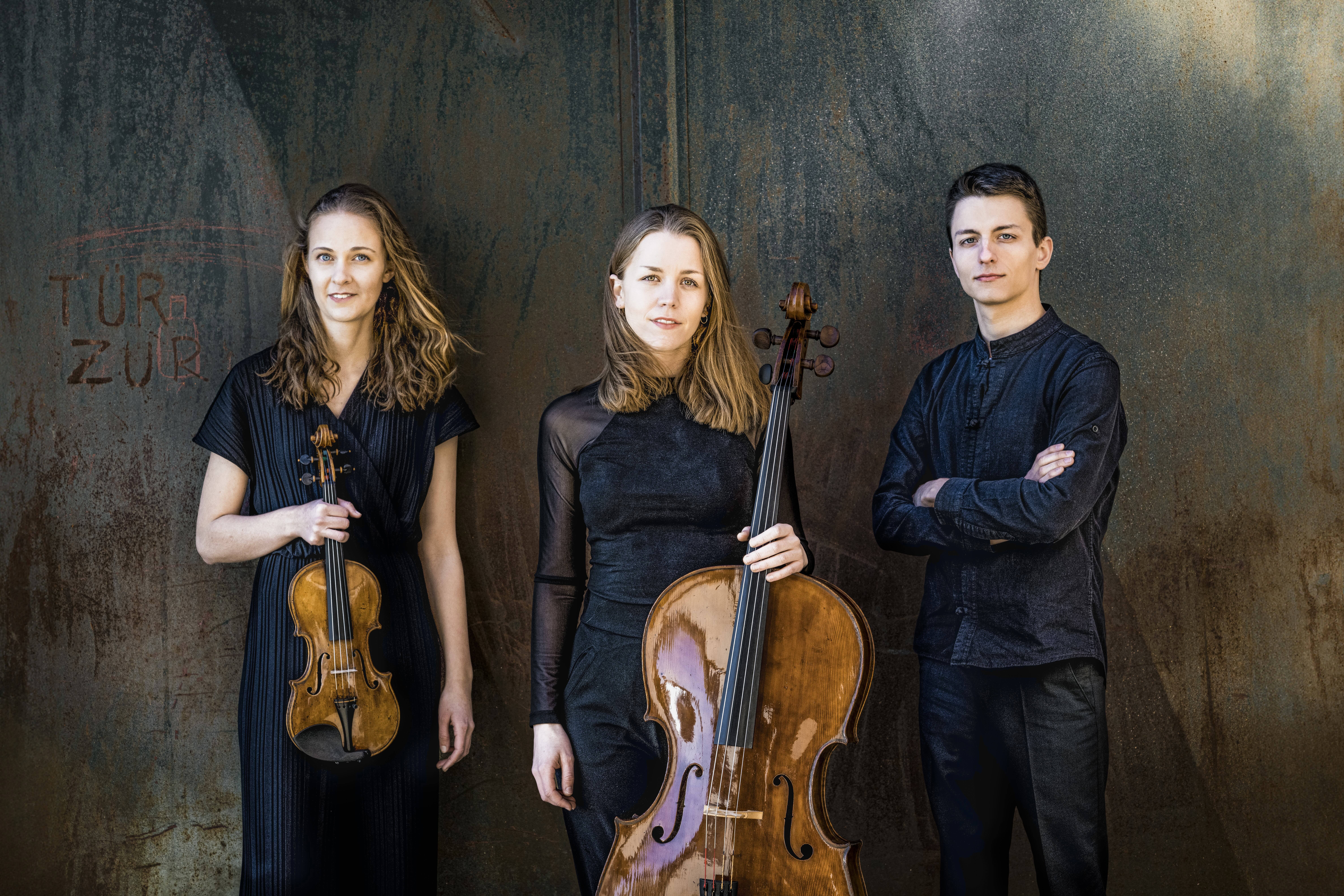
The Amelio Trio – with Johanna Schubert (violin), Merle Geissler (cello) and Philipp Kirchner (piano) – played with striking clarity of intention. Not a fusion into one homogeneous sound, but three voices that continually measure their mutual distance with precision. That precision made their playing transparent without reducing it to smoothness. Moreover, you noticed how naturally their collaboration had grown: a simple glance sufficed to coordinate entries and phrasings. That years of playing together is no detail, but became audible as an almost organic unity.
The opening with TSIAJ (This Scherzo Is A Joke) by Charles Ives (1874-1954) was not approached as an effect piece, but as constructed irony. The many references to student songs and folk-like melodies sounded like playful persiflage, brought with joie de vivre. Precisely because of this, the desire lingers to hear this piano trio in its entirety: not as fragmentary play, but as continuous musical logic.
After the apparent flood of melodies, Kirchner provided commentary on the programme in a crystal-clear manner, which subsequently sharpened the listening even more.
This was followed by the Allegretto in B-flat, WoO 39 by Ludwig van Beethoven (1770-1827). A rarely heard work, which here acquired unexpected charm and lightness. The trio played it with an almost affectionate precision: restrained, but never colourless. The lines of violin and cello remained open and easy to follow, while the piano laid a clear foundation without dominating the balance. Beethoven appeared here not as a monument, but as a careful, intimate thought.
The centrepiece was "vertrautes angezogensein" by Birke Bertelsmeier (°1981), a work from 2024 written explicitly for this ensemble as a hinge moment after Beethoven's work. The music moves in a fragile balance of proximity and restraint, where each development is more a shift than a direction. A subtle theatrical touch – with an obligatory wine glass – underscores the vulnerable character, without resorting to effect-seeking. The Amelio Trio's interpretation was remarkably sober: no interpretive excess, but precise attention to micro-tension. The surprising ending left everything in a state of provisionality, as if the music was not yet ready to settle itself.
This was followed by the Piano Trio in C minor, op. 1 no. 3 by Beethoven – the work he himself regarded as his opus 1 and which here came fully into its own as an early, but already exceptionally self-assured composition. Everything you associate with Beethoven is contained within it: dramatic energy, formal awareness and contrasting work. The trio played it with striking equality between the voices, so that no single instrument elevated itself above the others. It was precisely this symbiosis that made the performance particularly convincing: a constantly shifting balance in which every detail gained meaning without becoming heavy.
What made the Amelio Trio's performance this afternoon so convincing was the consistency of their approach: no stylistic switch per work, but the same clarity of listening that materialized differently each time. Ives, Beethoven and Bertelsmeier remained clearly distinguished, but were approached from the same concentration.
And it was precisely in this that this Espresso concert became more than a format. It was not a programme in the classical sense, but a delimited space of time in which listening itself was sharpened. The espresso thus remained not only metaphor in name, but also in experience: brief in duration, but with an effect that unfolded fully only afterwards.
But above all, the image lingers of three musicians who have sensed each other blindly for years. That collaboration – so natural and precise – above all makes clear how much there is still to discover here.