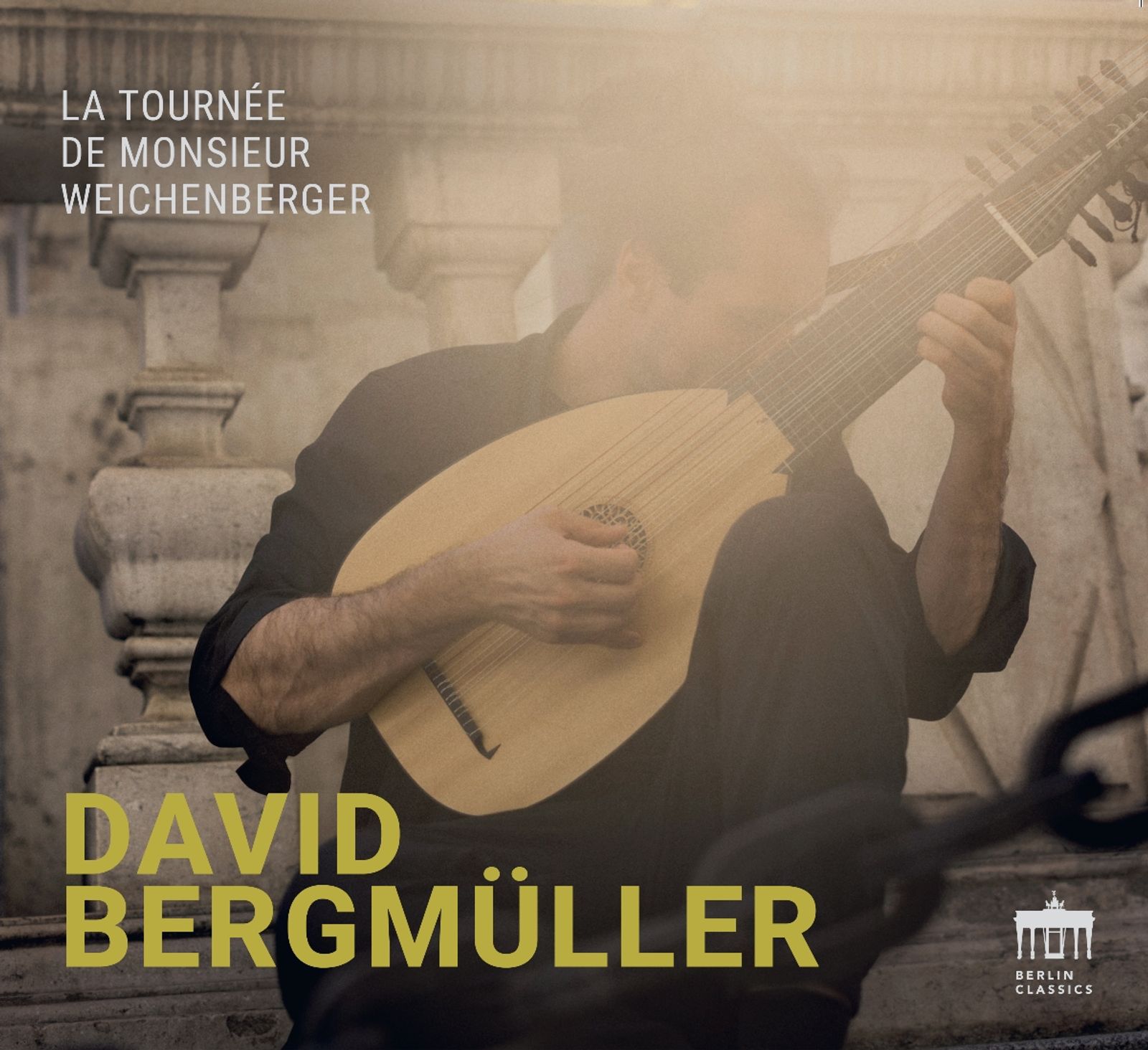
Little is known about Johann Georg Weichenberger (1676–?). He was born in December 1676 as the son of a merchant from Graz and worked as an official in the imperial court accounts in Vienna, the only place we can associate with his life. He was not a professional musician, but he was known as an exceptional lute player. Portraits, letters and anecdotes are lacking. What remains is his music, preserved in lute manuscripts from the Austrian-Bohemian region.
For this album, David Bergmüller brings together 28 compositions from three manuscripts: that of Brno, a manuscript from Poděbrady and a manuscript from Kraków. They are grouped into three cycles: the Partita en re mineur, the Galanderei and the Partie de M. Weichenberg. It concerns repertoire that is rarely heard on CD and in which different stylistic influences exist side by side.
That difference is immediately audible between the manuscripts. In his commentary, Bergmüller points to the Galanterie from Poděbrady (on this CD the Galanderei), which is already written in a light, melodic galant tone. The Partie en la mineur from Kraków (here the Partie de M. Weichenberg) and the Partita in d from Brno (the Partita en re mineur) sound noticeably older. They stand closer to the Habsburg lute tradition, with echoes of Logy and the French masters.
One can hear this as the development of a long life, but it could also be different: perhaps the galant pieces were by a younger namesake, for example a son or pupil, whose work was later transmitted under the same name. Bergmüller deliberately leaves this question open, and with the available material no conclusive answer can be given.
Three musical worlds
The Partita en re mineur opens with a richly varied Prélude. Bergmüller takes the time to bring the motifs forward and gives the piece a contemplative character. The Courante is lyrical and slightly melancholic, but retains a lively movement. The Gavotte sounds more urgent, the Menuette & Trio refined and light-footed. In the Sarabande the music slows and room opens up for reflection. The penultimate minuet is more elaborately developed. In the closing Chaccone Bergmüller gradually builds the tension. The melody keeps singing, with a wistful undertone that fits well with the subtitle of the piece, Bis ich nicht tot bin, werde ich spielen. It is a convincing conclusion to the first cycle.
The Galanderei forms a clear contrast. In the Arioso an almost folk-like lightness shines through, with a touch of Viennese charm. Bergmüller plays this passage with natural suppleness. In the dances that follow, the rests and small interruptions play a major role: they briefly take the movement out of its regularity and make the music playful and lightly wilful. The following minuet also benefits from these small delays. The Allegro brings a more cheerful moment in which the pleasure of playing is palpable, without the refinement being lost. In Le Maricha the sound becomes darker and somewhat more threatening, while the melodic line keeps singing. The closing minuet, Pasorella, surprises with a sound that for a moment recalls a harp glissando.
The third cycle, the Partie de M. Weichenberg, asks for a different kind of listening. The Ouverture is serious and contemplative. In the Allemande Bergmüller holds the tension, mainly through the slowing and stilling at the end. The highlight is the Sarabande, one of the most beautiful moments of the album. Bergmüller chooses a restrained approach and lets every note ring out. Through carefully chosen rests, the changing tone colours of the lute come fully into their own and the piece gains depth. Afterwards the Bourrée brings more movement and playful joy, and the minuet convinces with its penetrating character. The extended Echo, the longest piece in this cycle, leads to the closing Gigue, which lively concludes the programme.
A personal approach to the Baroque
Bergmüller does not wish to reconstruct the past meticulously, but to understand the intention behind the music and translate it to the present. This is best heard in the opening prelude of the Partita en re mineur, which, without a fixed metre, sounds like spoken language: the phrases unfold like a story and short motifs fall like loose words, while the broad line remains intact.
This personal perspective is also visible in the titles. Weichenberger himself gave nicknames to some pieces, such as Le Maricha, Schmids Echo and Pasorella, and the album title La Tournée also goes back to him. Bergmüller adds his own Viennese subtitles, such as Springinkerl, Zuckergoscherl, Holzpyjama and Heast Oida. They bring the music into the Vienna of today and are not a programme, but an invitation to listen with different ears.
Close to the instrument
Bergmüller plays various Baroque lutes, each with its own tone colour. He plays the galant Galanderei on the largest and lowest-tuned lute, which resonates most. The smallest lute has a remarkable provenance: maker Karl Kirchmeyr made it from the soundboard of a nineteenth-century Bösendorfer grand piano, with eighteenth-century wood. In this way the wood sounds a second time, after a full piano life.
The recording also contributes greatly to the listening experience. Bergmüller deliberately chose a close perspective, nearer to the lutenist than to the concert audience. You hear the breathing, the moving fingers and the sympathetic vibration of other strings, and these are intended parts of the sound world, not disturbances.
The result is intimate, although not everyone will take to it immediately: those who prefer a broader concert sound may need a little time to get used to it. Personally, I find the direct sound an asset, because it allows the subtle nuances of the instrument to come through so clearly. Bergmüller himself handled the recording and editing in Vienna in April 2026; Martyn Heyne was responsible for the mix and mastering.
A repertoire that arouses curiosity
After several listens, what stays with me above all is the alternation between lightness and stillness. With La Tournée de Monsieur Weichenberger, Bergmüller shows how rich and versatile this little-known repertoire is. His attentive playing, with a feeling for rhetorical structure and the dance character of the music, and the varied tone colours of the lutes make the album a fascinating discovery.