

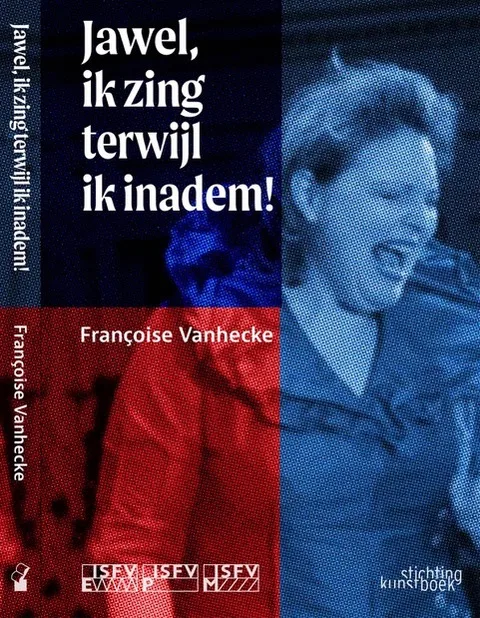
Françoise Vanhecke is an artist who cannot easily be confined within the boundaries of a single discipline. Her work moves between singing, composition, improvisation, theatre and artistic research. That versatility also forms the breeding ground for Inhaling Singing, the technique at the heart of this book.
The title immediately arouses curiosity. Singing while inhaling? It runs counter to what we take for granted. With Vanhecke, however, it is neither a curiosity nor a matter of showmanship, but the result of years of research into the possibilities of voice and breath. The sound and video fragments that accompany the book are therefore important. They make audible what can hardly be adequately described on paper. The sometimes unsettling sounds prove to be part of a much broader search for tone colour, physicality and musical expression.
Singing against the natural direction
In traditional singing, air flows from the lungs past the vocal folds and outward. Vanhecke explores what happens when this process is reversed and sound is formed during inhalation. The result is a striking palette of sounds. At times the voice sounds fragile and almost weightless, elsewhere raw, sharp or nearly instrumental. These sonic possibilities lend themselves exceptionally well to contemporary composition and music theatre.
Vanhecke does not present Inhaling Singing as a spectacular vocal trick. An important part of her research concerns precisely the physical consequences of this way of singing. In collaboration with medical and scientific specialists, she investigated what happens in the body while singing. Among other methods, MRI research and videostroboscopy were used. This scientific component gives the book additional weight. Artistic curiosity is linked to the question of what is technically and physically responsible to achieve.
From experiment to musical instrument
Vanhecke is not only a singer but also a pianist, composer, actress, improviser and pedagogue. These different disciplines constantly overlap in her research. Perhaps this is precisely why Inhaling Singing could come into being. Those who remain within the usual vocal tradition generally seek to refine existing techniques. Here a more fundamental question is asked: what happens when one of the basic principles of singing is reversed?
In this way her research connects well with developments in contemporary music. The human voice has long since no longer been required to sound exclusively according to traditional ideals of beauty. Whispering, speaking, shouting, breath sounds and other extended vocal techniques now belong to the vocabulary of composers and performers. Inhaling Singing adds a distinctly personal possibility to that.
A book that wants to be heard
Writing about an unusual singing technique inevitably has its limitations. Words such as fragile, sharp, raw or otherworldly give an impression, but never tell exactly how something sounds. That is why the QR codes linking to sound fragments and performances are one of the strong points of this publication.
They also change the way the book can be read. Reading, listening, leafing back and then listening again works better for this subject than reading the book from front to back in one go. This makes Jawel, ik zing terwijl ik inadem almost a hybrid publication: book and listening experience constantly complement each other.
When a technique becomes music
The most interesting question is ultimately not whether someone can sing while inhaling. The examples make it sufficiently clear that this is possible. Far more important is what a composer or performer can then do with that possibility. It is precisely there that Inhaling Singing shifts from experiment to music.
In works by, among others, Moniek Darge, Sebastian Bradt and Annette Vande Gorne, the technique takes on various functions. In Question Marks improvisation plays an important role. Triticus Arscotiensis shows how the breathing technique can function within a compositional structure, while in Déluges et autres péripéties the boundaries between voice, language and acousmatic sound blur.
This distinction is important. A new playing or singing technique has no artistic meaning in itself. That arises when the sound acquires a function within a composition or performance. The examples in the book make clear that Inhaling Singing has by now gone far beyond merely demonstrating an unusual vocal possibility.
The voice in a digital world
There is moreover an interesting contradiction in Vanhecke's research. We live in a time when virtually every conceivable sound can be digitally produced, manipulated and endlessly repeated identically. The human voice does precisely the opposite. It remains dependent on breath, muscles, tension, fatigue, acoustics and the moment at which a sound arises. With Inhaling Singing that physicality becomes even more audibly present.
This does not mean that electronic and human sound are each other's opponents. Within contemporary music they can coexist and work together extremely well. Vanhecke's research serves above all as a reminder that the human body has by no means yet surrendered all of its musical possibilities.
Not a course in a vocal trick
Anyone who expects to be able to start working with Inhaling Singing immediately after reading it has not quite chosen the right book. Jawel, ik zing terwijl ik inadem is not a straightforward practical manual. It documents above all an artistic discovery and the long road from experiment to research and application.
That said, the book is not exclusively interesting for singers. Composers, music students, teachers and lovers of contemporary music also gain insight into the way a new vocal technique can emerge and continue to develop. The combination of text, research and listening examples is essential here. Without the recordings, a large part of the subject would necessarily remain abstract.
Curiosity as a starting point
Ultimately, Jawel, ik zing terwijl ik inadem is about more than singing while breathing in. It is also about curiosity. One of the most interesting qualities of experimental music is that an apparently wrong or impossible action can become the beginning of something new. Rather than immediately rejecting what falls outside existing technique, one investigates which musical possibilities are hidden within it.
Vanhecke has pursued that idea remarkably far. A reversal of something as self-evident as breathing grew into years of artistic and scientific research and eventually into a technique with which other composers and artists can also work. That makes Jawel, ik zing terwijl ik inadem a fascinating book about the human voice, but equally about the way musical renewal can arise. And with this book, more than with most other music publications, the advice holds: don't just read it.
Listen.