


The 2021/2022 season at the Belgian label Cypres was marked by their 30th anniversary. Cypres celebrated this pearl jubilee at the same time as 150 years of Adolphe Biarent (1871-1916). This was a good opportunity to record his Huit mélodies for mezzo-soprano for the first time with Clotilde Van Dieren (mezzo) and Katsura Mizumoto (piano). The cd La chanson du vent tells the story of a sensitive subject - orientalism in Belgium and France.
Western fascination with "the Other"
From the Renaissance onwards, Europe has known a fascination with the cultural dimension of the East. The earliest examples even date back to the Middle Ages. By distinguishing itself from the East ("the Other"), the European continent developed its own identity. The way the West viewed the East knew different rages and trends. In this so-called orientalism, the East is considered subordinate to the West. According to the European approach, the East is, among other things, irrational and sensual, in contrast to the Europeans who consider themselves rational and strong.
The orientalist attitude is not the outcome of scientific research but rather an ideological worldview from Eurocentrism. The idea knew extreme popularity during 19th-century Romanticism and the fin-de-siècle, not coincidentally also the time when many countries had colonies. The mystical, sensual and magical Orient became a beloved topos in the visual arts, in literature as well as in music.
Musical orientalism
The central work on the cd is Huit mélodies by Belgian composer Adolphe Biarent (1871-1916). The title of the last song from this cycle gives the cd its name. The poem Lied by the symbolic poet Pierre Quillard opens the cycle. This text was set to music by several composers. The Greek Emilios Riadis (1880-1935), the Frenchman August Chapuis (1858-1933) and the Swiss Gustave Doret (1866-1943) each composed their own version. However, Biarent's arrangement is the most remarkable and stands out due to the quality of the music.
The accompaniment of "I. Lied" [track 1] already reflects the meaning of the first sentence of the poem - "Quand sur l'eau changeante". The song begins with a word painting. Broken chords sound out the water play before the sentence is sung. The water motif disappears during the first stanza but makes its entrance again in the third stanza when the sentence "Comme l'eau changeante" rings out. The poem and the music thus acquire a cyclical character.
The song collection itself contains the same cyclicity. Also in "VIII. La chanson du vent" [track 8] with text by Jean Lahor, broken chords again serve as a musical rendering of water play. Here they depict the waves of the ocean.
The stormy character of this song is expressed in different vocal registers and styles. The first stanza has a carefree and cheerful melody in the high register of the voice. The second stanza contrasts by means of a recitative. The register of this section is lower and has a dark character. The beginning of the third stanza resumes the cheerful opening melody and continues upward. But in the second part of this stanza, the melody makes a leap to the lower registers. This combined with extra dissonance completely changes the mood of the song. The turbulent undertone for the last stanza is set and the vocal line goes back up again. This time not in a cheerful mood but in hysteria. Clotilde Van Dieren emphasizes this feverish passage with her refined timbre and text placement.
The oriental aspect of Biarent's song collection is the most subtle of all songs on this cd. His style, like the poems, is suggestive. The text has a sensual undertone and the music plays with dissonance and minor-major ambiguity.
As a contrast, the song cycle is followed by a less subtle example of orientalism. La Captive (Orientale), Op. 12 (1831) by Hector Berlioz (1803-1869) refers both explicitly to the oriental by name as well as the process of subjugation that according to literary scholar Edward Said was characteristic of orientalism. Swaying rhythm and romantic harmonies create an idealistic dream image. Said's description "the East becomes a living tableau of queerness" is perfectly applicable here. As a listener, you are a spectator who observes the scene from a distance via a dreamy, repeating melody.
The chosen song by Georges Bizet (1838-1875) takes the oriental character a step further. In Adieu de l'hôtesse arabe [track 12], the composer integrates ideas from Félicien David (1810-1876) and Francisco Salvador-Daniel (1831-1871) [track 10]. David and Salvador-Daniel were pioneers in devising an oriental modal music system so that the Orient no longer needed to build on "traditional, Western harmony". This "authentic" system of modality found resonance with Bizet. Vocal embellishments and the melisma at the end also contribute to this oriental character.
The cd closes with La Caravane, Op. 14 [track 16] by Ernest Chausson (1855-1899). In this song, unusual sound colors and whole-tone scales are used to add extra drama to the meaning of the text. It thus shows once again another way in which orientalism can be expressed in sound.
The program of this cd is adequately compiled. It is clear that careful thought has been given to which songs to integrate and in what order. This indicates extensive research into the repertoire and subject matter. Remarkable is the content of the accompanying booklet. The first section about Adolphe Biarent is well-argued and substantiated. The second section on orientalism lacks depth and context. There is a lack of critical engagement with the subject. The European practice of making something "oriental", Western dominance over the Other, and the fusion with motifs of colonization are not mentioned at all. Clearly a missed opportunity to address this.
That said, the performance of this program is commendable. Clotilde Van Dieren manages to balance her timbres evenly in both her high and low registers. Depending on the content of the text, she sounds now bright, now dark. The sometimes rapid changes in performance testify to Van Dieren's vocal control. The piano part certainly should not fall behind either. The accompaniment comes to the fore at appropriate moments, and Katsura Mizumoto also interprets the virtuosic passages with sensitivity. This forgotten repertoire is worth discovering.
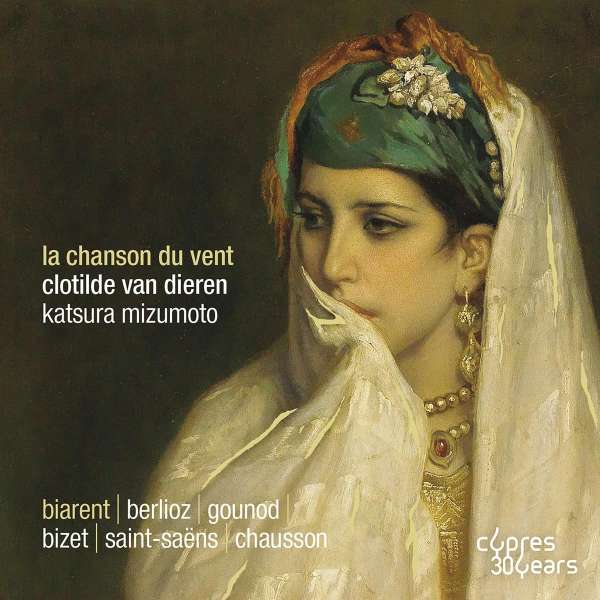 4/5
4/5
- WHO: Clotilde Van Dieren [mezzo], Katsura Mizumoto [piano]
- WHAT: La chanson du vent
- LABEL: Cypres CYP8614
- ORDER: JPC