

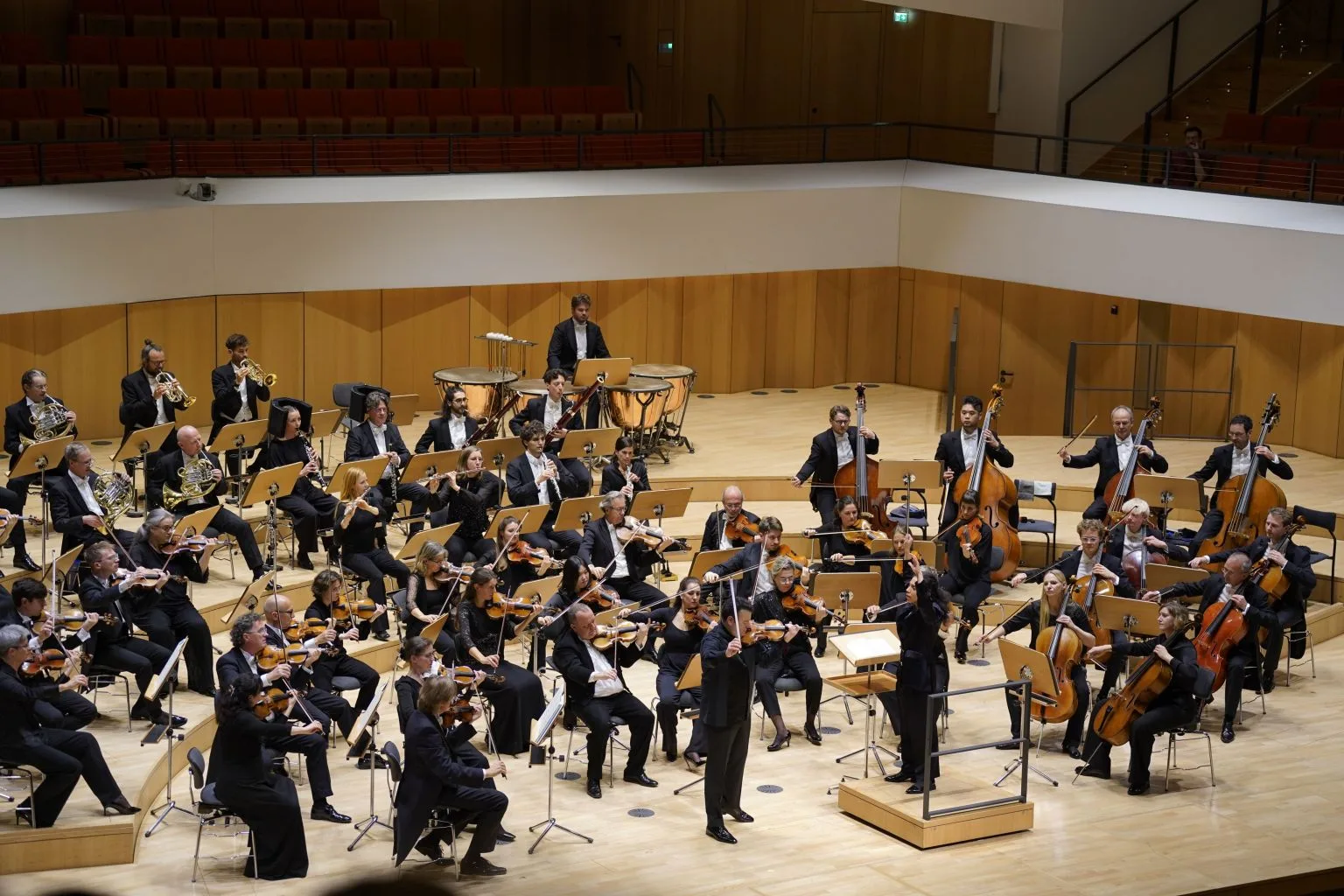
What a day! In the morning I attended the opening of the Mendelssohn-Festtage in Leipzig, with the presentation of the Internationaler Mendelssohn-Preis to former German Chancellor Angela Merkel and composer, clarinettist and conductor Jörg Widmann. In the evening, Dresden placed the music of another member of the Mendelssohn family at the centre: Das Jahr, the piano cycle by Fanny Hensel (1805-1847), in the orchestration by Detlev Glanert. In this way the musical legacy of Felix Mendelssohn and his sister, whose significance as a composer long remained underexposed, received attention in two cities on a single day. Alongside Hensel's work, Brahms' violin concerto was on the programme, with Vadim Gluzman as soloist and Bar Avni conducting the Dresdner Philharmonie.
A composer rediscovered
Fanny Hensel possessed an exceptional musical talent, but the social conventions of her time limited her opportunities to step forward as a composer. Her brother Felix (1809-1847) built up an international career, while her own music received far less recognition. In 1841 she composed Das Jahr, a cycle of twelve character pieces for piano, in which each month receives its own musical character. At the same time, the pieces together form a carefully constructed unity.
In an interview for Klassiek Centraal, Detlev Glanert told me how he initially approached the cycle with some reservation. He associated the music with salon music, but changed his mind when he studied it thoroughly. He discovered a distinct musical voice, an adventurous harmonic imagination and a strong sense of form. The scale and coherence of the whole particularly impressed him. Moreover, Hensel herself had already considered orchestral possibilities in certain places.
An orchestration from within
In his arrangement, Glanert did not want to position himself as a second composer alongside Hensel, but wished to stay as close as possible to her musical intentions. In our conversation he emphasised how important it was for him to respect her indications and internal connections. Recurring motifs and transitions after all contribute to the cyclical coherence. The grouping of the months into three series also played a role. His experience with the orchestra and his sense of dramaturgy helped him bind the individual character pieces into one whole.
This is clearly audible in the performance: the orchestration is refined and carefully considered. Glanert knows which instruments complement one another, how tone colours relate to each other and how a climax can be built without losing sight of the musical line. Everything serves Hensel's idiom. The orchestration does not detract from the original, but makes aspects audible that play a less prominent role in the piano version.
The Dresdner Philharmonie, under Bar Avni, allowed the music's many colours and moods to come fully into their own. The opening, with the warm, somewhat dark sound of the low strings, immediately created its own atmosphere. A rich palette then unfolded, with fine solo contributions from woodwinds and brass and a wide range of tonal nuances in the strings. The harp also received a remarkable role. Its delicate contributions were far from merely decorative, but were ingeniously woven into the orchestral fabric, sometimes in dialogue with the cello or woodwinds. In the more chamber-like passages, the individual orchestral musicians came nicely to the fore. Avni, moreover, maintained transparency well, even when the music gathered strength.
A few moments stayed with me in particular. The hunting horn passage in October was truly phenomenal: the horns played the passage flawlessly, but it was above all their sound that made an impression, more so than the technical mastery. In December, the chorale Vom Himmel hoch received a rich orchestral treatment. The tension was gradually built up to an impressive climax, after which the postlude with the chorale Das alte Jahr vergangen ist provided a deeply felt conclusion. The reference to Bach is meaningful, especially in light of the musical tradition of the Mendelssohn family.
Listening to this orchestration, the comparison with Ravel's arrangement of Mussorgsky's Pictures at an Exhibition briefly imposed itself. Yet in the end it does not entirely hold. Glanert does not strive for a spectacular new sound world that pushes the original piano version into the background. His approach is more subtle: he makes audible what is already present in Hensel's music and at the same time offers a fresh perspective on the composition. It is therefore much more than an orchestral garment: Glanert reveals the versatility of her musical language.
A small reservation concerns the presentation. Since Das Jahr, and certainly this orchestral version, will be unknown to many listeners, surtitles with the names of the months could have helped the audience follow the individual pieces and the larger structure of the cycle more easily. The performance itself was warmly received. Bar Avni and the musicians of the Dresdner Philharmonie played with great commitment and conviction. The concert certainly made me curious for more music by Fanny Hensel. Das Jahr deserves to be programmed far more often, both in the original piano version and in this orchestral guise.
Lyricism and interplay
After the discovery of Hensel came Johannes Brahms's (1833-1897) violin concerto, a familiar masterpiece. Bar Avni launched the opening movement with a brisk, driven and yet warm orchestral introduction. She drew a remarkable amount out of the orchestra and brought forward accents that often get lost in a live performance.
This was evident, among other things, in the way she guided the orchestra. When Vadim Gluzman entered in the first movement, the horns and timpani remained clearly present, whereas in other performances they usually fade away. At other moments Avni explicitly asked for the dark colour of the cellos and double basses, or for the pizzicati of the violas. The orchestra followed her excellently in this. It was free to play out fully, but held back as soon as the soloist took the lead. In this way the balance between soloist and orchestra remained good throughout the concerto, and details from the score in the various parts stayed audible.
Gluzman impressed with a clear, rich violin tone that made an impression throughout the whole concerto, and with a distinctly singing approach. His vibrato varied from discreet to intense, depending on the musical moment. In the cadenza of the first movement he developed the familiar theme into a penetrating variation, with more attention to lyricism than to virtuoso display.
Avni let the Andante begin somewhat broadly. The oboe solo was delightful and was beautifully supported by the other woodwinds and the brass. After the solo, Gluzman seemed inclined to push the tempo slightly, and he also carried that impulse through. I found this somewhat disruptive: it broke the lyrical breath of the movement. Otherwise, soloist and conductor were excellently attuned to each other, with a great deal of eye contact.
I had one reservation about the long pause between the second and third movements. I would have preferred to let the lyricism of the Andante flow into the finale without interruption. On the other hand, the finale, with its fresh energy, also gave the impression of a new beginning, although it was undoubtedly a deliberate choice. In that finale the joy of playing of all the musicians was palpable, and Gluzman could display his virtuosity to the full without losing the melodic line.
A playful ending
As an encore, Gluzman and the concertmaster played together a gavotte by Jean-Marie Leclair (1697-1764). It is always a pleasure when a soloist plays an encore with an orchestra member, especially when soloist and concertmaster have been friends for more than twenty years. This could be heard in their interplay, and it gave the concertmaster every chance to shine as well. The surprising ending worked excellently as a punchline. A charming close to a concert in which both Hensel's music and Brahms's familiar masterpiece came convincingly into their own.