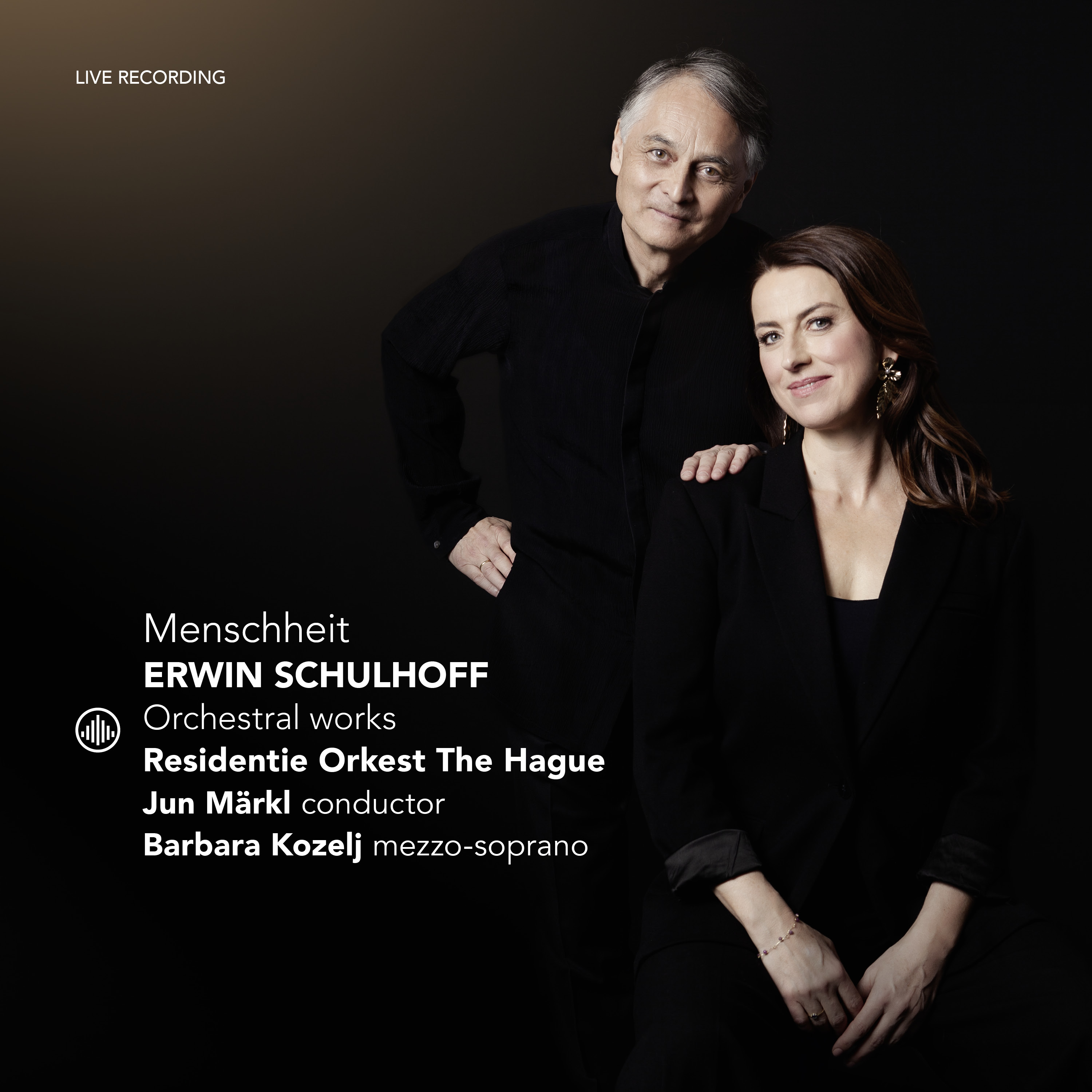
Erwin Schulhoff (1894-1942) remains one of those composers about whom it is barely possible to write a conclusive portrait: just when you think you have grasped him, the next work reveals yet another facet. This new cd by Challenge Classics, with the Residentie Orkest Den Haag under the baton of Jun Märkl and Slovenian mezzo-soprano Barbara Kozelj as soloist, offers a convincing sample of this.
The choice of repertoire is particularly interesting in this regard. Two vocal symphonies from the years following the First World War take centre stage: Landschaften, opus 26, and Menschheit, opus 28. Between these sounds the lighter Suite für Kammerorchester, opus 37, while the cd concludes with Schulhoff's orchestration of Beethoven's Rondo a capriccio, better known as Die Wut über den verlorenen Groschen. Four works that each shed a different light on the composer and together sketch a picture of a musical personality that does not allow itself to be easily pinned down.
The shadow of war
Especially Landschaften and Menschheit make clear how profoundly the First World War affected Schulhoff's artistic development. The composer, who initially departed from a late Romantic idiom, became increasingly attracted to more modern and radical artistic movements after the war. Dada, the Second Viennese School and jazz would each leave their mark on his oeuvre. Schulhoff was a respected figure in European musical life in the twenties and early thirties. As a Jew and communist, he was later persecuted by the Nazis and eventually deported to Wülzburg, where he died of tuberculosis in 1942.
Landschaften, composed in 1918-1919, shows Schulhoff still in a distinctly lyrical and late Romantic guise. The five songs on poems by Johannes Theodor Kuhlemann (1891-1939) form a mixture of natural imagery, longing, awareness of death and religious suggestion. The score was long considered lost and only came to light again in 1999. That rediscovery story gives this music something almost ghostly in retrospect: as if a voice from a vanished world becomes audible again.
There is little to be heard here of the brutal, sometimes ironic and rhythmically whipped-up Schulhoff of later years. Rather, we hear a composer indebted to Mahler and Richard Strauss, yet developing a very distinctive emotional world at the same time. Beneath the quiet, atmospheric soundscape lurks a recurrent undercurrent of unrest between the vocal line and the orchestral undercurrent.
Die Türen sind zugeweht sets the tone immediately. The oppressive content of the poem receives an equally moving musical translation. Barbara Kozelj brings the text with great sensitivity to the meaning of the words, while Märkl sets down the orchestral passages with energy and a sense of tension-building. Alle Frauen weinen in particular makes an impression. When "der graue Prinz hat seinen Vater erschlagen" sounds, the threat becomes almost tangible. Subsequently everything falls silent at "einsam": a brief moment that lingers precisely because of its restraint.
Demut faltet den Raum also gains pronounced weight, especially at the words "wir müssen sterben" and "zittert die Unruh". In the immediate aftermath of the war, those words carry extra historical weight. The strings lay down a dense sound weave, after which the orchestra further densifies the atmosphere and the harp at the end provides an unexpected opening. Kozelj keeps her performance restrained; this gives the oppression all the space it needs.
After these three restrained, melancholic-hued songs, Viele Wege sind, kleine, vergangene brings a welcome calm. The orchestra becomes lighter and more transparent and a small affinity with Strauss' Morgen briefly emerges. A violin solo contributes to the stilling and cautiously a hint of hope dawns, although the song ultimately withdraws into itself again.
Die goldnen Winde closes the cycle with more rapture. The orchestra swells without overshadowing Kozelj and for a moment the music even seems to verge on triumphant exhilaration. Yet the melancholic undertone remains. The words "erkreiste ungeheuer den Sinn" leave a wry feeling, after which Schulhoff opens the music again.
Märkl keeps the orchestral texture clear, so that the finer colour shadings remain audible. Kozelj has a warm, characterful mezzo-soprano and excellent diction, although not all of the sometimes pronounced symbolist poems are equally strong literarily. Yet Schulhoff manages to lift them musically above themselves: here poetry is given a second life in sound.
What after the catastrophe
With Menschheit the horizon becomes considerably darker. This symphony for alto and orchestra was created in 1919 on five poems by Theodor Däubler and clearly reflects the turmoil of the post-war period. The late Romantic sensibility of Landschaften gives way to music in which the voice is in constant tension with the orchestra and Schulhoff's language becomes more expressive and more intractable.
Der Dudelsack begins almost carefree, with recognizable motifs reminiscent of bagpipes. This lightness soon proves to be illusion. At "eine Nachtigall sie klagt, sie schweigt" the music takes on a more somber character and the orchestration makes itself heard more extensively than in Landschaften. Märkl brings the various orchestral layers clearly to the fore, while "nun bangt mich überall" develops into an oppressive passage.
Flügellahmer Versuch opens with a broadly spun orchestral introduction in which that richness comes even more to the fore. Kozelj places her sonorous, dark voice against it and builds convincingly towards the climax on "ich leid es nicht". It is especially the orchestral colours that linger; "Unter Feigen" eventually fades away almost weightlessly.
After these passages, Oft initially brings some lightness, which then turns into the melancholic-dreamlike Dämmerung. Here it is especially the orchestra that sets the tone: a fragile woodwind line and restrained strings build an intimate, almost chamber music atmosphere even before the voice enters again. At "Du sollst nicht immer traurig sein" a small ray of light opens up for a moment, but there is no real sense of liberation.
Then comes Einblick, the emotional centerpiece of the symphony. The deeply felt orchestral introduction immediately puts pressure on the text, after which Kozelj enters with restraint. "Du kannst die Menschen nicht retten" captures the hopelessness of the poem succinctly. The orchestra becomes almost threatening here, especially in the final stanza. And then everything changes at "Du wirst sie mit Demut besternen": the music breaks open into a radiant climax that seems barely reconcilable with the preceding despair. It is precisely this contrast that makes the ending so moving.
Striking is the way Schulhoff uses recurring musical ideas to create coherence. Motifs from Der Dudelsack return later, so that the five movements do not present themselves as separate songs, but gradually form a unified whole. Against a text that is deeply pessimistic about humanity and its capacity for self-destruction, Schulhoff ultimately places a radiant D major. That feels anything but like a cheap happy ending. Rather, he refuses to give up on humanity after the catastrophe. Perhaps something naïve resonates in that, but above all you hear a composer who continues to hope against all odds. It is precisely this tension between despair and hope that makes Menschheit so moving.
Kozelj is excellently cast for this music. Her voice has sufficient glow to carry the lyrical moments, but also enough edge when the music becomes darker. Only in the densest orchestral passages does the text not always remain completely intelligible – a small sacrifice for the dramatic power that the score gains precisely through this. Märkl and the Residentie Orkest give the symphony a broad arc without obscuring the complex orchestral part.
To the nightclub
After the two vocal symphonies comes a radical stylistic break. The Suite für Kammerorchester from 1921 shows a Schulhoff who plunges into the popular music of his time with visible pleasure. The six movements take us directly from the concert hall to the dance floor. Schulhoff sounds playful, ironic and rhythmic here, clearly fascinated by the dance culture of the twenties. Jazz, too, which was still relatively new in Europe at that time, finds a place there. Schulhoff does not simply adopt this new music, but incorporates it into a distinctly European concert context.
Ragtime has a rhythmic vitality that is difficult to ignore. Valse Boston provides a moment of refinement with a violin solo, after which Tango again places the violin at the centre and even acquires an almost oriental colour in its dialogue with the orchestra. Shimmy surprises with a siren whistle, Step is carried by the percussion and Jazz closes the suite with a fiery movement full of drive.
Märkl holds the different layers together well. The suite sounds energetic without descending into mere effect-seeking, and it is especially the dialogues between the instruments that give the music its charm. The Residentie Orkest plays with audible pleasure and the lightness this music requires. With so much playfulness, as a listener you can't help but move along in your seat and sitting still becomes almost impossible.
Beethoven through Schulhoff's eyes
The finale then casts a completely different light on Schulhoff: Beethoven's Rondo a capriccio in G major, opus 129, in the orchestration that Schulhoff made in 1940. He allows the piano work to grow into an exuberant orchestral piece, whereby the recognizable material of the rondo gains especially in colour and rhythmic vitality. Märkl lets the orchestra revel in the infectious rhythm, but keeps the different sound groups in good balance.
The orchestration does not necessarily add a new Beethoven, but it does show how unerring Schulhoff's sense of colour and instrumental profiling was. That the CD ends with this work is therefore more than a nice bonus. It brings different sides of the composer together: the admirer of tradition, the modern orchestrator, the lover of dance rhythms and the composer who never settled for a single stylistic identity.
Between despair and joie de vivre
What is strongest about this CD is ultimately not that each part is presented individually as a masterpiece, but that the recording allows different sides of Schulhoff's artistry to coexist. From the fragile lyricism of Landschaften, shadowed by war, it moves to the existential tension of Menschheit, then to the dancing irony of the Suite and finally to Schulhoff's idiosyncratic view of Beethoven. The contrasts thus become not isolated stylistic exercises, but different answers from one composer to his time.
For Märkl this is a strong starting point as the new chief conductor of the Residentie Orkest Den Haag. He does not opt for a streamlined Schulhoff, but for music in which the orchestral richness and stylistic contrasts are given room. The orchestra follows him with great control of color and rhythm, while Kozelj especially in Menschheit demonstrates that she can not only sing a text but also carry it dramatically. The recording at Amare is spacious without becoming distant. Even in the richly orchestrated passages, the different instrumental layers remain easy to follow, while the balance between orchestra and Kozelj's voice remains virtually exemplary.
Anyone who knows Schulhoff mainly as a footnote to the music history of the interwar period will have every reason to revise his judgment here. This recording shows how fragile lyricism, existential tension, dance rhythm and orchestral virtuosity can come together within one oeuvre. Schulhoff proves to be a composer who eludes any unambiguous stylistic categorization. That makes this CD not only convincing, but also an invitation to delve further into his work.