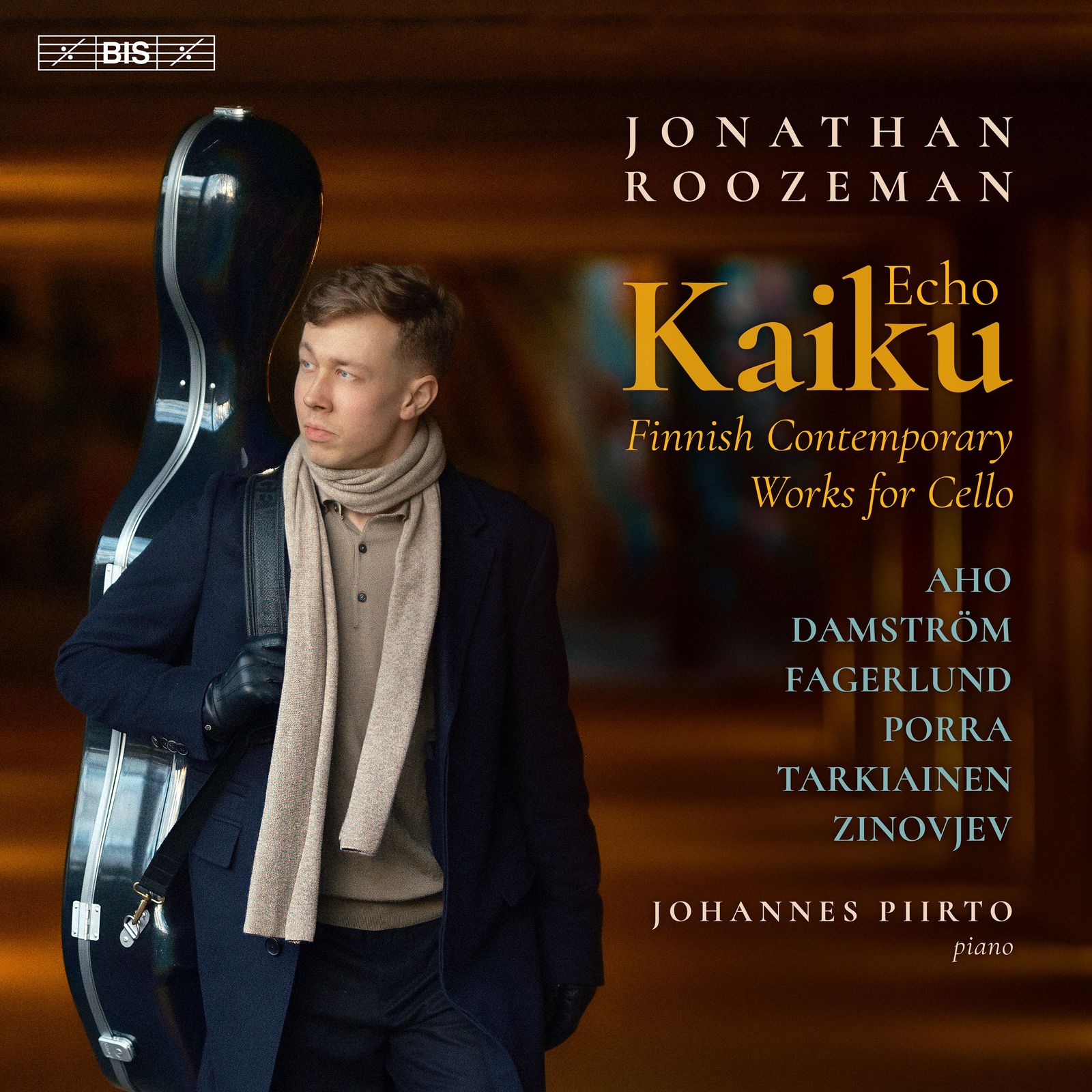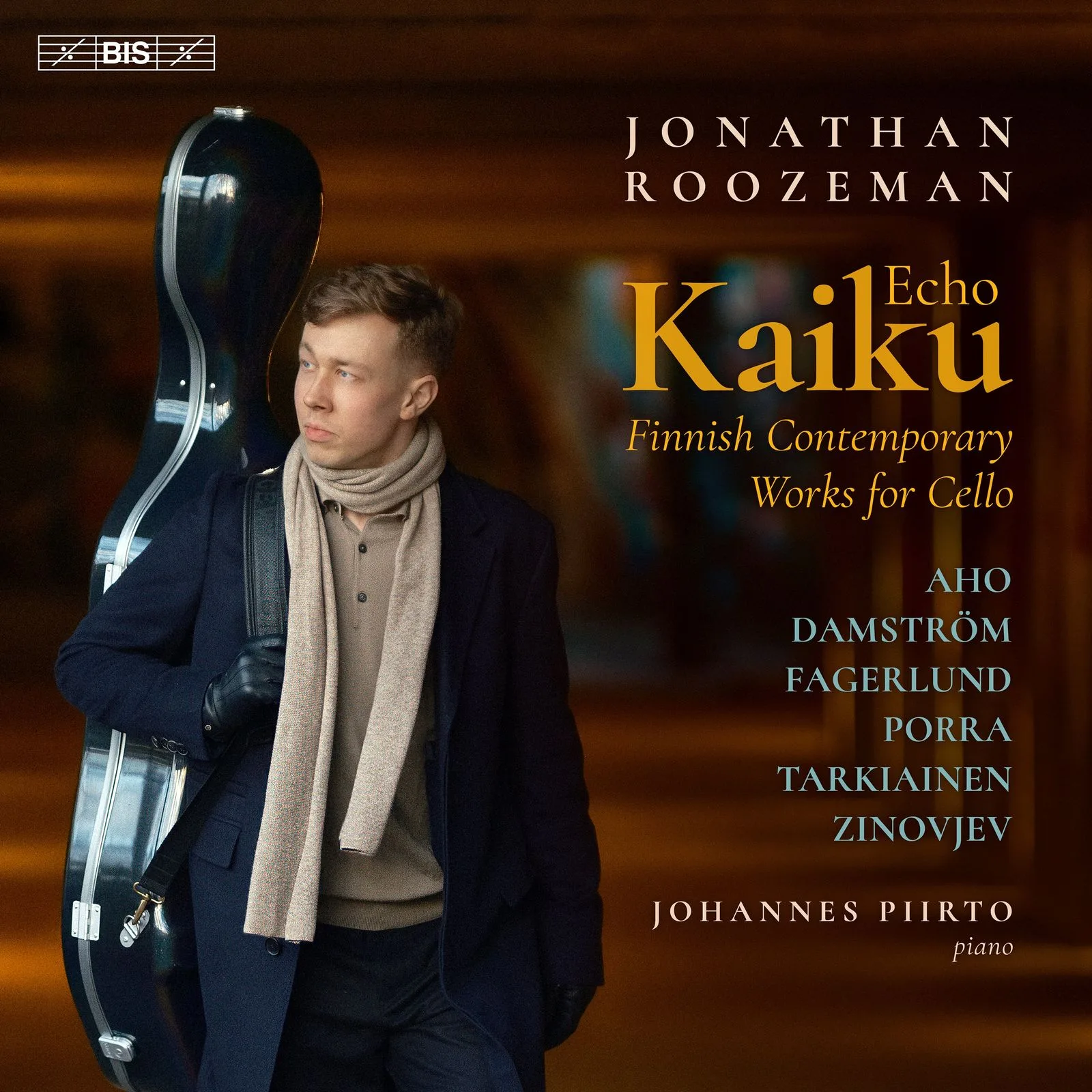
As soon as one thinks of Finnish classical music, Sibelius still tends to come to mind automatically. Kaiku (Echo) presents a programme that broadens that horizon considerably. Jonathan Roozeman brings together six works by Finnish composers who, with the exception of Kalevi Aho (b. 1949), belong to a younger generation. The result is not a survey of contemporary music, but a programme with remarkably many internal contrasts.
From recognition to estrangement
The title Kaiku is more than an attractive name. An echo repeats what has sounded before, yet at the same time changes its colour and meaning. That idea is immediately audible in Sustained by Sauli Zinovjev (b. 1988), the work Roozeman commissioned himself in 2024 and which here opens the door to the rest of the programme.
The beginning still seems familiar: a sparse cello sound set against a finely woven piano pattern, with something of the atmosphere of a Romantic nocturne. That recognisability, however, does not hold. The intonation shifts, the line becomes more uncertain and intense, and what at first sounds like a melodic gesture gradually takes on an estranging character. Zinovjev lets the memory of a Romantic sound-image slowly fall apart. Roozeman gives the smallest shifts in colour and pitch all the space they need to do their work. At the piano, Johannes Piirto provides a subtle musical colouring and responds with great precision to the changing cello sound. Together they turn this intriguing opening work into a convincing transition from recognition to estrangement.
Next comes Aho's Sonata for Cello and Piano, a work of nearly half an hour that considerably enlarges the scale. Aho writes music that cannot be reduced to a series of beautiful moments. The four movements build tension, withdraw, and then seek a new intensity. Especially the contrast between contemplative passages and restless, at times eruptive middle sections determines the character of the first movement. Roozeman frequently assumes an almost speaking role, while Piirto does much more than merely accompany. He keeps the whole in motion and helps shape the architecture of the work. In the second movement, too, this interplay remains intact. The tension is driven ever higher, after which Roozeman lets the movement end intriguingly in a rarefied register.
Particularly striking is the third movement, a cadenza played here without the original option of throat singing. As a result the cello remains entirely on its own. Roozeman develops that musical solitude further: searching as he goes, he keeps attention alive with small shifts of accent and unexpected changes of direction. The finale opens up again with the piano joining in, with rhythmic agility and changing metres, before unexpectedly withdrawing. Both musicians are given room for an individual voice without losing the coherence of the whole. The high harmonies at the end do not form a triumphant conclusion: the sonata seems almost to dissolve. What began as a large and sometimes unruly argument ends in a sound that hardly carries any weight anymore.
In Aho it immediately becomes clear how well Roozeman handles such varying scales. This becomes even more evident in the three solo works that follow: the cello stands alone, yet in each work it takes on a different function and a different character.
The cello as a solo voice
Aveo by Cecilia Damström (b. 1988) starts from life with long COVID and the longing for a return of what was lost. The composition does not lapse into a programmatic illustration of illness, but translates physical and psychological disruption into a constantly changing cello language. Fragments, repetitions, abrupt gestures and scratching, fragile sounds seem barely allowed the time to stabilise. The piece therefore has something nervous and unpredictable about it, without resorting to showmanship. The moments in which the music forms almost out of nothing are especially powerful. Roozeman treats silence as a full-fledged part of the tension and plays intensely without overloading the music: the restlessness seems to arise from the sound itself.
After that unrest, Recitativo by Sebastian Fagerlund (b. 1972) works as a remarkable concentration. The title is well chosen: this is music that stays close to speech, but without words. Fagerlund writes one long musical line that gradually unfolds and gains weight along the way. The piece is technically less spectacular than some other works on the disc, but precisely for that reason it demands a great deal of the performer. Roozeman gives meaning to the smallest shift in direction or intensity, and so keeps a piece that seemingly moves little constantly alive.
From lyricism to outburst
Sanasi, kiveen uponneet by Outi Tarkiainen (b. 1985) then pulls out all the stops. Where Fagerlund directs expression inward, Tarkiainen opts for contrast and movement. Roozeman takes on a far more physical role, in which melodic lines, polyphonic suggestions, virtuosic passages and scherzo-like movements follow one another. The motif with which the piece opens may briefly recall Sibelius, but Tarkiainen uses that association only as a starting point. Her music follows its own path and becomes gradually richer and more tumultuous.
Here Roozeman perhaps most clearly shows how versatile he is in handling the sound of his instrument. The virtuosity always remains connected to the musical idea. He lets the cello sound lyrical, but just as well percussive and almost raw. Especially the transition to the most charged section is given sufficient weight as a result. At the same time, there remains room for fragile passages, so that the composition does not culminate in one big expressive climax. Roozeman follows the changing sound characters of the cello without losing sight of the musical line.
An open ending
The closing track of the CD comes from Lauri Porra (b. 1977), with We Lie Down Only to Get Up Again from Cabins & Hideouts. After the intensity of Tarkiainen, this is almost a change of light. Porra, who started out on cello, moved through jazz and heavy metal and ultimately became best known as an electric bassist, writes here music in which repetition, resonance and timbre are more important than virtuosic display. The cello is built up layer by layer; Roozeman also plays the additional cello parts himself, which broaden the original instrumental picture. As a result, the ending acquires something spatial.
Roozeman makes it one of the strongest moments of the CD. With great control, he holds the different layers together and gives each sound the time to resonate. The fragile high notes with which the piece opens gradually gain more warmth and movement, while the intimacy is preserved. Even within the repetition, he introduces small shifts and tensions. This perhaps requires less outward virtuosity than Tarkiainen, but certainly no less concentration. It is precisely in this restraint that Roozeman shows his strength: he not only masters the instrument, but also knows how much space a sound needs to retain its effect. The piece does not aim for a grand conclusion. After the accumulation of tensions and contrasts, the CD may end with music that simply continues to breathe. Thanks to Roozeman's assured and sensitive performance, that sound lingers in the air for a little while longer.
Six voices, one cello
Ultimately, that is also the strength of Kaiku. The CD does not try to attribute one recognizable identity to contemporary Finnish music. The differences between Zinovjev, Aho, Damström, Fagerlund, Tarkiainen and Porra are too great for that. What does emerge is a different coherence: the cello stands at the center as an instrument that can whisper, speak, scrape, sing and almost completely dissolve into sound.
The programme lasts just under 55 minutes, but convinces as a whole. The dramaturgy is moreover well thought out. The works seem to respond to one another: a sound is introduced, distorted, deepened or released, and later returns in a different guise. In this way a coherence arises that rests not on stylistic unity, but on the way the cello is listened to anew each time.
An echo is by definition never the original sound. It preserves something of it, but at the same time changes through the space in which it resonates. Perhaps that is exactly what makes Kaiku so interesting. What returns takes on a new form each time. Roozeman makes those differences audible and thus brings six diverse voices together in one instrument, which on this CD reveals its possibilities from a different angle.