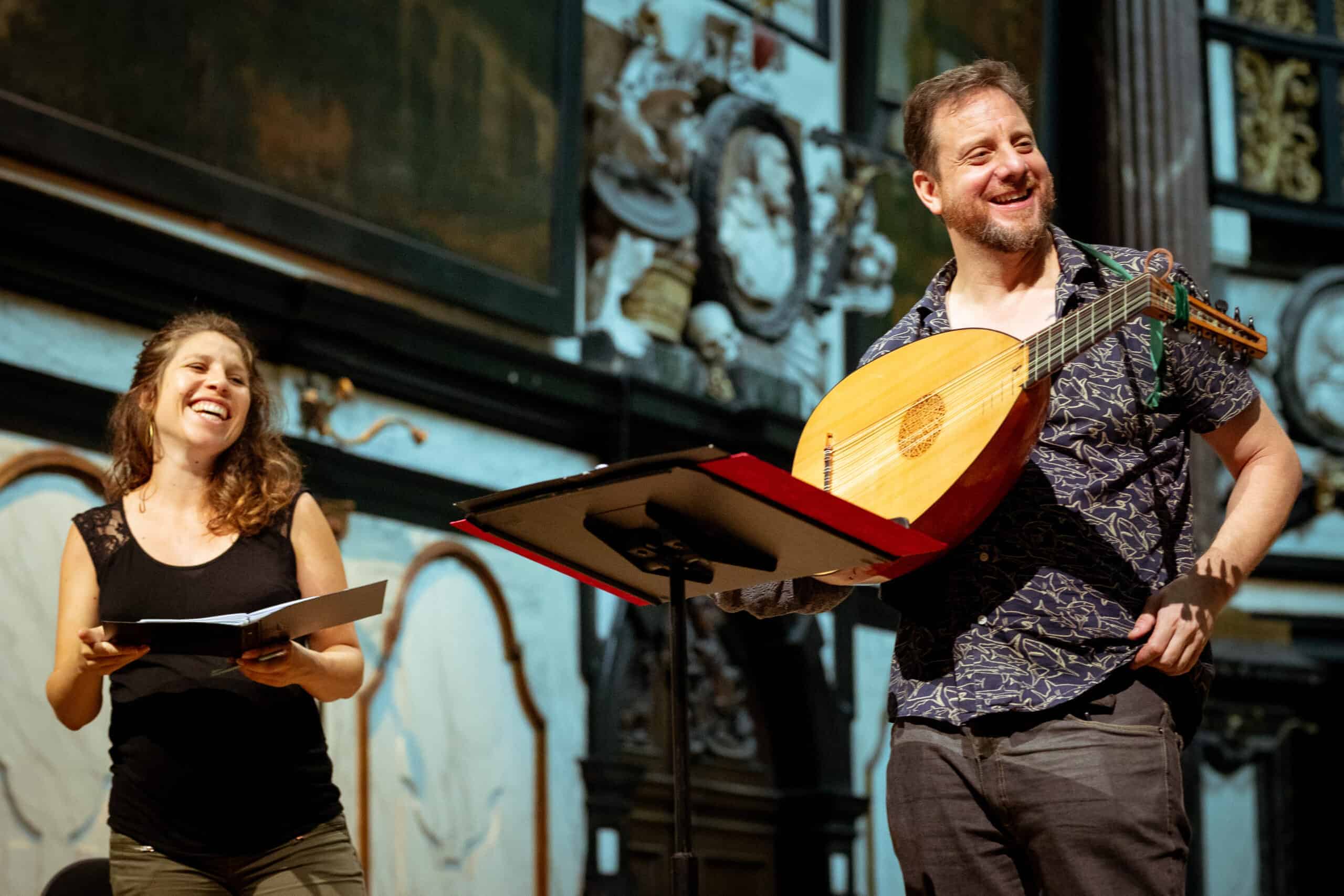
Laus Polyphoniae, this ten-day festival for early music, is running at full speed with a day and evening programme. Around Laus Polyphoniae 2023 hangs an energetic atmosphere through the special approach: the city of Antwerpen was chosen as the central festival theme 'Antwerpen. Townscape – Soundscape'.
Antwerpen is a metropolis. An international hub of trade and culture past and present. That is being capitalised on. Antwerpen was no less fascinating in the 15th and 16th centuries than it is today. Past and present are united in a harmonious way in this edition. Place to be: among others the Sint-Augustinuskerk, a baroque pearl in the heart of Antwerpen. The former church is a shrine of artworks. You can't see enough to admire the beautiful interior: stucco with an abundance of putti, immense paintings and three large altarpieces realised in the recognisable style of Jan Fabre with wing panels of jewel beetles.
AMUZ does not present a thin programme booklet per concert. But rather a compact and hefty booklet, the bible of Laus Polyphoniae. An interesting reference work. The concert-goer can thus browse through the glorious history of Antwerpen. You learn how the city and the music in churches and city palaces sounded vocally and instrumentally in the 15th and 16th centuries. You discover the fascinating international metropolis that Antwerpen was then, with all the economic and musical activity that came with it.
For this afternoon concert Full House. The performers Perrine Devillers and Ariel Abramovich were inspired by various Antwerpen prints of Phalesius containing music for lute and singing voice. The lute became a beloved instrument in the late Middle Ages. It was used as a solo instrument, in small chamber music ensembles or to accompany singers. Just as was customary in the renaissance, Abramovich and Devillers perform their own arrangements of collections with vocal music. Le rossignol musical des chansons is an anthology of French chansons that appeared in 1597. Here too the most recent music was included such as works of Eustache De Caurroy, Andreas Pevernage, Noé Faignient, Claude Le Jeune and Séverin Cornet.
Soprano Perrine Devillers is a ravishing appearance with a warm, supple voice. She knows how to add relief to a tender rendition. With grace and charm she sings of the love that ties complex knots in a whirl of notes. Love: the gap between desire, fulfilment and disappointment. The sober accompaniment of Ariel Abramovich catapults you back centuries and the vivid love lyrics. A latifundium of love where present-day songwriters pale in comparison. Perrine Devillers is wonderfully attractive with her rounded belly. She is pregnant, filled with tenderness and gives the songs an extra dimension. The sounds swirl through the space. The acoustics are perfect. Chemistry arises between the two performers.