

A church that now doubles as a circus school: it's something different to attend a concert there. The Sint-Lodewijkkerk in Mortsel, for 45 years the venue where Cultuurproject Dieseghem organises its concerts, has in the meantime taken on a new role as the home base of Art To Move. Nevertheless, the space remains available for concerts and organ lessons. For many in the audience, it was therefore a special renewed acquaintance with a familiar place that suddenly looks very different.
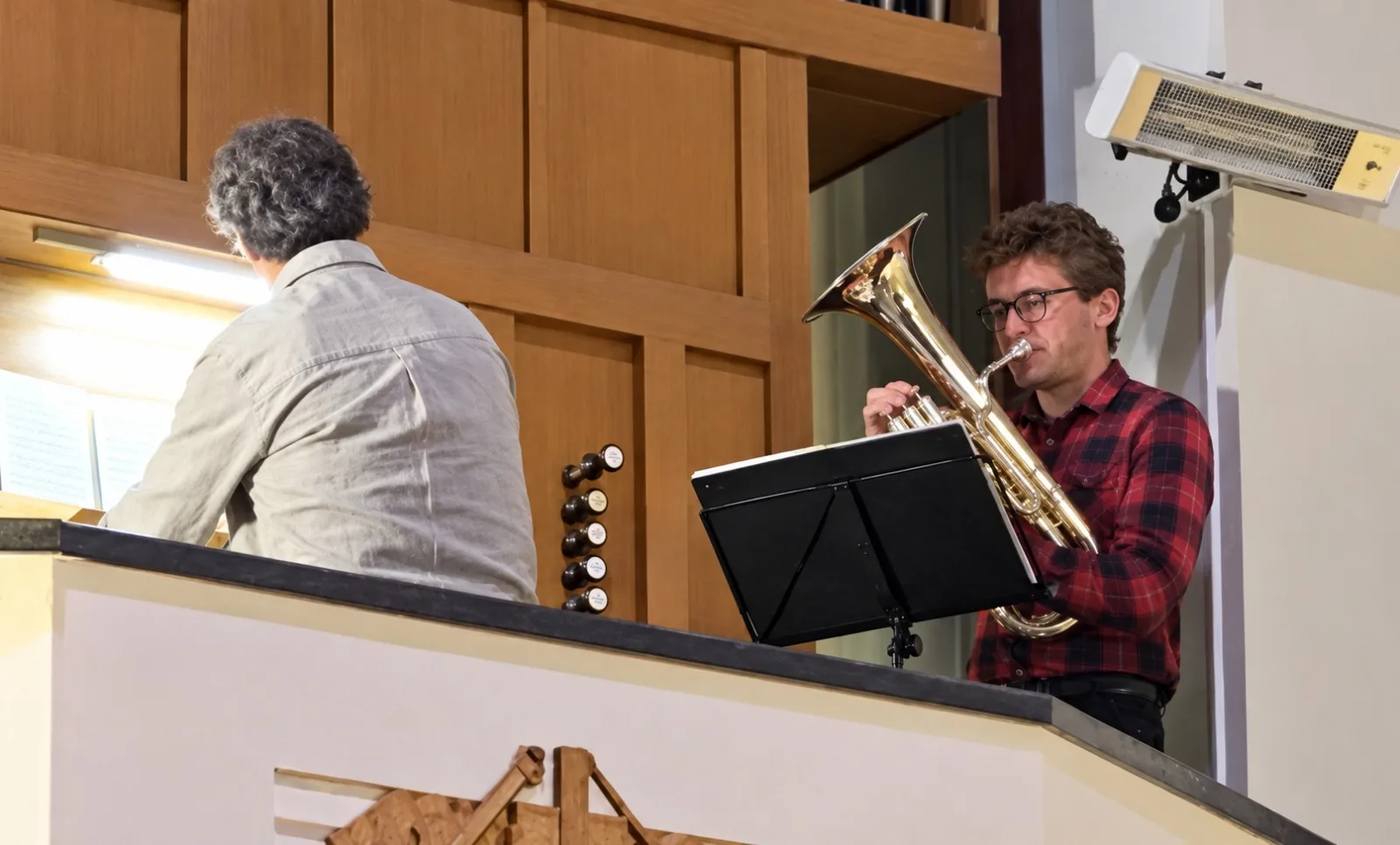
The acoustics have not suffered from this new function. The small but fine Pels organ, played by Luc Vanvaerenbergh, and the baritone of Thibaut De Bondt came into their own excellently in this intimate space. The arrangement also contributed to this. The organ stands to the left of the upper choir, so that both musicians were clearly visible. In this way, both musicians seemed much closer to the audience: not somewhere high and far away, but in the middle of the same space. The placement also proved ideal for the acoustics: organ and baritone repeatedly found each other.
It was, by the way, a fascinating discovery for me: I had never heard the baritone live, and the surprisingly engaging programme immediately showed how many different sides this intriguing instrument has. After the concert, De Bondt told me that he and Vanvaerenbergh had had a great deal of fun preparing this programme.
From meditative to jazzy
This was immediately evident in The Green Hill by Bert Appermont (b. 1973), with which the evening opened. Not an exuberant entrance, but first a meditative, slightly melancholic atmosphere. Then the music gained more energy and even a jazzy character. The music immediately set the tone for a varied concert.
In Carrickfergus by Stephen Roberts (b. 1952), a delightful Irish melody took centre stage. It first sounded on the baritone, supported by the organ. Then Vanvaerenbergh took over, after which De Bondt picked up the melody once more and let it slowly fade away.
Symphonic Rhapsody by Edward Gregson (b. 1945) then brought a very different kind of energy. Against the sharp rhythms and the challenging organ part, De Bondt placed a more contemplative baritone. Towards the end, his part too took on an idiosyncratic character.
A moment of remembrance
A resting point was formed by the Pastorale by Johann Sebastian Bach (1685-1750), the only work of the evening that was entirely for organ. Vanvaerenbergh registered it atmospherically, with a sound that took on an almost Christmas-like quality. While the baritone was silent, Vanvaerenbergh played this work as a moment of remembrance for the many people who had devoted themselves to Cultuurproject Dieseghem over 45 years and ensured that concerts could take place here all this time.
With Fantasy by Johann Nepomuk Hummel (1778-1837), the baritone returned. It is above all a technically interesting composition, with many notes and challenges that allowed the skill of both musicians to shine.
By the Waterside by Gabriel Fauré (1845-1924), in an arrangement by De Bondt, again brought a very different mood. The beautiful, penetrating song received a warm rendition on the baritone. The arrangement gave De Bondt full scope to also reveal the lyrical side of the instrument.
From stillness to virtuosity
Peace by John Golland (1943-1993) was for me the emotional high point of the evening. An intimate organ accompaniment allowed the warm, almost heavenly sound of the baritone to come through all the more beautifully. The audience, which had grown considerably, listened attentively and was visibly moved by this deeply felt performance.
Finally, with Party Piece by Philip Sparke (b. 1951), both musicians provided a splendid encore. The technical possibilities of the baritone were once more fully displayed, and Vanvaerenbergh enthusiastically joined in on the organ. The feats De Bondt sometimes had to pull off with his baritone actually fitted the surroundings. But there was no acrobatics for acrobatics' sake. The virtuosity served the music.
Thus the baritone took the leading role in the Sint-Lodewijkkerk for an entire evening. The church may have changed its appearance, but this evening above all recalled what has been happening here for more than 45 years: bringing people together around music.