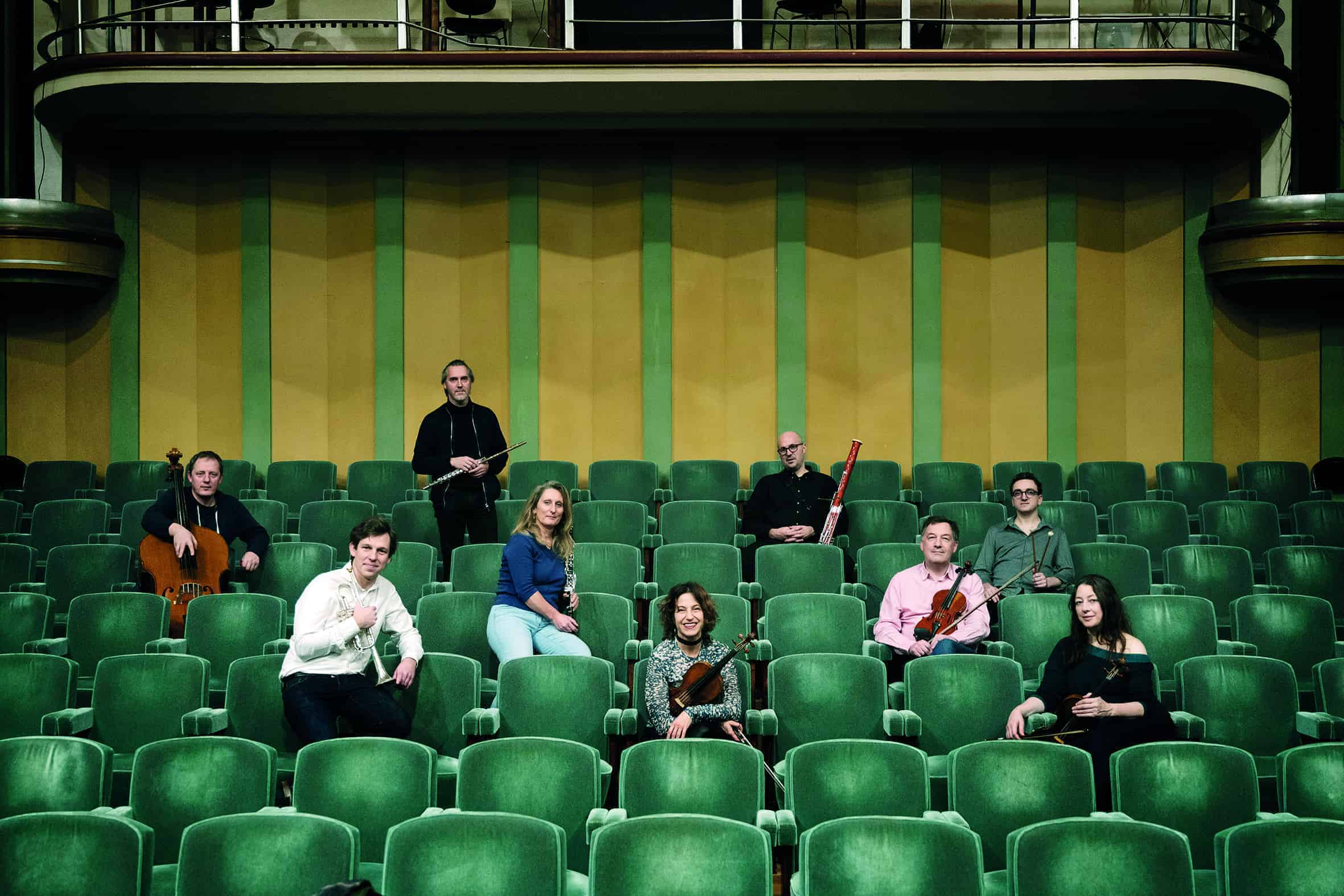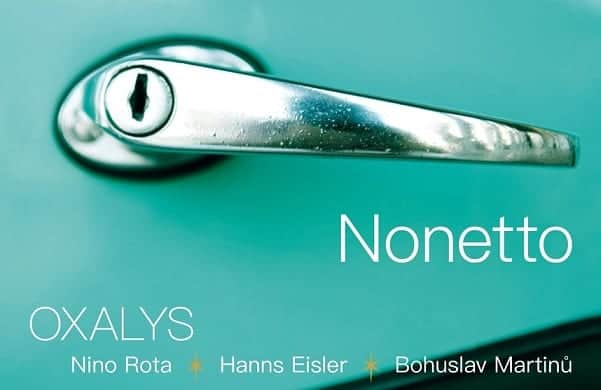
The more souls, the more joy of playing, as Oxalys convincingly confirms on its latest album. The Brussels chamber music ensemble, on this occasion with nine members, is helped in this by the cheerful, vivid and highly personal musical language of Nino Rota, Hanns Eisler and Bohuslav Martinů. But what do this trio, or their compositions, have to do with the Messerschmitt Kabinenroller 200, which shines in full glory on the cd cover of Nonetto?
One thing is crystal clear: this three-wheeler of German make is far too small to fit nine musicians, with or without instruments, inside it. Does someone among them perhaps have a thing for vintage cars? Indeed, well-known Koenraad Hofman told Klara. The bassist of Oxalys got the idea when he came across an old photo of this tiny automobile. There were also nine bystanders on it, who marveled at the futuristic two-seater with the airplane steering wheel and the quirky curves. Moreover, these micromachines rolled off the assembly line at the end of the 1950s, and that is precisely the period in which both Nino Rota and Bohuslav Martinů came up with their nonets. The gleaming Kabinenroller, from the collection of Autoworld Brussels, thus graces the cover of this new release on the Belgian label Passacaille for good reason. More than that, the picture piques curiosity and puts an end to the worn cliché that album covers of classical musicians are deadly boring and all look the same, as Marie François recently argued in rekto:verso . A further pertinent contribution, by the way, in which the pianist wanted to dispel the stereotyping of classical music.
Positive with an edge
François criticizes her sector, among other things, for a lack of courage and inspiration. "So: be unpredictable, dear colleagues, be capricious." Well, with the three pieces that together form Nonetto, Oxalys answers this call with verve. Starting by adding a handful of guest players to its/her regular core of strings, flute and clarinet. By the unorthodox instrumentation too, which produces precisely that extra fifth, even more so in the second nonet for three violins, double bass, flute, clarinet, bassoon, trumpet and percussion by Hanns Eisler (H. 374) than in the works of Rota and Martinů. For in these, the somewhat traditional combination conceived by Louis Spohr (1784-1859) in 1813 of wind quintet and string quartet – with the second violin giving way to the double bass – is maintained. But above all by the chosen repertoire itself which, although rarely recorded, brims with vitality, is usually particularly capricious and testifies to an astonishing wealth of ideas. "The music of Rota and Martinů radiates that typical positive attitude of the 1950s, of an unbridled belief in the future, but with an edge," as Toon Fret puts it in the video below. "We actually return to a kind of neoclassicism and an absolute denial of any heaviness. Lightness is essential." And that makes the whole thing, according to the flutist, very pleasant and at the same time exciting to listen to.
The Nonetto by Giovanni Rota, written in 1959 but reworked more than once afterwards, is indeed a good-humored piece that repeatedly brings a smile to the listener's face. Although Nino left behind numerous operas, ballet and orchestral music, vocal work and a versatile chamber music oeuvre, this adventurous, five-part roller coaster shows that the composer in crime of Federico Fellini (1920-1993) was much more than the icon of 20th-century Italian film music. Francesco Lombardi, longtime curator of the Rota archive in Venice, describes this nonet as "one of the most successful syntheses of his art." And that successful synthesis decidedly skips the study round. The Allegro, on the other hand, takes flight forward, and does so at full speed: as if it were a real relay race in which oboe, flute and violin brilliantly pass the baton to each other. Also in what follows, and if things slow down a bit, the protagonists gracefully interrupt each other. Neither for the performers nor for the audience does this elegant overture with its Mozartian playfulness hold a moment of boredom in store. The same amusing and at times abrupt alternation between a tart discourse and restrained banter also makes the lively Allegro con spirito and the enthusiastic finale (Vivacissimo) a resounding success. And we haven't even mentioned the Canzone with five variations yet, the second-to-last and by far longest movement of the work, in which the solemn song in question (Allegretto calmo) is transformed by means of successive rhythmic interventions into a playful, deliberately self-relativizing march. The Nonetto by Rota is a chamber music pearl that, thanks to an inspired Oxalys, can shine in all its splendor.
Optimistic yearning
Another composition, but equally much empathy is also enjoyed by the second nonet of Hanns Eisler. That we would again be treated to vivid music, we learned in advance from the accompanying text by Olivia Wahnon de Oliveira. In the quadrilingual booklet, the librarian of the Brussels conservatory explains that Nonet no. 2 was created during Eisler's stay in Mexico City, late 1940, early 1941, when he wrote music there for John Steinbeck's documentary film The Forgotten Village. This account, lasting just over an hour, about disease, death and healing in a remote and still untouched Mexican Indian village, posed a tremendous challenge for the Austrian (East-)German composer, since the score had to run almost non-stop. Despite the considerable headaches, the displaced composer distilled from this soundtrack a suite that first consisted of eight and later of ten short movements. Without images, the suspense is lost when listening to these narrative pieces. But their at times mysterious character continues to shimmer equally strikingly through the rhythmically colorful score. Oxalys breathes life into this nonet both literally and figuratively, gives decisive shape to the sometimes subtly changing tempi – witness the Comodo, to name but one example – and does all this without losing the balance. Experience clearly prevails here. Just like the well-known rhythm from the title track of Mission: Impossible, so it seems, unexpectedly, at the beginning of the Marcia funèbre a la Mexicana. Did Lalo Schifrin (°1932), mind you an Argentine, let himself be inspired by Eisler here? Or did the musical assimilation take place earlier with his European colleague?
Bohuslav Martinů found himself separated from his birthplace for even much longer than Eisler. Not because of a Jewish background or communist sympathies, but because the Bohemian went to study in Paris in 1923 and subsequently fled to the US to escape the advancing horrors of war. A return ultimately never came to pass. The Iron Curtain, and the violent misdeeds that took place behind it, crushed that fervent hope. But what failed to work physically, Martinů achieved with manuscript paper: going home. Something he succeeded brilliantly at with his second Nonet from 1959, his chamber music swan song which he composed in January for an ensemble from the homeland. A remarkably cheerful wind blows through the Poco Allegro, which is given voice with appropriate lightness of touch. The final Allegretto too has the same contagious spirit, and ends with an optimistic ode to his own birthplace. But Martinů shows himself most openly in the intervening Andante, in which his deeply personal longing is translated into restrained, skillfully phrased solos and poignant interplay. Longing keeps people alive, even after death, as the music of Martinů and these nine musicians, together with recording director Benjamin Dieltjens, make us understand.
Oxalys plays today, 6 July, a home match during the Brussels Festival Midis-Minimes. Are you curious whether the Trio for clarinet, cello and piano by Nino Rota will also strike such a joyful note, then by all means take a seat from 12:15 in the plush of the concert hall of the conservatory. To afterwards acquire a copy of Nonetto… for an encore you are guaranteed to enjoy much more!
- WHO: Oxalys [Shirly Laub (violin), Frédéric d'Ursel (violin), Elisabeth Smalt (violin, viola), Amy Norrington (cello), Koenraad Hofman (double bass), Toon Fret (flute), Piet Van Bockstal (oboe), Nathalie Lefèvre (clarinet), Pieter Nuytten (bassoon), Anthony Devriendt (horn), Bram Mergaert (trumpet), Titus Franken (percussion)]
- WHAT: Nino Rota (1911-1979) – Nonetto | Hanns Eisler (1898-1962) – Nonet no. 2 | Bohuslav Martinů (1890-1959) – Nonet no. 2 (H. 374)
- RELEASE: Passacaille (PAS1103)
- PHOTOS: © France Dubois
- LINK to the YouTube channel of Oxalys