

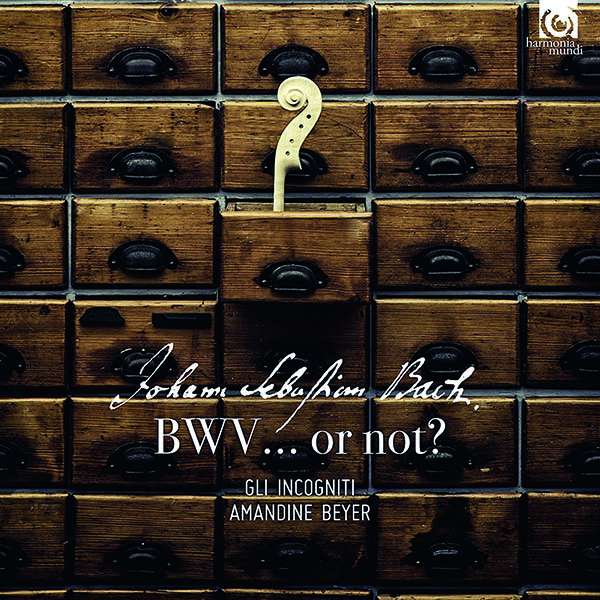
Bach … or not? Musicologists and interested listeners often ask themselves this question when they hear a work attributed to Bach and therefore bearing a BWV number, but which sounds nothing like Bach. With their CD Bach … or not? ensemble Gli Incogniti want to draw attention to these lesser-known works which, wholly or partially, are wrongly attributed to Bach suites and sonatas.
In the 18th century, many European composers enjoyed reworking themes or entire pieces of music composed by their colleagues, often out of interest or admiration or as a form of practice. In a time when concepts such as 'copyright' and 'intellectual property' did not yet exist, it was therefore quite common for composers to arrange or rework other people's compositions without mentioning where they had actually got their inspiration from. Johann Sebastian Bach did this occasionally as well, with the result that some of 'his' works found in the Bach-Werke-Verzeichnis (BWV) are actually just arrangements or reworkings of existing themes by other composers.
It requires considerable interpretative skill and musichistorical knowledge on the part of the performer to determine what comes from Bach himself and what was written by the actual composer. Of course, this is somewhat easier for one passage than another, and complete certainty is not always possible. A fine example of this is the Suite for violin and harpsichord in A major (BWV 1025) whose second movement, the Rondeau, is based on a lute suite (SC 47) by Silvius Leopold Weiss. The first movement, the Fantasia, indeed sounds much more like Bach than this Rondeau: one recognizes the prelude style that Bach uses in other works of his own such as his Prelude for lute in C minor (BWV 999) or even the well-known Prelude for harpsichord in C major (BWV 846) from Das wohltemperierte Klavier. Both violinist Amandine Beyer and harpsichordist Anna Fontana bring this suite with delightful virtuosity and the ornamentation in the accompaniment is certainly in place in the Fantasia.
The Sonata for violin and basso continuo in C minor (BWV 1024) is in turn (with some doubt) attributed to violinist Johann Georg Pisendel, a contemporary of Bach. Olivier Fouré, the author of the information booklet supplied with the CD, describes the work as "hard to square with Johann Sebastian's stylistic canons". A perfect description, I think: the end of the Presto, the second movement, even reminds one of Boccherini (despite the anachronism). Yet here and there there are a few Bach-like features noticeable, so it requires the performers (again Beyer on violin and Fontana on harpsichord, but now also with gambist Baldomero Barciela) to have the necessary expertise to interpret and perform this work correctly. The ensemble undoubtedly succeeds here, although it seems to me that it is interpreted somewhat more 'freely' than Bach is usually performed, but that is perhaps due to the fact that the work is not by Bach himself.
Of course, Bach did not always have to look far to find inspiration for arrangements or versions. His own son Carl Philipp Emanuel was after all a very prolific and moreover talented composer from whom Bach himself occasionally dared to borrow. The Sonata for transverse flute, violin in scordatura and basso continuo in G major (BWV 1038) and the Sonata for violin and harpsichord in D minor (BWV 1036) could both be by the hand of Carl Philipp Emanuel, although the first may have been partly composed by Johann Sebastian. Beautiful ensemble playing between flautist Manuel Granatiero and violin soloist Beyer, although the performers clearly opt again for a more dynamic and rhythmically free interpretation.
The CD BWV … or not? also contains several other works that are (sometimes certainly wrongly) attributed to Bach or whose authenticity is questioned because of stylistic characteristics that are very atypical for Bach. It is also notable that the Fugue in G minor (BWV 1026) is clearly performed with much stricter rhythm than the other works which, by their character, allow more freedom. Dynamically, however, it remains very free, which is of course a choice by the performers because Bach rarely wrote dynamics in his compositions.
- WHAT: BWV … or not
- WHO: Ensemble Gli Incogniti with Amandine Beyer (solo violin), Alba Roca (violin), Manuel Granatiero (transverse flute), Baldomero Barciela (viola da gamba), Francesco Romano (lute) and Anna Fontana (harpsichord)
- RELEASE: Harmonia Mundi (HMM 902322)[embed]https://youtu.be/3W2zaivrSzk[/embed]