

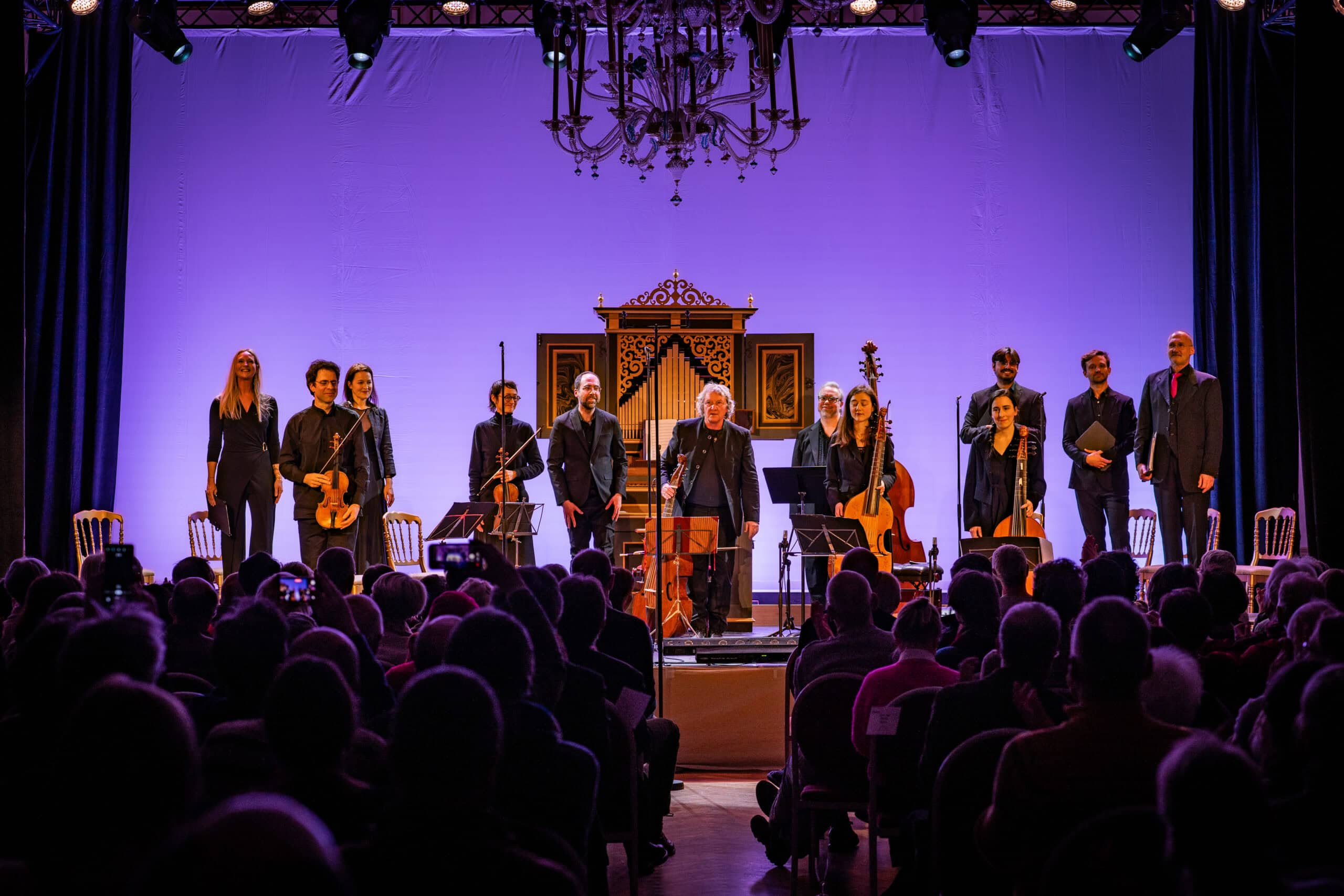
On Valentine's Eve, far removed from roses and well-trodden sentiment, Ricercar Consort brought a concert that nestled itself where music finds its deepest meaning: in the vulnerability of being human. In the Brussels Cercle Royal Gaulois, a programme unfolded around Heinrich Schütz (1585-1672), flanked by instrumental jewels from Johann Hermann Schein (1586-1630), that was not only historically thoughtful, but above all existentially striking.
That Schütz fitted perfectly within the festival theme of FestiVita!26, which this year focused in part on Dresden, hardly needs explanation. Dresden was Schütz' artistic home, the city where court culture, liturgy and politics intersected. But more importantly: Schütz composed his most moving music against the backdrop of the Thirty Years' War (1618-1648). His works breathe not triumph, but sobriety; not abundance, but concentration. In times of scarcity – fewer musicians, limited means – he found a language that cuts all the deeper. In simplicity he managed to penetrate to the core of what it means to be human.

That spirit hung tangibly in the hall. The programme began with Schein's Intrada à 5 from the Venus-Kränzlein: not an exuberant overture, but a restrained invitation. A sound that did not impose itself, but spread like breath in an empty space, as if listening began here even before the music actually sounded. As if the door to an inner space was slowly being opened. From there, Ricercar Consort led us through a carefully constructed dramaturgy of Schütz motets: from the searching Was betrübst du dich, meine Seele via the pleading intensity of Verleih uns Frieden genädiglich to the hushed monumentality of passages from the Musikalische Exequien. Each work seemed a stop on a spiritual journey without certainty, but not without support.
Striking – and meaningful – was that the sequence of works differed from that on the recent Da pacem CD. Where the recording – an absolute must for every music lover – offers a more cyclical listening experience, the ensemble chose here a dramaturgy that worked even more powerfully in the concert hall. The arc of tension was not built linearly but breathingly: complaint and hope, despair and trust alternated with each other. That breathing dramaturgy reflected no theological schema, but a human rhythm: falling and rising, wavering and hoping. This gave words like "peace", "comfort" and "mercy" an ever-growing weight. When at the end Da pacem, Domine sounded again, this time as an encore, it felt not like repetition but like completion: not as closure, but as an open ending, a prayer that, after everything that preceded it, only now truly gained meaning.

The performance itself was of rare intensity. The musicians could without exaggeration be seen as twelve apostles of peace: perfectly attuned to each other, listening, responding. Philippe Pierlot breathed visibly along with his ensemble; sometimes he even moved his bow when he was not playing – a small, telling gesture that showed how deeply this music was experienced together. This ensemble did not play next to each other, but with each other, as one breathing body, in which sound arose from attention and silence was as important as movement.
The singers sang with perfect clarity, their intonation was flawless, their German diction exemplary. Every word was comprehensible, every letter carried meaning. In music in which text and rhetoric are so central, that is not a detail but an essence. The instrumentalists offered a warm, transparent sound fabric that supported the voices without ever overshadowing them. The viols coloured the whole with a velvety melancholy, while the continuo never pushed, but breathed – as if silence here was as important as sound. Here music was not a message, but a space in which listening itself gained meaning. The music did not speak to convince, but to be present. The whole was a caress to the ear, but never without commitment: the musicality was iron-strong, the interpretation deeply felt.

A particular moment was formed by the sung Was ist der Mensch? – a question that seemed to hang over the entire evening. What is man, in the midst of war, fear and longing for peace? That question continued to resonate to the end, not as intellectual reflection, but as physically experienced silence. That precisely on Valentine's Eve no sweet love was celebrated, but a profound reflection on what love between people can truly mean – attention, compassion, peace – gave this concert an extra layer.
The framing also deserves mention: the introductions in French and Dutch offered meaningful context and opened listening windows without being didactic. For those unfamiliar with the festival: this evening unmistakably left you wanting more. FestiVita! presents itself with this challenging and brilliant programming as a place where early music is not museumified, but brought to life again.
This was not a concert you leave "unscathed," but one that stays with you. Da pacem sounded here not as a historical artifact, but as a highly topical, human prayer, not because the world is more peaceful today; far from it, but precisely because it still needs it just as urgently.