

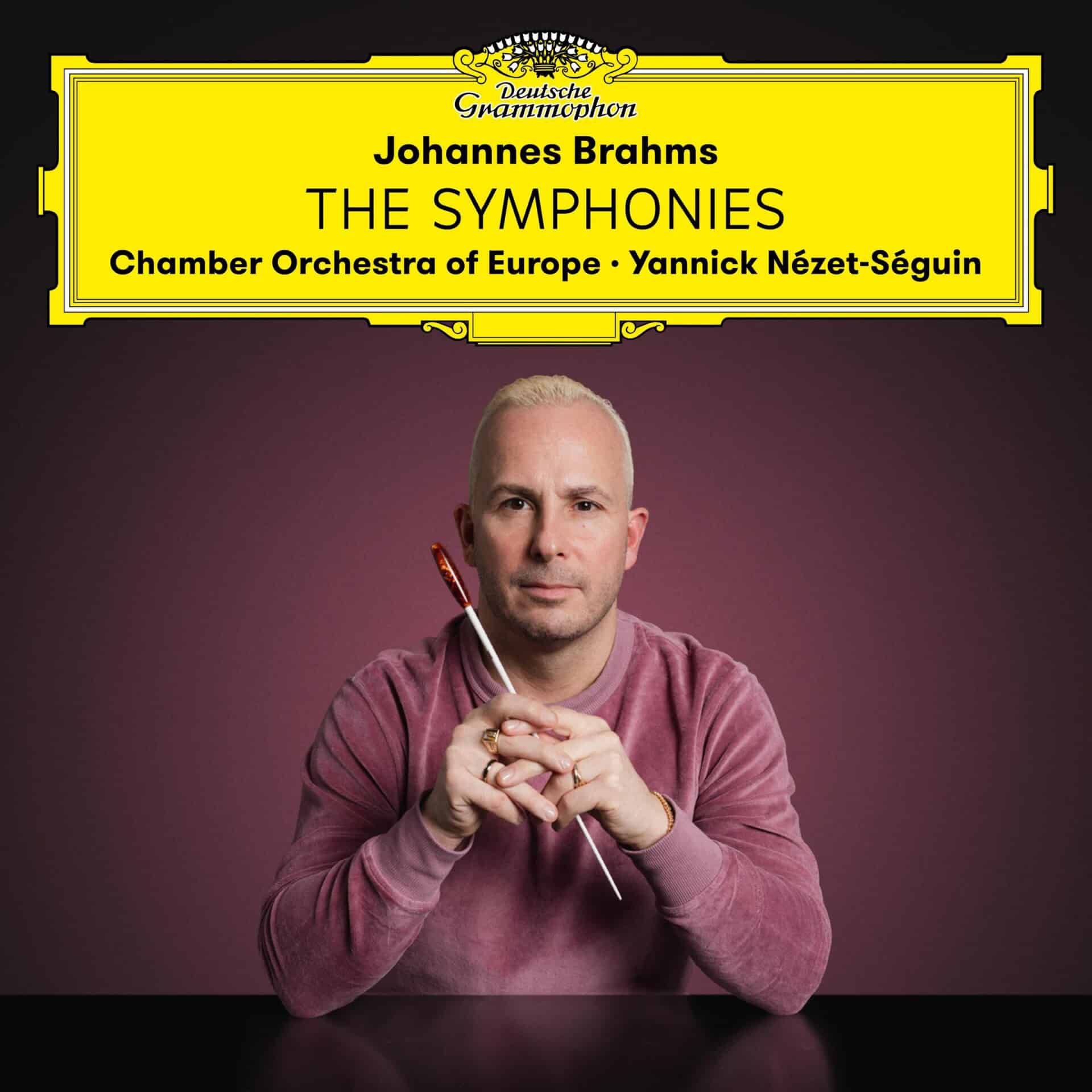
Brahms: Symphony no. 1 in c, op. 68 - no. 2 in D, op. 73 - no. 3 in F, op. 90 - no. 4 in e, op. 98 Chamber Orchestra of Europe conducted by Yannick Nézet-Séguin
DG 4866000 • 2.45' • (3 cds)
Live recording: July 2022 & July 2023, Festspielhaus, Baden-Baden (D)
No one who had any interest in 'authentic' musicmaking or a Brahms symphony in small ensemble during the deep sixties, let alone in the consistently flawed historical sources derived from it. 'Urtext' editions, if they existed at all, were nowhere near the top of the average music lover's list at that time. The fact that the scores used then were sometimes rife with imperfections only received proper attention later. We were accustomed to or spoiled by 'our' music as it was presented by conductors such as Bruno Walter, Wolfgang Sawallisch, Herbert von Karajan, Karl Böhm, John Pritchard, Claudio Abbado (who only shifted much later in his career towards the 'historicizing camp'), Bernard Haitink, Karl Böhm, Eugen Jochum, Thomas Beecham, Otto Klemperer and many others.
Brahms in streamlined form? This too only appeared fairly late on the scene, around the millennium, now almost a quarter century ago, with the Telarc release with the Scottish Chamber Orchestra under the direction of the sharply conducting Charles Mackerras as the first 'ear-opener'. It must have been a revelation for many, although there was not much new to report regarding the texture followed. Around the same time – coincidence does not exist – there was another, internationally even more prestigious chamber orchestra that presented Brahms' symphonies in a comparable manner: the Chamber Orchestra of Europe, led by the rather conservative Paavo Berglund, recorded live during the music festival in Baden-Baden. More followers came in due course: Thomas Dausgaard and Robin Ticciati again with the Scottish Chamber Orchestra, Paavo Järvi with the Deutsche Kammerphilharmonie Bremen (a fascinating documentary about this can be seen on YouTube: 'These pieces are never the same twice', according to the conductor) and Ádám Fischer with the Danish Chamber Orchestra (who successfully deployed his enormous Haydn experience).
A smaller ensemble does not necessarily mean better, but certainly a different sound picture. For that reason, it is thus not a priori a decisive selling point. Only its commercial significance, unlike its artistic value, is undisputed. Many music lovers simply already have the Brahms symphonies, anchored in a long performance tradition, in their record collection and if they were to consider a new recording at all, only on the basis of newly formulated premises or an even better recording.
Now, almost a quarter century later, it is again the Chamber Orchestra of Europe and the Baden-Baden music festival that have devoted themselves to the four Brahms symphonies, with the widely praised Canadian Yannick Nézet-Séguin on the podium who, thoroughly seasoned, can read and write with this ensemble; and the orchestra members with him. Has that produced a superior Brahms recording? Absolutely, with at most a few modest caveats; and these concern only the First Symphony, in which the conductor goes a bit too far in expression, with as 'auxiliary troops' an excess of vibrato and rubato, alongside a number of unjustified tempo changes, but that is all.
What strikes attention not only on first listening is the great precision (articulation, accentuation, phrasing, balance, rhythm, voice-leading), the richness of orchestral colours (including the extremely profiled woodwinds and glowing horns!), the 'bite' (strings!) and perfectly matching ferocious timpani. That this ultimately is not chamber music is evident both from the scores and from the luxurious sound character of the ensemble as a whole, but also as it has been captured by the technicians.
Does it make sense to go through these four symphonies in terms of performance and express a certain preference? No, because for that Nézet-Séguin's approach to these scores and the demonstrated orchestral playing is too consistent (which is something different from uniform or routine, as there is no sign of that whatsoever). It thus counts as a compliment.
What also emerges from these interpretations – and that too is a compliment – is that we are dealing with music of the mature Brahms (the First Symphony dates from 1876, the composer was already 43 then). Does that explain that they, like his great predecessor and model Beethoven, are unique in their kind? Hard to say, but it is true that each symphony has a completely individual character thanks to a rich palette of styles and evocations and that this comes across excellently in these performances.
Given the enormous number of recordings, both as a cycle and individually, it is absolutely impossible to listen to them all from beginning to end (unless one has seas of time, of course). What is decisive in this regard? What is not? Moreover, not everyone wants the same thing. One person swears by the legendary Wilhelm Furtwängler with his Berliners, lived through to the bone, more tragic than mild. Or by Eduard van Beinum and the Concertgebouw Orchestra, in a humane reading stripped of all romantic frills. Or alternatively by Herbert von Karajan, first with the Philharmonia Orchestra and subsequently his first set with the Berliner Philharmoniker from the nineteen sixties. Otto Klemperer and the Philharmonia Orchestra perhaps? Interpretations carved from granite where an imposing grandeur speaks, the woodwinds prominently present (in Klemperer style so to speak), extremely disciplined but not particularly 'gesangvoll'. The vision saturated with warm mildness of Bruno Walter and the Columbia Symphony Orchestra. George Szell who drives his Clevelanders to unprecedented perfectionist heights, without frills and thus penetrating to the core of every work. Or much later in time, with this time as leader Riccardo Chailly who achieved an unprecedented feat with the Gewandhausorchester? And so on. In short, the Brahms interpretation does not exist and never will be able to exist, although, at least as far as the Fourth Symphony is concerned, Carlos Kleiber and the Wiener Philharmoniker come very close to it.
The list with more than respectable performances is endless, but whoever wants to be or remain 'up to date' can do very well with Yannick Nézet-Séguin and the Chamber Orchestra of Europe. With the added advantage that the recordings stand out in sonority and transparency.