

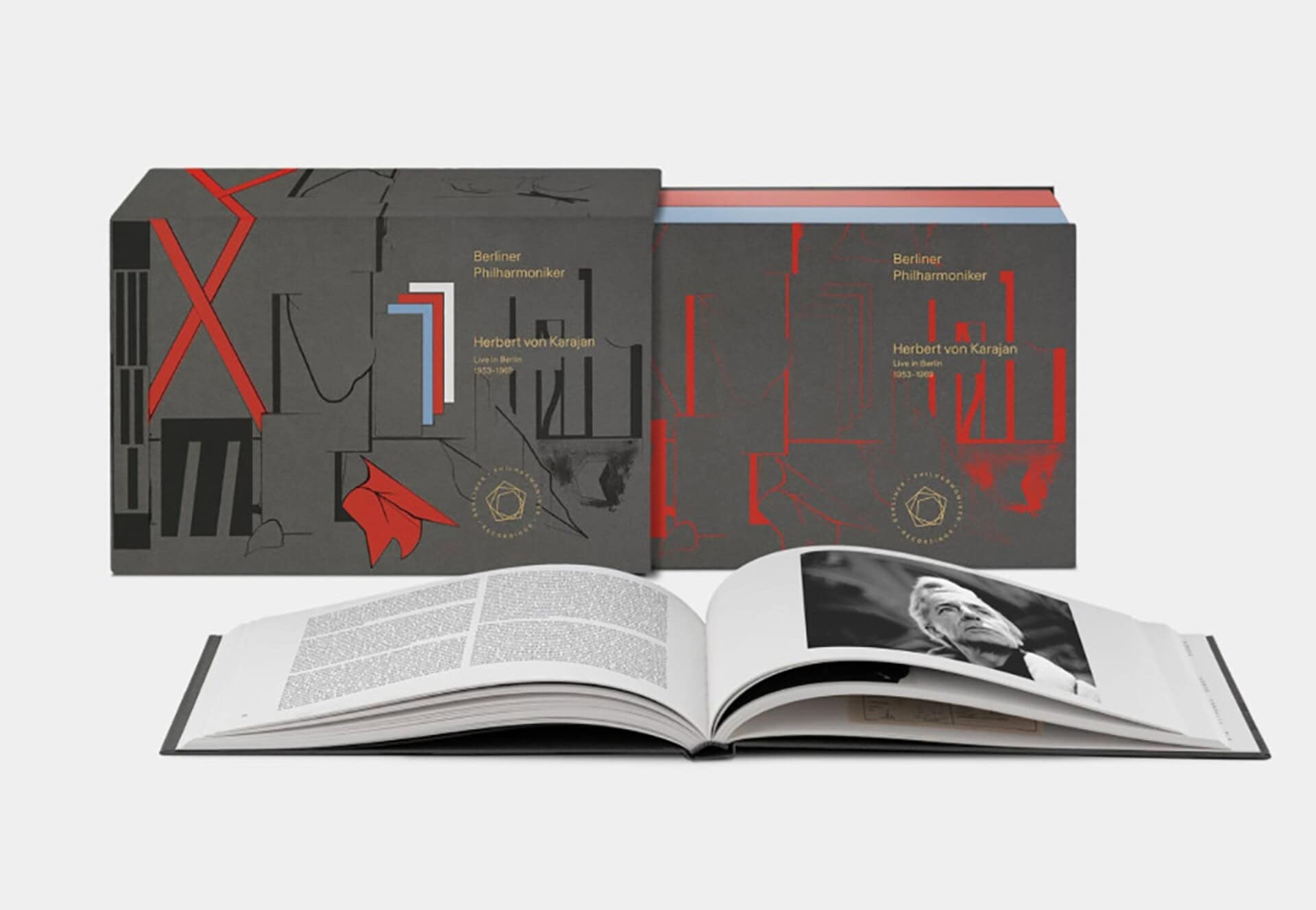
This luxurious hardcover edition, designed by painter and sculptor Thomas Scheibitz, comprises 24 SACDs (CD compatible) containing all 23 surviving live recordings of the Berliner Philharmoniker under Herbert von Karajan in chronological order from the period 1953-1969. Incidentally, the vast majority of the live-performed repertoire is also available in studio recordings.
The accompanying, luxuriously produced booklet featuring numerous photographs alongside essays by, among others, Karajan biographer Peter Uehling and music publicist James Jolly follows the style of earlier sets released by the Berliner Philharmoniker.
This is thus – following the publication of Wilhelm Furtwängler's radio recordings from the period 1939-1945 – the second major historical edition by the Berliner Philharmoniker and also an important milestone in documenting the media history of this world-renowned orchestra.
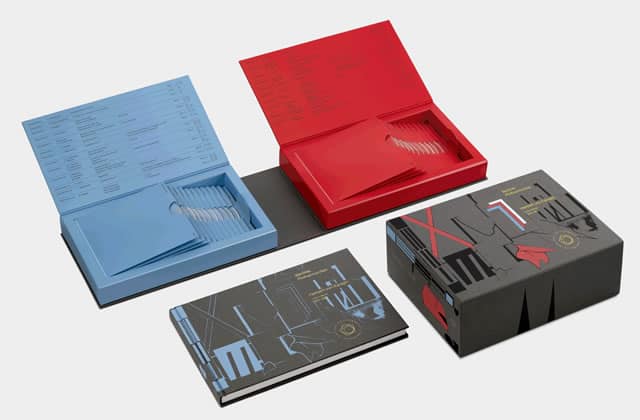
In the preface to this edition, two orchestra members, violinist Philipp Bohnen and cellist Olaf Maninger, write that it was part of Karajan's philosophy to rehearse so thoroughly that he could make himself redundant during the concert – 'as an observing creator'. And: 'The performances on stage were particularly impressive when he not only loosened the reins with complete confidence in his musicians, but released them entirely. This willingness to take risks and the inherent danger of failure form the basis of the incomparable appeal of a live performance, which we experience in the most literal sense – while we sometimes only admire studio recordings that have been perfected to the smallest detail with the latest sound technology.' Are they right? More on that later.
This richly appointed edition comprises all live recorded concerts, a total of 23, from the period 1953-1969. The original tapes used come from Rundfunk im Amerikanischen Sektor (RIAS) and Sender Freies Berlin (SFB) and were specially digitalized in high resolution for this purpose. Most of them have not been released before and are in accordance with the concerts as they took place at that time. This also provides insight into Karajan's – albeit limited – dramaturgical development as a whole.
Karajan conducted the Berliner Philharmoniker for the first time in April 1938, a debut that already generated considerable discussion and mostly led to positive reviews. It is hardly surprising, therefore, that after Furtwängler's death in 1954, it was Karajan who took over a concert tour through the US in 1955 that had been planned with Furtwängler well in advance. Once again the success was commensurate, leading shortly thereafter, in 1956, to Karajan's appointment as chief conductor for life. During his long career with the orchestra, he, like no other conductor before him, determined both the artistic and media-genic development of the orchestra. Karajan departed only in April 1989, fairly shortly before his death on July 16 of that year, preceded by considerable fuss surrounding clarinetist Sabine Meyer, whom Karajan felt deserved a place in the orchestra, but which strongly opposed her appointment. This was still at a time when a woman as an orchestra member was not desired.
[caption id="attachment_43581" align="alignleft" width="300"]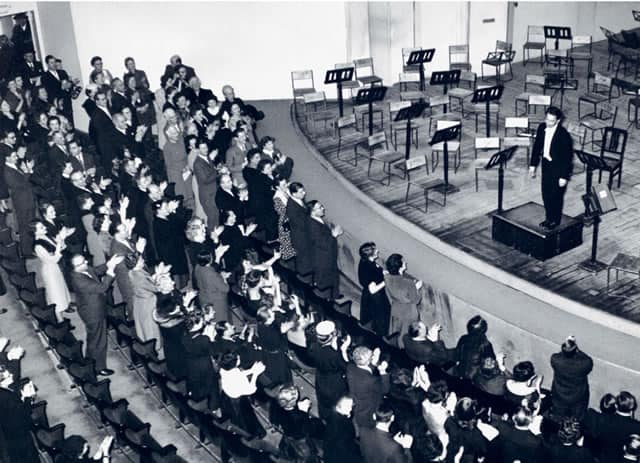 Titania-Palast, Berlin (1956)[/caption]
No classical musician has made and sold more recordings than Karajan, but after his death the music world heard little more about him or his musical legacy. The reasons are matters of speculation, but it is likely that the emergence and gradual spread of historically informed performance practice across all genres played an important role.
Karajan's conducting style quickly fell out of sight in the nineties. Apart from historically informed performance practice, other aspects may also have played a role, such as his authoritarian behavior, the show element (conducting with closed eyes), his attraction to the jet set (including a private jet and high-speed cars) and his cult status derived from it.
In musical terms, his growing preference for 'beautification' of the orchestral sound developed from the seventies onwards, the increasing drive for perfection from his own perception with which no one else could interfere even slightly.
This striving for the 'perfectionist model' evolved already in the mid-sixties, when not only audio but also video became an important driving force for Karajan. He had become fascinated by the technology of image and sound and was firmly convinced that it was this combination that could greatly contribute to the worldwide appreciation of classical music.
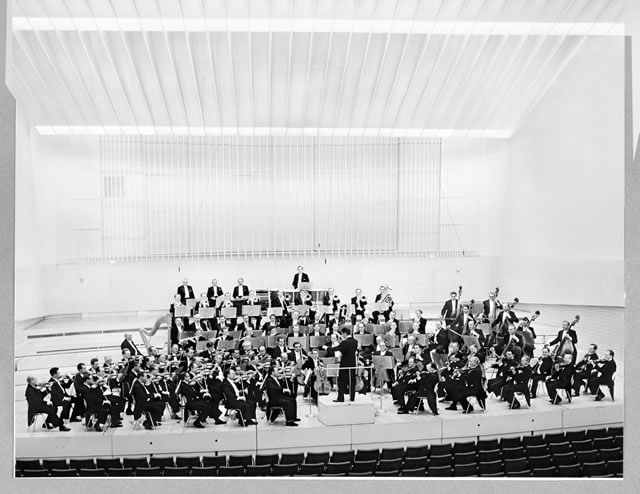 From that period dates his collaboration with French film director, screenwriter and producer Henri-Georges Clouzot (1907-1977), a true 'heavyweight' in his field with a string of highly successful films including Le Corbeau (1943), The Wages of Fear (1953) and Les Diaboliques (1955). Films that demonstrated Clouzot's pessimistic view of mankind.
With Clouzot, himself a great music lover, Karajan worked on an extremely ambitious project for German television: a planned series of as many as thirteen films about the art of conducting: The Art of Conducting. In the period 1965-1967, five films were ultimately completed, in which we hear and see Karajan and the Berliner Philharmoniker at work during rehearsals and concerts. And as was customary with Karajan: prepared down to the smallest detail.
That pursuit of the 'perfectionist model' evolved already in the mid-1960s, when not only audio but also video became an important driving force for Karajan. He had become fascinated by the technology of image and sound and was firmly convinced that it was this combination that could strongly contribute to the worldwide appreciation of classical music.
From that period dates his collaboration with French film director, screenwriter and producer Henri-Georges Clouzot (1907-1977), a true 'heavyweight' in his field with a string of highly successful films including Le Corbeau (1943), The Wages of Fear (1953) and Les Diaboliques (1955). Films that demonstrated Clouzot's pessimistic view of mankind.
With Clouzot, himself a great music lover, Karajan worked on an extremely ambitious project for German television: a planned series of as many as thirteen films about the art of conducting: The Art of Conducting. In the period 1965-1967, five films were ultimately completed, in which we hear and see Karajan and the Berliner Philharmoniker at work during rehearsals and concerts. And as was customary with Karajan: prepared down to the smallest detail.
[caption id="attachment_43585" align="alignleft" width="300"]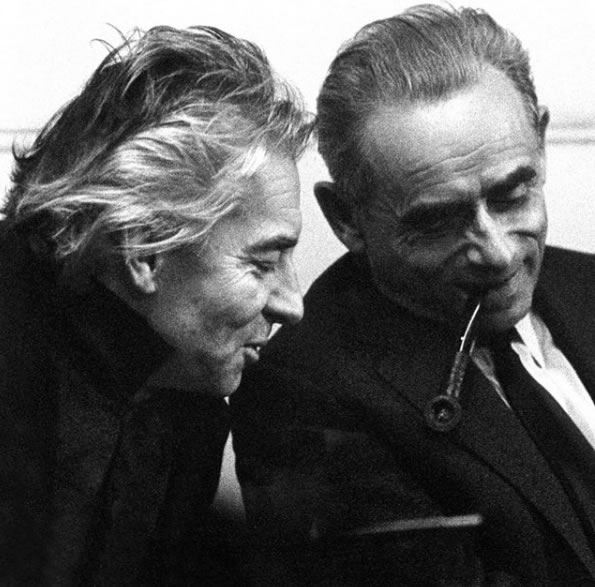 With Henri-Georges Clouzot (1969) (photo Siegfried Lautenwasser)[/caption]
That collaboration began with a documentary, in which Karajan was filmed by Clouzot during the rehearsal and performance of Schumann's Fourth Symphony with the Wiener Symphoniker. The two clicked, they admired each other's work.
Soon after Clouzot's death, Telemondial came into the picture, the production company founded and financed by Karajan himself, which was created to continue Clouzot's work unabridged, but subsequently also expand it further by making the productions (concerts, opera) suitable for specific digital platforms as well. In this respect too, Karajan was a pioneer. It led to a large number of projects, most of which are now available on Stage+, the streaming platform run by Deutsche Grammophon.
The 'perfectionist model', for Karajan left absolutely nothing to chance. Everything and everyone was staged down to the finest detail. While it was about the music, its visual presentation had to be created with a clear vision – his, of course. For the orchestra members, this involved matters such as uniformity, with as few movements as possible that moreover had to be strictly coordinated, no exaggerated physical expression, clothing precisely suited to the occasion, etc. Karajan's own involvement in both the direction and the editing determined to a large and often decisive degree the final result.
Because this entire process was meticulously prepared and had to be executed, it left little or no room for taking risks. A straitjacket, then, from which no one could – let alone wanted to – escape. Not only was Karajan the true master of this process, but there were also major financial interests involved, including those of the orchestra members.
[caption id="attachment_43586" align="alignleft" width="300"]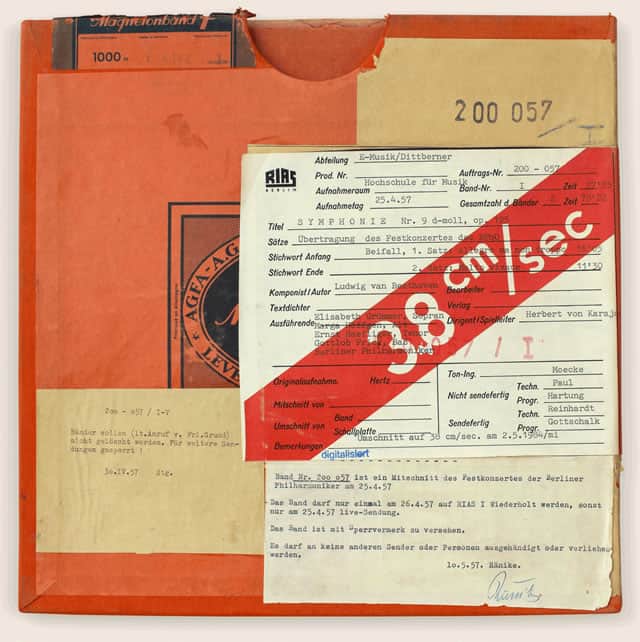 Audiotape of the concert on April 25, 1957 in the Hochschule für Musik with Beethoven's Ninth Symphony on the program[/caption]
From his studio recordings with the Philharmonia Orchestra, founded by the renowned producer Walter Legge, in London in the late 1940s and early 1950s, it becomes crystal clear what Karajan focused on at that time: rhythmic vitality rather than, as in his Berlin years, a more voluptuous sound, with the associated absolute control as the counterpoint to spirituality, liveliness, emotion. It had two outcomes, with sterile beauty and stylistic uniformity (the contrast between the different stylistic periods is partly smoothed out or even disappeared). The theatrical and sensuously bombastic is then not a valuable substitute.
Both on the concert platform and in the studio, Karajan the perfectionist dominated, tireless, consistent, persistent. The better the orchestra, the more they come to the fore. This is also evident from these live recordings, particularly those from the mid-1960s onwards. Earlier recordings show a more expressive, more spontaneous radius of action, though the differences are still relatively minor. Karajan's recordings with the then Wiener Symphoniker also testify to this.
Karajan the 'control freak': the already-mentioned, highly influential producer Walter Legge noticed this early on: the exceptional precision, the unparalleled mastery of the time, the sound refinement. Just as there was that shared goal: the great artistic potential of studio recordings and in this context a very high quality standard. It produced many groundbreaking recordings.
Legge (he played an essential role in Karajan's post-war career) once said: "Over the years his (Karajan's, AvdW) interpretations have varied little in tempo, texture, and form, probably because he did not play a work until he had convinced himself how it should sound."
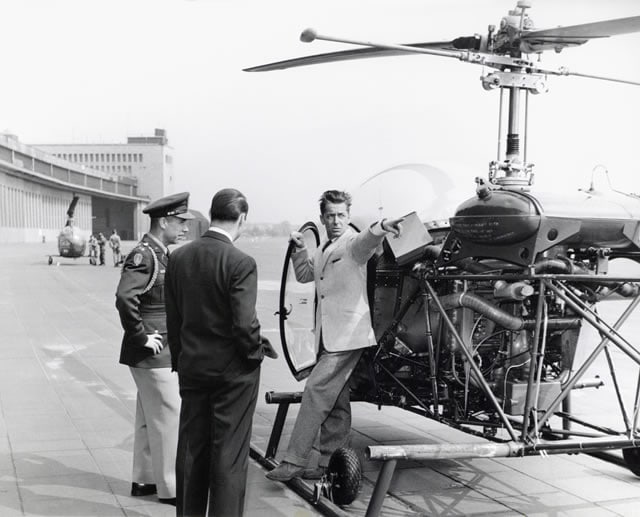 'How it should sound' applied, for example, to Arnold Schönberg's Orchestervariationen op. 31. During the recordings in the early 1970s, Karajan experimented with various orchestra arrangements with a view to achieving the acoustic balance he wanted, but also to allow the complex textures to come into their own as much as possible. Each variation brought a different position with it: instrument groups were moved or sometimes just a single instrument was repositioned based on the idea that what was possible in the studio would be impossible in the concert hall (Schönberg's op. 31 is part of cd 23, the concert at the Philharmonie on 3 February 1969, strangely enough in mono). Of course, criticism came later: that there was 'technical manipulation', but the conductor replied by pointing to the necessity he felt to represent the composer's intentions as well as possible.
We hear it back in the live performances (they also served as preparation for the eventual recording), albeit with the caveat that these are typically radio recordings (some of which are moreover in mono) and therefore less 'refined' than the studio recordings made by Deutsche Grammophon in the 1960s with their greater tonal richness, in the Jesus-Christus-Kirche in Dahlem, a suburb of Berlin, with its excellent acoustics for recordings, and from October 1963 in the newly opened Berlin Philharmonie.
Even in those radio recordings I detected little of Karajan's willingness to take real risks, to make music in the heat of the moment. There are differences between live and studio, but these are usually limited to details in voicing and balance (insofar as the recording quality does not stand in the way of assessment). And that something occasionally went wrong is the logical consequence of 'live'.
Risk and spontaneity go together. Violist Philipp Bohnen and cellist Olaf Maninger believed - it was mentioned before - that this was the case under Karajan's direction, but the surviving radio recordings do not bear this out: the canvas is consistent, only the fine-meshed 'wiring' sometimes lights up just a bit differently. It seems more like suggested spontaneity arising from preparation worked out to the smallest detail (anyone familiar with Karajan's rehearsals knows exactly what I mean by this).
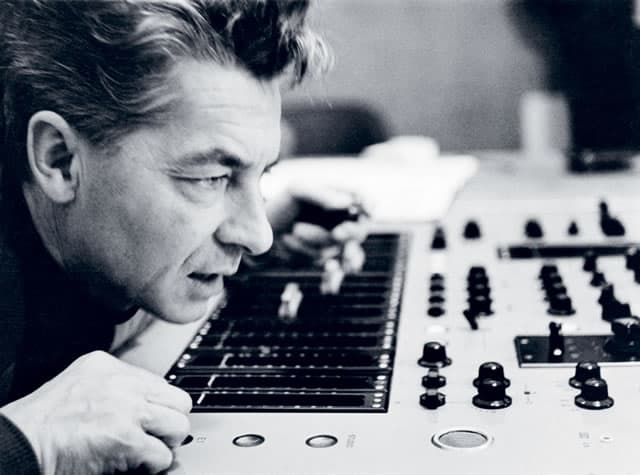 The shift to stereo in the 1960s meant more (also suggested) spatiality and detail, but the technology itself had also advanced. Karajan, always deeply interested in that technology, seized every new possibility or advance with both hands. He was intensively and often forcefully involved in the work of 'sound engineers' such as Hans Weber, Hans Hirsch, Otto Gerdes and Günther Hermanns (which they did not always appreciate), but he had little or no influence on the radio recordings. Furthermore, stereo was already in full practice when broadcasting was still tied to mono: only in 1967 did the first stereo recording appear, a live concert from the Philharmonie on 22 October (cd 16). Although there is nothing wrong with those mono recordings, provided they are not listened to on headphones or on two speakers.
As the collaboration between Karajan and the Berliner Philharmoniker intensified, the sound image also took on a more homogeneous character. The sound becomes 'smoother', more polished and streamlined, which at the time aroused much admiration, both from the public and critics.
The distinction between the sound of the fifties and that from the sixties onwards is expressed nowhere better than in the Beethoven cycles on EMI (Philharmonia Orchestra) and DG (Berliner Philharmoniker). How important the recording and playback technique was for Karajan in this regard is evident from the fact that as new technical developments emerged, part of the repertoire already recorded earlier had to be re-recorded; but often with artistically speaking considerably less successful results (examples of this are the Tenth Symphony of Shostakovich, Debussy's Prélude à l'après-midi d'un faune and La Mer, and the Beethoven symphonies from the seventies and eighties; apart from the audiovisual cycle on LaserDisc released in the late eighties by Telemondial).
What all those different studio recordings do convey is Karajan's obsession with sound, with one of the most compelling examples of this being the Ring des Nibelungen created in conjunction with the Easter Festival in Salzburg which he himself founded during the period 1967-1970, also a textbook example of Karajan's absolute control over everything and everyone (including stage direction).
An enormous amount has been written about Karajan and a large number of documentaries have been devoted to him. Regarding his influence and his eccentricities, the most (un)palatable anecdotes have been circulated, but for the music lover of today, the only thing that is (still) relevant is the musical content of the message and not so much the messenger.
The recently released 24 SACDs represent a picture of the times that has admittedly long since passed, but the value and significance of this sound document in the light of our musical history is indeed considerable. Not only because Karajan managed to promote the Berlin Philharmonic Orchestra to the top of the world (his successor Claudio Abbado was extremely grateful to him for this), but also because his musical legacy still influences the appreciation of classical music. Although the stylistic characteristics of his conducting art came under criticism during the course of the nineties, through his charisma and the many initiatives he set in motion, he fundamentally changed the world of classical music. Some will be grateful to him for it, others perhaps not, but the fact itself cannot be disputed.
Finally, a word about the SACD process with regard to 'old' recordings. The digitization is done in high resolution (DXC, Digital eXtreme Definition or alternatively PCM, Pulse Code Modulation, 24 bit, 192 kHz). Subsequently, the conversion takes place to DSD (Direct Digital Stream) 64 (1 bit, 2.8 Mhz) or even higher, DSD 128. During remastering, the original is further optimized using noise reduction, equalization and dynamic bandwidth. The DSD files mastered in this way are prepared for SACD layering, after which the glass master is made to press the SACD discs. The result of all these efforts is (hopefully) an overall better sound quality that is also at least partially perceptible on 'ordinary' CD players.