Behind the title, of course, lies the world-famous and beloved story of Shakespeare. But Vincenzo Bellini and his librettist Felice Romani wanted to give the love idyll of Romeo and Julia a different twist and made this immediately clear with their title I Capuleti e i Montecchi. Sparkling bel canto is in no short supply, and the Opéra Royal de Wallonie certainly knows how to appreciate this nineteenth-century pearl!
Vincenzo Bellini composed his opera I Capuleti e i Montecchi in six weeks for the Teatro La Fenice in Venice. His ability to complete the work in such a short period is made possible in part because he reused passages from his previous opera Zaïra, which was a fiasco at its premiere in Parma, a procedure that was not uncommon at the time. In the story of the lovers of Verona, the emphasis lies on the social aspects that threaten the couple. Behind fate lies familial and social repression. The two families are enemies, which is accompanied by the political opposition in nineteenth-century Italy between Guelfi (Capuleti) and Ghibellines (Montecchi). In the hostile world, hatred always triumphs over love. This is why the opera contains so many confrontations and duels, fortunately punctuated with moments of gripping lyricism. The scenes follow one another rapidly and lead to an unavoidable denouement.
Somber unified set
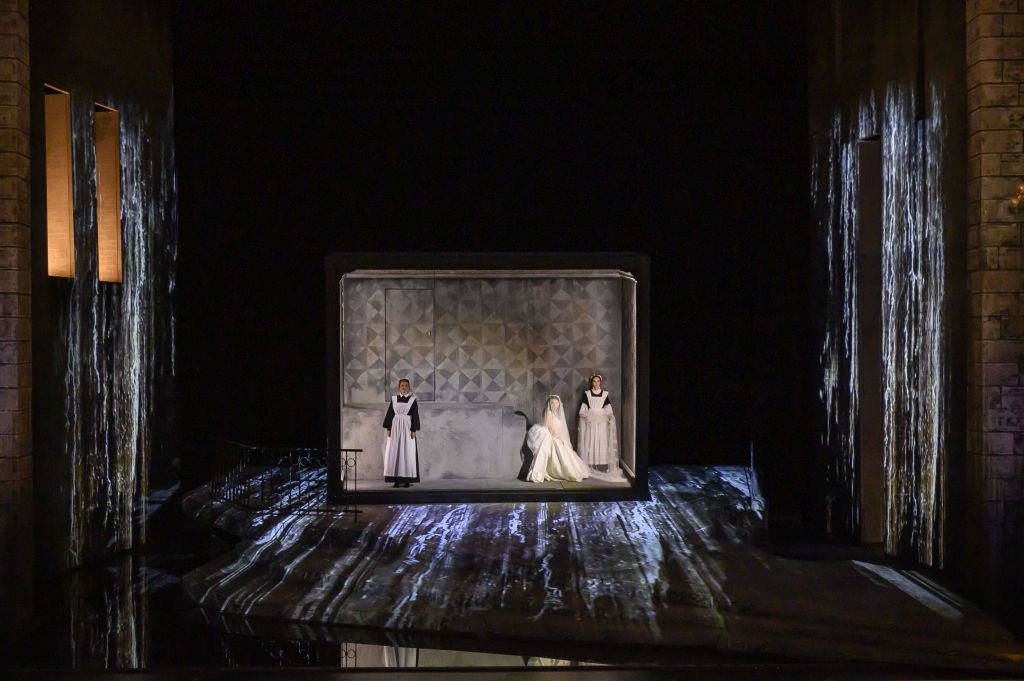
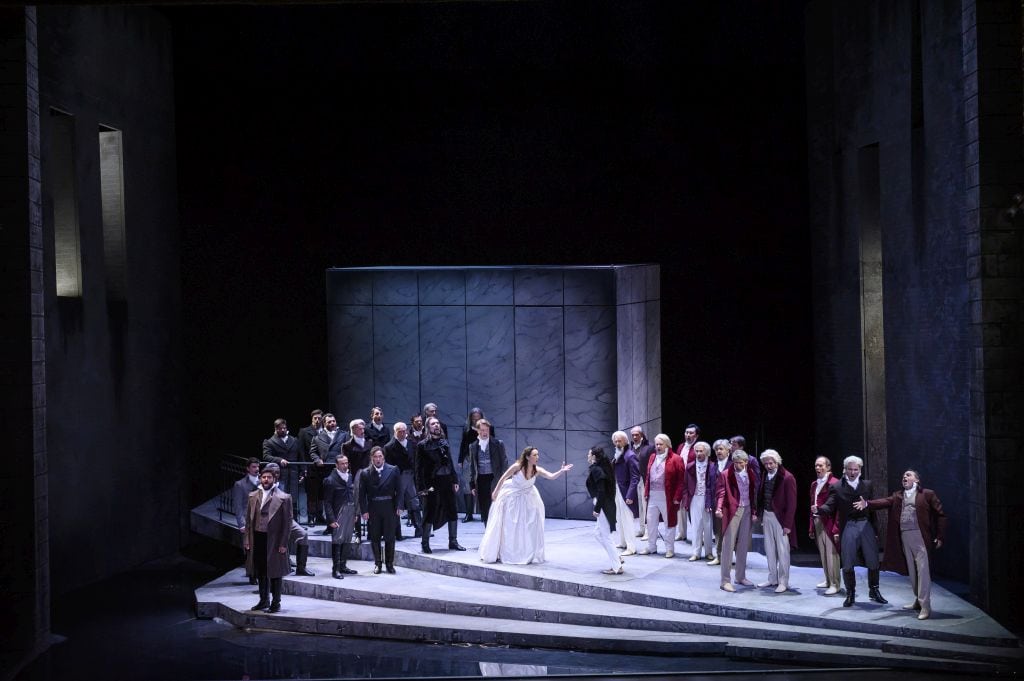
Allex Aguilera, responsible for direction and design, succeeds in skillfully interweaving the parallel intrigues. The set shows a desolate-looking castle with a moat in which, with minor adjustments, all scenes receive an appropriate representation. The massive cubic form that stands center stage is cleverly transformed into Giulietta's chamber where she is prepared by servants for the arranged marriage, projection screen for nightmarish visions, or partition wall between the clans. In her poignant opening aria Eccomi in lieta vesta the grey side walls with long dripping tears seem to weep with Giulietta, who sadly faces her forced marriage and hopes that Romeo can still save her. The interplay of light on the sparse set elements accentuates the foggy despair of the intrigue. Simple but full of meaning.
Limited number of characters
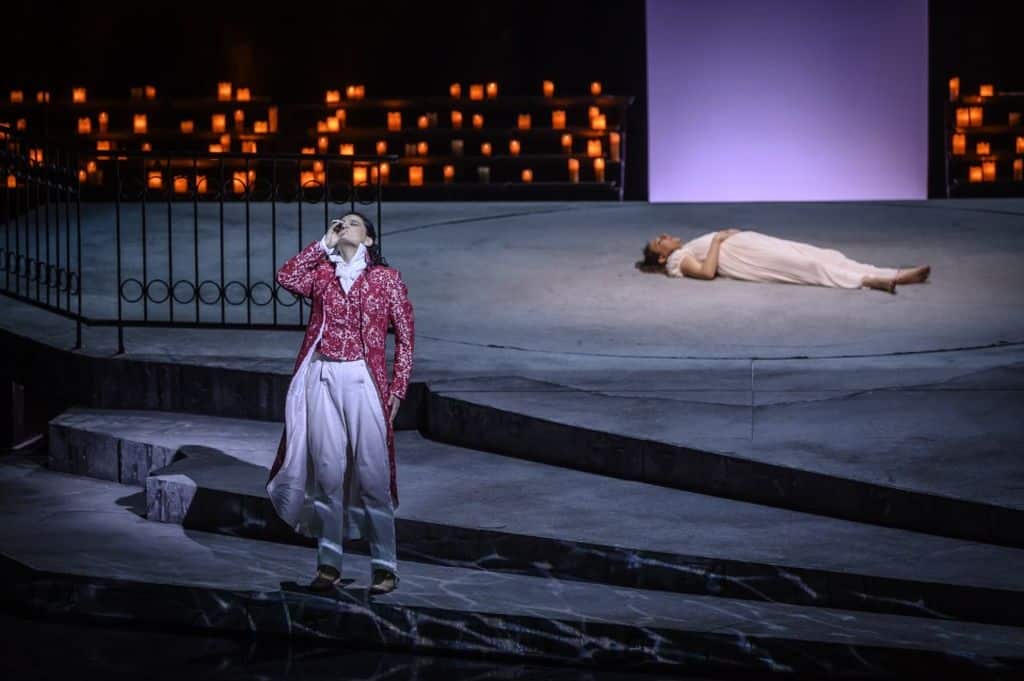
The limitation of characters in the libretto gives Bellini the musical opportunity for expressive characterization, and this is skillfully utilized by the director. The opening scene briefly insinuates the backstory that Romeo killed Giulietta's brother in the fight, so her father cannot possibly give her as a bride to Romeo – even though Romeo proposes it as a sign of reconciliation between the hostile clans. From the very opening scene, the direction establishes the relationships clearly: the unwavering father, the hopeful bridegroom Tebaldo – who gets to sing his love first and prominently (L'amo tanto e m'è si cara). The carefully crafted nineteenth-century costumes allude to the period of the opera's creation. In the important confrontations, the focus is always on the characters in such a way that nothing distracts from the essence. For example, the understanding between Lorenzo and Giulietta, the fierce and hostile confrontation between Romeo and Tebaldo in the second act (against the background of the projection of the seemingly dead Giulietta), and of course the harrowing despair of the lovers in the final scene, where the direction requires nothing more than a few sober movements, making use of the beautiful set (with the water in the moat further intensifying the melancholy).
[embed]https://www.youtube.com/shorts/xUVC25lNsDo[/embed]
Bel canto in the literal sense
Besides the simple effectiveness of letting the story flow smoothly and engagingly from scene to scene, it is of course the vocal virtuosity of the performers that ensures a moving opera experience. From the very first love duet between Giulietta and Romeo, both Rosa Feola and Rafaella Lupinacci manage to align the melodic richness of their parts with dramatic expressivity. The admittedly sometimes frighteningly high notes and long-sustained phrases of Giulietta never sound shrill or forced. The ornaments in her final aria Deh! Tu bell'anima she colors naturally with melancholic tones into a heartbreaking scene. Rafaella Lupinacci not only has the ideal figure for the travesti role of Romeo, but also the soft beautiful tone for the lovestruck hero, which does not prevent her/him from also being convincingly angry and swearing vengeance. (Se Romeo t'uccise un figlio – followed by the cabaletta: La tremenda ultrice spada)
Besides the two lead roles, the other performers also deserve all praise: the clear tenor of Maxim Mironov as the – albeit somewhat neutral – rival Tebaldo, Roberto Lorenzi as Capellio, with the harshness but also defeat of the father in the solid bass voice, and certainly the beautiful charismatic portrayal of Adolfo Corrado as Lorenzo. The end of the first act thus provided a splendid quintet as finale.
And then there is the orchestra conducted by Maurizio Benini. Known as a master of the genre, he draws the best out of the Opéra Royal de Wallonie orchestra. He guides it through the emotional turns of the story. He consistently allows the scenes where Bellini uses solo instruments to underscore the atmosphere to come into their own, of course particularly the dark tones due to the feelings of drama (the horns in Giulietta's opening aria, the touching cello in her aria at the beginning of the second act (Né, alcun ritorna) and the clarinet in the duet between Romeo and Tebaldo (Deserto è il luogo).
A breathtakingly beautiful performance of this belcanto gem by Vincenzo Bellini that rightfully received enthusiastic applause from the premiere audience.