

An intense journey between loving and rejecting.
With Duke Bluebeard's Castle Bartók composed his only opera. It is such a compact and dramatic work that it always overwhelms. This is also the case in this production by the Aalto-Musiktheater in Essen. Director Paul-Georg Dittrich opts for absolute rejection of scenic details and focuses directly on the thrilling relationship between Bluebeard and Judith. The music provides deepening of the psychological journey through the relationship between the two protagonists.
Bartók is thirty years old when he begins the opera in 1911. In May 1918 the premiere takes place in Budapest, after overcoming many difficulties including with the orchestra. The creation is a success. It is his first composition in which the melody is based on Hungarian folk music. The use of the pentatonic scale is the most striking musical characteristic of the opera, together with the constantly recurring motif of the second.

The work is problematic because of its symbolic content and intimate feelings. The theme is derived from Charles Perrault's fairy tale La barbe bleue. Librettist Béla Balász and Béla Bartók align with the spirit of the time and give the old legend a new symbolic coating. For example, the second symbolizes blood, both of the murders committed and of the penetration of the conquered women. They bring a psychological version of the gruesome knight who murders women. Bluebeard is a lonely, tragic figure, Judith the passionate woman in love, who wants to penetrate what is hidden behind the seven doors, all aspects of Bluebeard's inner life.
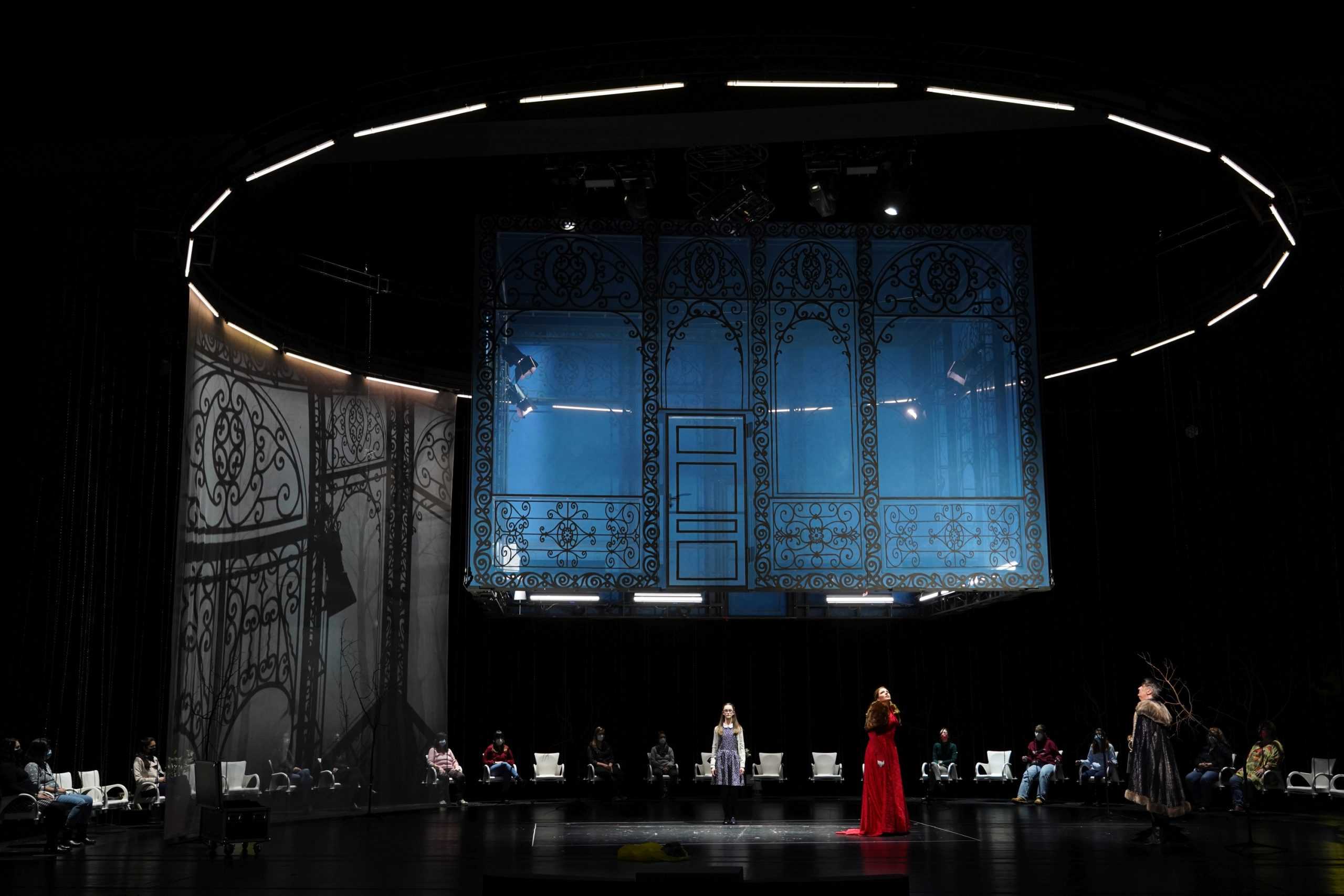
The production plays on this beautifully through the sober scenic execution with an almost empty stage. At the beginning there are a few withered trees that suggest the sterile environment of the mysterious castle. These are later replaced by small clusters of white lilies (symbol of the pure love that Judith tries to offer Bluebeard?) In the background we see a black and white video of an autumnal forest landscape as the desolate location of the castle. The stage is otherwise bordered by a semicircle of white chairs, where spectators can experience the opera. In the last two scenes they are also involved in the action. Above the stage, a circle of neon lights that align with the circular structure of Bartók's opera. A fairytale peepshow house provides a reference to the old legend in a few scenes. The accompanying text "Es war einmal" emphasizes the fairy-tale element. The decorative arabesques also give it a fin-de-siècle touch, the period in which the opera was created. The house doesn't hold up, tilts and disappears. It fails to represent a "love nest," which is also expressed by the sentence: "War Nicht" – of which Judith at the end deletes two letters, so that "War ich" gives a harsh foreshadowing of a negative outcome. Her attempt to love Bluebeard has failed and who can she still be?
Despairing partners
Bass Karl-Heinz Lehner and soprano Deirdre Angement excellently embody the central conflict: the distant relationship between Bluebeard and Judith and the impossibility of love. The struggle for closeness between the two is a fight of two despairing partners, doomed to continually – and ultimately definitively – fail. Lehner has a moving yet supple bass voice, can be brutal but also painfully soft in his insistence. Angement performs every emotion of the demanding score with clear virtuosity. The costumes also contribute to the portrayal of desire on one hand, loneliness and distance on the other. Bluebeard is dressed as the aristocratic knight from a distant past, Judith dresses elegantly and gracefully (the red cloak) but especially sensually.

In Bartók's opera no one wins or nothing wins, not Bluebeard and not Judith, not love and not the couple. Karl-Heinz Lehner is no monster; through his tenderness and his persistent pleading he makes the too curious Judith with her poorly controlled affectivity almost into a negative character. Deirdre Angement performs her role as a self-assured woman, on the verge of aggression, making her almost become the negative character and in her obtrusiveness gives Bluebeard no chance to spare her from the fate that the previous women have undergone. The last two doors then show the definitive separation. At the same time the orchestra launches a hymn rhythmed by clarinets and bassoons and in the tutti of the orchestra the second sounds once more.
The prologue in the original version is spoken by a bard, who asks to listen to an old, still true story. Then follow the episodes that build a dramatic tension curve. The director has chosen here to have the prologue recited by different voices, which seems somewhat strange. I also miss the meaning of his procedure to split Judith with extras and have spectators take seats on stage and sometimes give them an extra role. It seems more of a curiosity to let some spectators who feel like it try a different approach to the opera.

The Essener Philharmoniker, under the direction of Hungarian conductor Gábor Káli, deliver an extremely dynamic and nuanced performance of the challenging score. The sustained chords, the glissandi passages of the tears in the sixth door, pianissimo passages (the harp at the second door or the mysterious sound in the garden) and the outburst of the full orchestra as the fifth door reveals Bluebeard's lands, the musicians continuously sweep the audience along. Their performance runs perfectly parallel with the atmosphere of the hard struggle and gentle longing that the protagonists experience. There are no doors to be seen on stage, the orchestra guides the audience through the music into Bluebeard's inner life, to which Judith attempts to gain access at each successive door.
The performance shows a gripping drama of the impossibility of authentic love and the loneliness that follows. An opera experience that leaves you quietly departing the theater.
WHAT: Béla Bartók, Duke Bluebeard's Castle
WHO: Paul-Georg Dittrich [director], Karl-Heinz Lehner [Bluebeard], Deirdre Angement [Judith], Essener Philharmoniker conducted by Gábor Káli
WHERE: Aalto-Musiktheater, Essen
WHEN: Performance viewed: 23 April 2022
Website: www.theater-essen.de