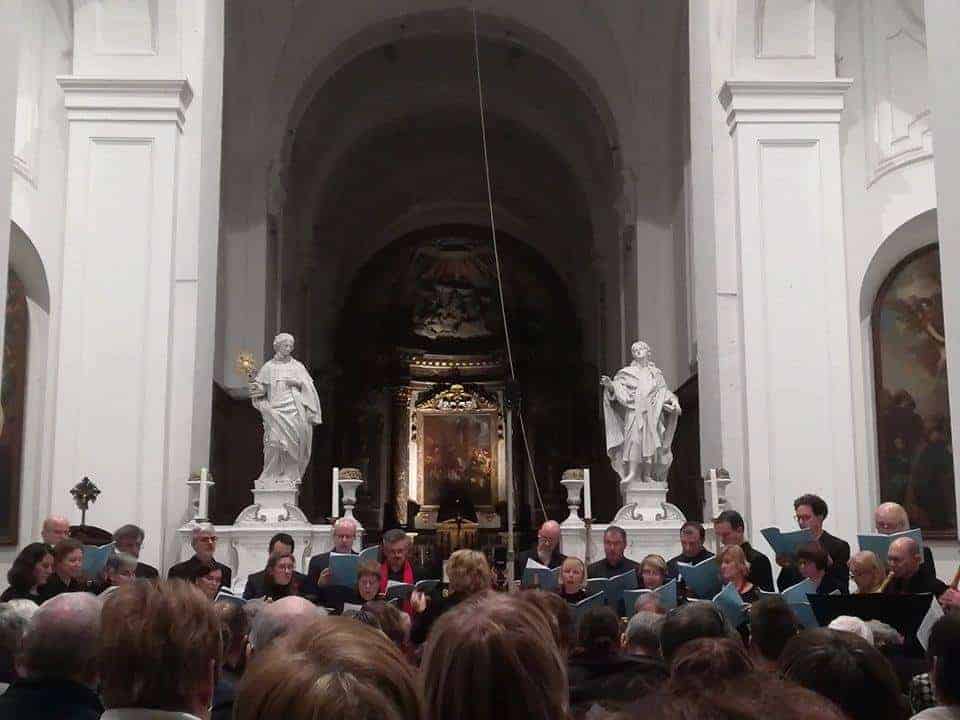
Bach's music is usually at its best when performed as historically correctly as possible. Ensemble Capella Nova undoubtedly succeeded in that goal with its concert J.S. Bach: Motets at one of the most beautiful locations in Flanders for baroque concerts: the Abbey of Park in Heverlee.
Even in the dark, the Premonstratensian Abbey of Park is a breathtaking site and the prime location in Leuven for organizing baroque concerts. The current form of the abbey dates from the late 17th century and early 18th century. The carriage house and tithe barn from 1663, the Lion Gate from 1725, and the 14th-century Church of St. John the Evangelist, adapted in a classicizing baroque style in 1729, ensure that the visitor feels as if transported to the time of Johann Sebastian Bach. Had Bach visited the abbey himself, he would have seen virtually the same as what we can still admire today.
Apart from the impressive location and the beautiful baroque church where the concert took place, Capella Nova's interpretation of Bach's Motets (BWV 225-230) under the direction of Marleen Reynders was also worthwhile. The singers and musicians of pre-professional level, as they describe themselves, delivered a carefully prepared performance of four motets, one sonata for flute, and one cantata. Why precisely these works were chosen and not an integral performance of all six motets remains unclear, but the combination with other genres did provide a pleasant variety.
The first part of the concert consisted of three motets: Komm, Jesu Komm (BWV 229), Der Geist hilft unsrer Schwachheit auf (BWV 226), and Singet dem Herren ein neues Lied (BWV 225). The small instrumental ensemble, consisting of two flutes, two violas da gamba, one baroque cello, and organ, created a restrained impression, which is certainly appropriate for motets composed specifically for performance at funerals. The balance was not always entirely perfect, but this was easily offset by the beautiful accompaniment of the organ. Organist Arno Kerkhof, known for his Bach interpretations, certainly deserves a mention here.
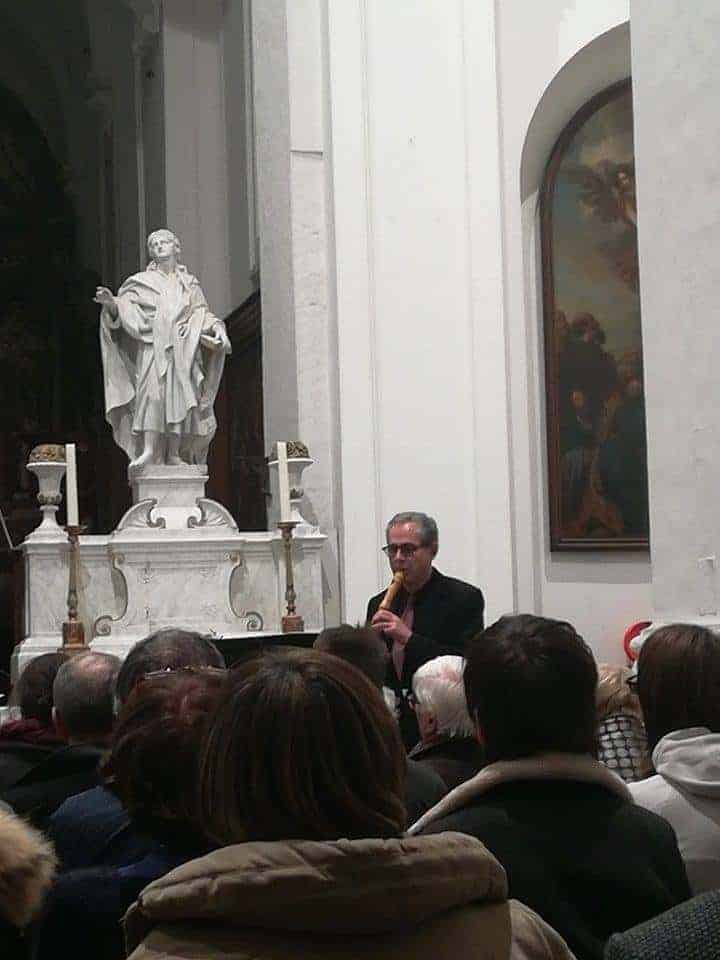
After the intermission, the ensemble resumed the concert with the motet Jesu, meine Freude (BWV 227), a very dynamic motet and a good choice to resume the concert and regain optimal attention. Capella Nova then presented the Siciliano from the Flute Sonata in E-flat Major (BWV 1031) with soloist Erik Panis on recorder, a beautifully executed intermezzo as a transition between the motets and the last performed work. The cantata Gottes Zeit ist die Allerbeste Zeit (BWV 106), one of Bach's earliest cantatas and also known as Actus Tragicus, was composed, like the motets, for a modest ensemble and to be performed at a funeral. The small ensemble used for the motets was therefore perfectly suited to perform this final work in an authentic manner. That the soloists had to bend each time under the pulpit to reach their places at the front of the orchestra might have been solved by removing a few chairs from the front row and would perhaps have given the entrances and exits of the soloists a less awkward appearance. Soprano soloist Hanne Raport-Hautekiet seemed somewhat nervous and therefore did not always sound perfectly in tune, but certainly performed well nonetheless. Soprano Brigitte Maes, tenor Jan Petes, and in particular bass Alessandro Cortese also delivered a praiseworthy performance.
The audience's reaction was very positive and the entire concert was for me a delightful intermezzo during the examination period.
- WHO: Vocal and instrumental ensemble Capella Nova conducted by Marleen Reynders
- WHAT: Motets Komm, Jesu Komm (BWV 229), Der Geist hilft unsrer Schwachheit auf (BWV 226), Singet dem Herren ein neues Lied (BWV 225), and Jesu, meine Freude (BWV 227); Siciliano from the Flute Sonata in E-flat Major (BWV 1031); cantata Gottes Zeit ist die Allerbeste Zeit (BWV 106, "Actus Tragicus")
- WHERE: Abbey of Park, 3001 Heverlee
- WHEN: Saturday, January 20, 2018, 8 p.m.