

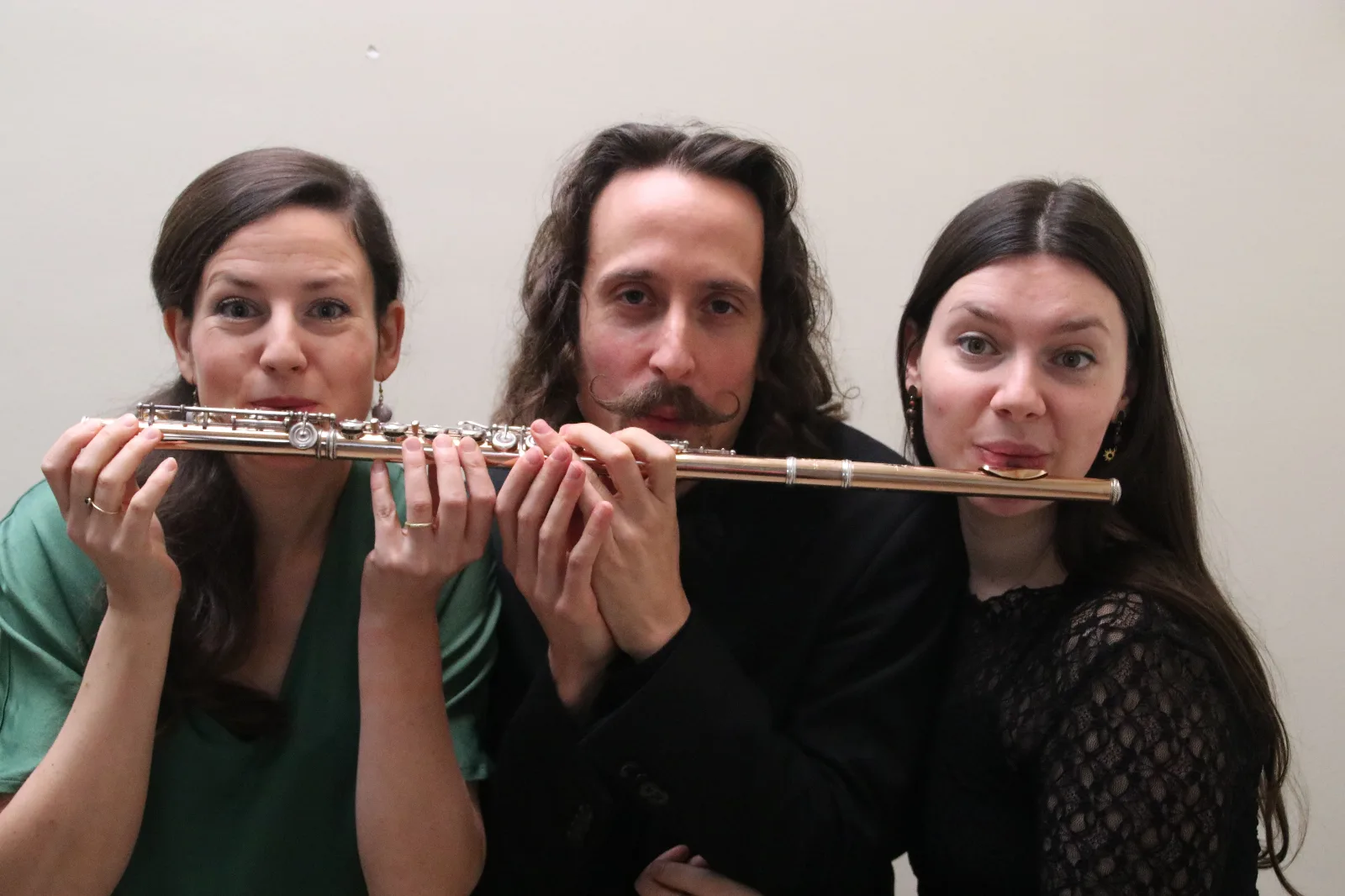
"'T Is weer voorbij die mooie zomer", sang Gerard Cox. Soprano Lissa Meyvis and instrumentalists Lester Van Loock and Valérie Burndorfer let themselves be inspired by the glorious Indian summer and built this first edition of the season around the seasons and their accompanying moods. The loyal audience was happily once again immersed in the world of belcanto & belle musica. It is always like coming home. From the overwhelmingly beautiful stream of music, these musical adventurers chose a richly colourful weave of arias, songs and instrumental music. A playlist, with guest flautist Valérie Burndorfer, who is known as one of the most promising young flautists in Europe.
These artists want not only to shine on large stages, but also enjoy the intimacy, the close and direct contact with the audience. Hostess Lissa Meyvis always manages to win over the audience completely with her unaffected charm and versatility. The chosen repertoire is broad, appealing, breathtaking and virtuosic. Refined enough to speak to an audience of classical music lovers, and accessible enough to reach people who have never been to a concert before. They make a golden selection from the specific repertoire for piano and flute, and where those compositions are not already written for violin, cello or another instrument, parts have been provided through an adapted arrangement. A good deal of preparation went into it. Passion and commitment radiate from every note.
As the opening number, Das Veilchen by W.A. Mozart. One of Mozart's best-known and most beloved songs, to a text by Goethe with a pastoral touch. There is an atmospheric introduction by flute and piano, and then Lissa Meyvis immediately dives in, full of expressiveness, into the melancholic story of a violet that a shepherdess wants to pick, but accidentally trampling the little flower. From the very first note, Lissa brings the narrative character of the text to life with body and facial expression.
She does not hide her crush on the repertoire of Toon Hermans. Entirely fitting the theme, she performs Aah, qu'il est beau le soleil. The sparkling song is a typical example of Toon Hermans' philosophy of life, celebrating the small, simple things in life. The blissful feeling that bubbles up when, after winter, the sun breaks through the grey cloud cover once again.
The instrumental part of the programme was built around the flute and piano. Une flûte invisible is a French art song based on a text by Victor Hugo and composed by Camille Saint-Saëns. Written explicitly for soprano, flute and piano, Saint-Saëns masterfully captures the atmosphere of the invisible flute.
This is followed by La flûte enchantée by Maurice Ravel from the second part of Shéhérazade (1903). It evokes Oriental and Arabic moods, to which the sound of the flute lends itself perfectly. Valérie Burndorfer can display her craftsmanship here with technical refinement, impressively, a small masterpiece combining atmosphere, exoticism and restrained longing.
A French classic from the lighter genre, an evergreen, La Mer by Charles Trenet. Lissa Meyvis never gives a sterile performance, but always with empathy. Lester Van Loock does not merely take on an accompanying role but is a full-fledged counterpart.
Another change of mood with one of the oldest traditional English folk songs in the world, Greensleeves. The song probably dates from the late 16th century. A melancholic melody and romantic text.
To close the first part, Valérie Burndorfer plays the Undine Sonata by Carl Reinecke, one of her favourite compositions, she reveals, a masterpiece for flute and piano from the late Romantic period. The instruments tell the tragic story of the water nymph Undine. At times the flute recalls babbling and flowing water, while the piano voices the dramatic action. A work full of shifts in mood, from happiness to threat, passion and despair. An exemplary illustration of how a composer seeks the sounds and notes, the poet the words, and the singer and instrumentalists give them feeling.
After the interval, Lissa performs the magnificent and impressive soprano solo Rejoice greatly from Handel's Messiah. In this vocal work the composer reaches towards the divine. A jubilant song that makes you instantly happy. She delivers not only a high-quality interpretation but also dizzyingly high notes. Music that leaves no one untouched. Messiah, an imposing and deeply human composition.
A tip: on 12 December at 20:15 she sings the Highlights of the Messiah in the Sint-Elisabethkerk in Kortrijk together with the Crescendo koor Rollegem.
Next, the aria Frère voyer from Werther by Jules Massenet. The violin and oboe parts have been transcribed for flute. Skilful work.
Room was also made for female composers, beginning with the highly successful French composer and pianist Cécile Chaminade. The trio performs Portrait valse chantée for soprano, flute, piano, in which her technical mastery is evident. The whole is elegant and light-footed.
Lester Van Loock briefly draws all the attention to himself. He plays Adagio, a work by Joseph Hector Fiocco in the piano arrangement by Emmanuel Durlet. An important work within the Belgian and Flemish classical music heritage. It brings together 18th-century Baroque music and the 20th-century piano tradition. Lester opts for restraint at the keyboard and shapes it according to his own feeling: atmospheric, and unafraid to let the silence between the notes speak as well.
Next comes Cecile Chaminade's composition: Chanson de neige. A beautiful, heartfelt art song. The narrator seeks comfort in the wintry nature, but finds only coldness and emptiness.
Lili Boulanger, the groundbreaking French composer and musical prodigy who, despite her tragically short life (she barely reached the age of 24), left an indelible impression on classical music, is represented by D'un matin du printemps. The piano score clearly reveals new tendencies, influenced by impressionism. The universal life force, the bubbling sap of nature, is also perceptible in the composition.
Then summer takes its turn with the beautiful Summertime from Porgy and Bess by G. Gershwin. Lissa Meyvis brings an unusual interpretation, with tight control yet so deeply felt that it gets under your skin and moves you.
Finally, autumn with Autumn Leaves by Joseph Kosma. Originally a French song, "Les feuilles mortes," written by the poet and screenwriter Jacques Prévert. Today it is best known as a jazz standard. Lester Van Loock also holds his own in those territories.
The program concludes with Le Rossignol by Léo Delibes. Originally written for voice and piano, it is today particularly known as a trio for soprano, flute and piano. It becomes a battle between the three performers, with exquisitely delicate solos in a devilish dynamic, tonal swirls like garlands. Delightful.
This first edition of the season belcanto & belle musica once again inspired the audience. Music as a tonic that drew a smile, even a laugh, and also a tear. A matinee of kaleidoscopic emotions. An impressive encore followed: Il est cinq heures, Paris s'éveille by the late Jacques Dutronc, once again with the beautiful sound of the flute. Inspired by their youthful fire and craftsmanship, the audience gave itself over to a appreciative and prolonged applause.