


In our country we have not only excellent musicians but also some talented musicologists who write with passion about music and its history. I should mention Bach scholar Ignace Bossuyt, Francis Maes with his history of European classical music, Marc Delaere with his short music history after the 1950s and the original approach with which Pieter Bergé created his "walk through music history" for young and old. Yves Knockaert also wrote a remarkable book about the many ways we can listen to music. Now he comes out with a heavyweight on the "classical masters". And he situates them primarily in the 18th and 19th centuries. Not a real music history, but a book in which you rather learn how 27 great composers in those two centuries react to each other's work. That casts a very special light on all those wonderful compositions they wrote. You could safely consider it an alternative music history.
Who influenced whom: some are each other's friends, others each other's enemies. This is about influences undergone and influence exerted, about drawing inspiration and inspiring, and from whom. And you read about that from one generation to the next. Remarkably, Knockaert does not begin his overview with the greatest of all, Bach. The first example is fellow countryman and contemporary Händel. How he proceeds with "borrowings" for his many operas - he wrote about 20 - to make "first-rate Händel" of them with the necessary modifications. Until he says farewell to opera writing and chooses oratorio, which the English meanwhile prefer to Italian operas.
And then comes that other master, Bach. Also someone who had no problem with borrowings from contemporaries and predecessors but did it in a very eccentric and perfect way. As evidenced by the many historical anecdotes and musical analyses you read about in this chapter on Bach, "the greatest". Brilliantly summarized, all of this, life and work of the baroque composer: depth and no ornamentations. And again and again those numerous references to contemporaries such as the Italians or to critics who found him bombastic and dark or to others who composed more to the public's taste like Telemann.
And all 25 other "classical masters" are treated equally eruditely in the same way. It is an intelligent analysis of how and what relationships exist in their work and their lives. The discussed composer is extensively analyzed in the light of the work of predecessors and contemporaries and all of this situated with the necessary biographical context. He tells connections and stories with very extensive knowledge. You also see this in the careful enumeration at the end of each chapter of all discussed compositions. Their number is countless. That number is moreover found in an extremely practical and extensive index.
And at the end of reading you immediately have a better sense of how over those centuries the musical styles developed in that Western classical music. In every generation, the next generation stands here again on the 'shoulders of giants'. And for each of those great or small giants, Knockaert gives a characteristic epithet in the subtitles that he then extensively justifies. For Beethoven it is briefly "the giant". For Schubert, "grand in the lied", Rossini "belcanto in the opera", for Bellini "even more belcanto", for Mahler "symphony as opera", Paganini, "violin virtuoso".....
Knockaert is also virtuoso in describing all those connections that do exist between all those classical masters. "Afraid of criticism", as Knockaert characterizes Anton Bruckner, the author certainly does not need to be.
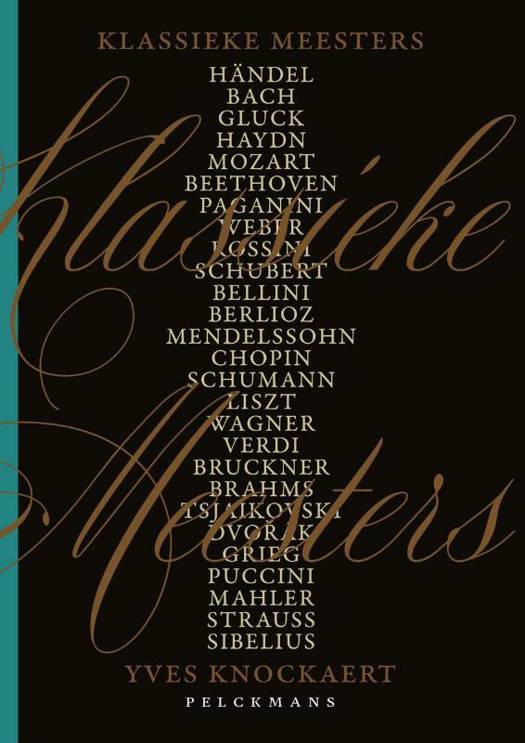
WHAT: Klassieke Meesters
WHO: Yves Knockaert
PUBLICATION: Pelckmans, 670 p. (2022)