

Being invited to a press conference on a beautiful spring day at a beautiful location with a wonderful concert to follow – which journalist would not succumb to that? You probably enjoyed those spring days in late April and perhaps you even know the location: the Abbey of Park in Leuven.
As a music lover, you may know that the first gatehouse of that abbey site is the House of Polyphony, the seat of the Alamire Foundation. But the press conference took place in another, even larger gatehouse on the abbey site, in the Norbertus Gate, for it also houses part of the Foundation. It is a very important workplace, if not the most important! It bears the name 'Library of Voices'. Here stands their mobile digital laboratory with which they can travel anywhere in the world to digitalize music manuscripts, the entire patrimony of polyphony from the 15th and 16th centuries, wherever it may be.
It was quite a feat when the team could digitalize and make accessible more than 13,500 items from the Vatican libraries in 2012 and upload them to their IDEM database, the Integrated Database for Early Music. And there is still much to discover. Now they want to systematically tackle known and yet unexplored music sources from the Baltic States and Central Europe over the coming years, linked to the Low Countries. In this way, the Alamire Foundation wants not only to make all those precious manuscripts accessible for scholarly research by musicologists, but also to enable musical valorization, to make those works audible again and to search for new performance practices, all in collaboration with professional musicians and specialized ensembles.
With the Sound Lab, they can also study the layering, the individual voices that together form the polyphonic texture, but furthermore also experiment with the historical acoustics of certain spaces and add them, for example. The Alamire Foundation thus also embraces AI (indeed) and XR ("Extended Reality Technology") to design immersive installations in which visitors can experience that historical music in its original acoustic context. Such an immersive experience room, a virtual dome of polyphony, is coming to the Leuven Predicant Church. It is the next project with which director Bart Demuyt wants to present for LOV 2030, when Leuven is European Capital of Culture. Such an immersion in a multidimensional representation of both the visual and auditive aspect of polyphonic music was already realized last year during the exhibition "Knowledge in Sight" on the occasion of 600 years of KU Leuven and the Sollazzo Ensemble was responsible for that.

It was high time, Bart Demuyt thought, to present their new CD: Flamboyance, made on behalf of the Alamire Foundation. It is a reference to the final phase of Gothic architecture where everything became more luxuriant and exuberant, and so too the music. You can read all about that change in sound during that time in the fine essay by Pieter Mannaerts in the CD booklet. It goes without saying that the terms 'luxuriant' and 'flamboyant' also apply to the performance; you hear an expanded (20!) ensemble in a decidedly lively and festive mood, conducted by Anna Danilevskaia.
Phaedrus Ensemble
[caption id="attachment_55167" align="alignleft" width="300"]
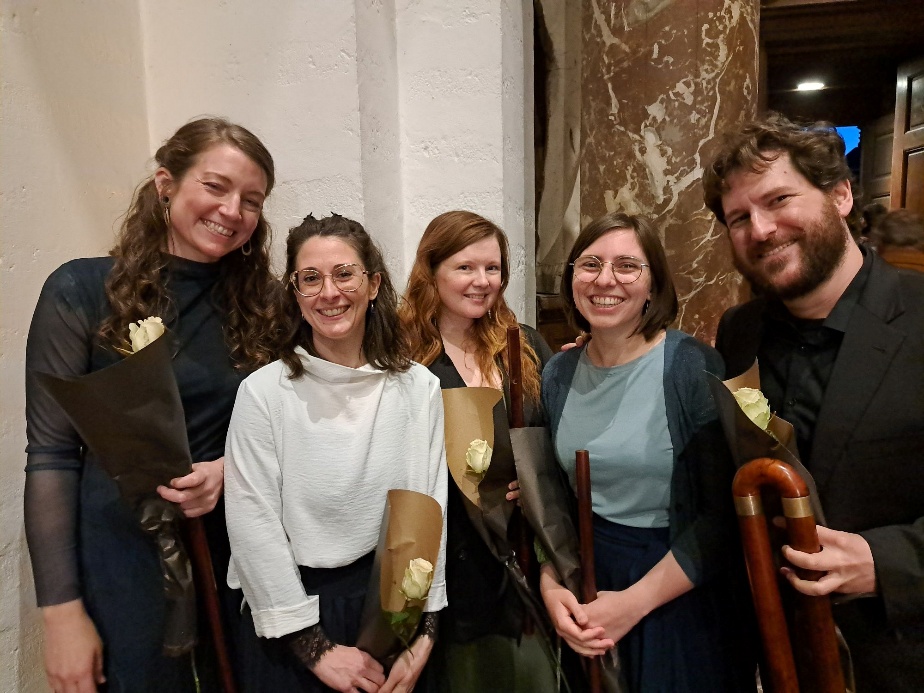 Mara Winter (traverso), Miriam Trevisan (zang), Liane Schneider,Charlotte Schneider en Luis Martinez Pueyo (traverso)[/caption]
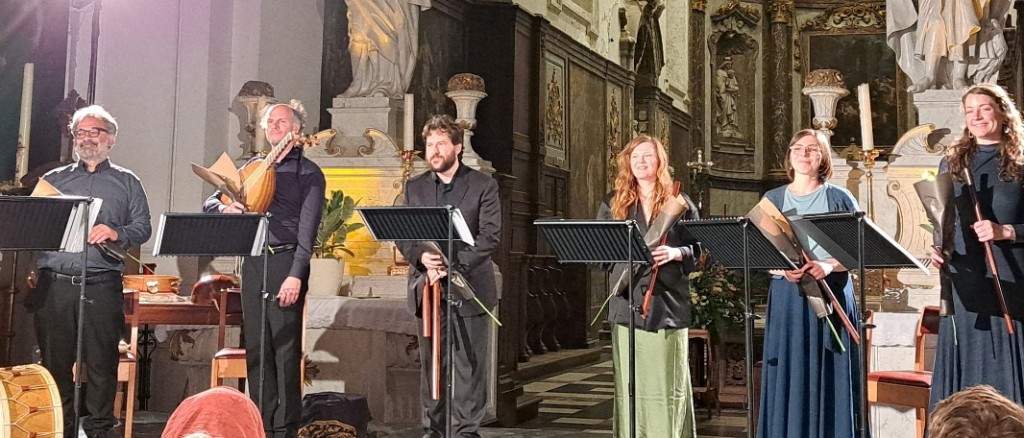
Among these musicians was Mara Winter, a specialist in the medieval and renaissance flute. That day she was there with her group Phaedrus as a guest in the Abbey Church at the Passion of Voices festival. It was the icing on the cake. Four musicians on the most simple forms of those old traversos, without keys, without mouthpiece, from soprano to bass, accompanied by drum and lute plus a singer.
They brought a selection of Chansons from the collections of Margaret of Austria and Maximilian I, thus bridging the Burgundian and Habsburg tradition. Little jewels by Henri Isaac, Josquin des Prez, Johannes Okeghem and anonymous works including from the Leuven Chansonnier (La plus dolente…), with or without arrangements by Mara Winter, who has no qualms about experimenting with three- or four-part arrangements. A delightful introduction to that earlier traverso consort practice, supplemented with drum, lute and voice. A beautiful whole with warm, soft but occasionally also spirited tones. Once again an illustration of the Alamire Foundation's passion to reveal lesser-known repertoire in a "different" way.
