

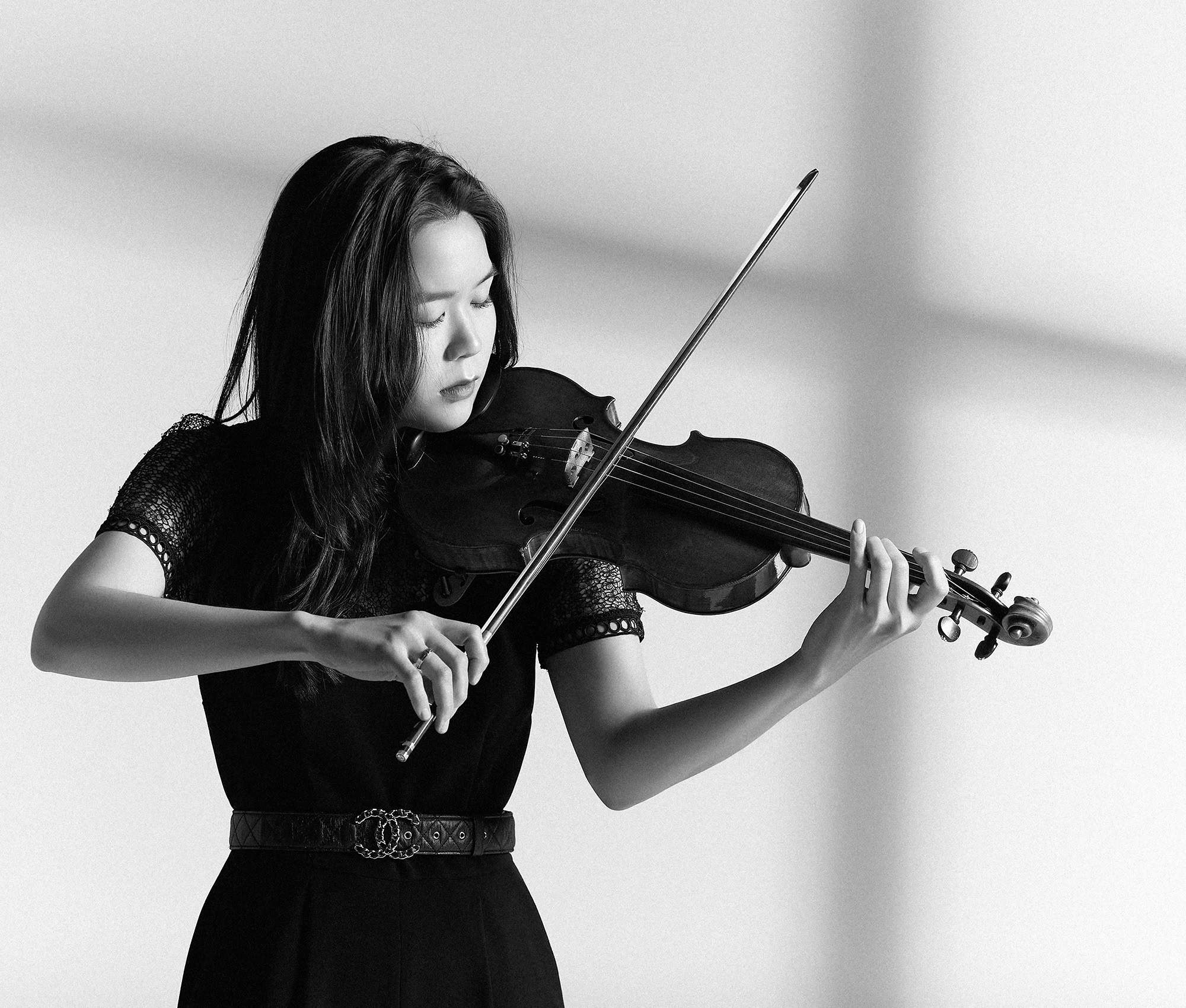
Following concerti by Sibelius, Glazunov and Tchaikovsky, the American violinist Esther Yoo now releases a new selection of concertos on CD. On the Deutsche Grammophon label she releases the concertos by Bruch and Barber. What a combination: a Romantic and a 20th-century classic. As a finale she plays the playful Yankee Doodle by Belgian composer and celebrated violinist Vieuxtemps.
The young violinist Esther Yoo became the first Artist-in-Residence of the Royal Philharmonic Orchestra in 2018. Together they performed Max Bruch’s (1838-1920) Violin Concerto No. 1 in G minor, Op. 26 (1866) for the first time at Cadogan Hall in London. Now, in 2023, she releases this concerto with the RPO on CD.
In the footsteps of Joseph Joachim
Yoo opens with this beloved concerto, followed by Bruch’s Adagio appassionato, Op. 57 (1891). Two works that reflect the influence of violin icon Joseph Joachim. Bruch composed the first version in 1864. The premiere was not a success and Bruch discouraged every violinist from playing it. The German composer reportedly sent the score to Joachim, who proposed various revisions. In 1868 Joachim premiered the new version, and since then the concerto has never left the core violin repertoire.
Yoo now performs this concerto as well. She opens with fitting intensity in the lyrical "Vorspiel" [track 01]. Her sober use of vibrato makes its application all the more powerful. After this emotional opening follows a forceful passage with double stops and virtuosic runs, which Yoo delivers with technical precision.
The relationship between Bruch and Joachim remained good after the concerto. In 1890 Bruch composed Adagio appassionato [track 04] for the Hungarian violinist. It is almost a miniature concerto with the violin in the leading role. Over a bed of strings, the solo violin steps forward. The opening theme is dramatically lamenting. The contrasting secondary theme is in major and offers relief. Once again Yoo brings this work with passion and intensity, dosing ornamentation and vibrato and deploying them at strategic points. The Romantic weltschmerz that softens towards the end comes through beautifully as a result.
Music from America
Samuel Barber’s (1910-1981) Violin Concerto (1938-39) is undoubtedly one of the best known of the 20th century. This American composer lets the violin seduce the human ear. Yoo enters solo in the "Allegro" [track 05]. Without orchestral support she unfolds the expressive theme. For the usual concert virtuosity you need patience. Gradually the violinist builds up the increasingly complex theme. After the climax, calm returns abruptly and the first movement flows into the second movement "Andante" [track 06].
The third and final movement of this concerto is perhaps the most brilliant. The blazing fast "Presto in moto perpetuo" [track 07] is a technical challenge. This final movement opens with a timpani motif, and from this very start the contrast with the previous two movements is clear. Yoo takes on this complex motif. Once she sets her stream of notes in motion, there is no rest until the end. Better still, in the coda Yoo must shift up yet another gear as the stream of notes accelerates. A stunning achievement.
After this American concerto follows a short work by the Belgian composer and violinist Henri Vieuxtemps (1820-1881). Yankee Doodle: Souvenir d’Amérique, Op. 17 (1843) [track 08] begins as an instrumental recitative in which Yoo again enters solo. She delivers the swelling notes and double stops with humour. When the soloist arrives at a long trill, the orchestra joins the musical play. Then the Yankee Doodle tune sounds. It begins simply, but each following variation brings a different technical challenge. Yoo manages these with a light touch, sometimes almost as if the violin could whistle. This delightful piece simply brings a smile to your face.

4/5
WHO: Esther Yoo [violin], Royal Philharmonic Orchestra conducted by Vasily Petrenko
WHAT: Barber Bruch
RELEASED BY: Deutsche Grammophon