

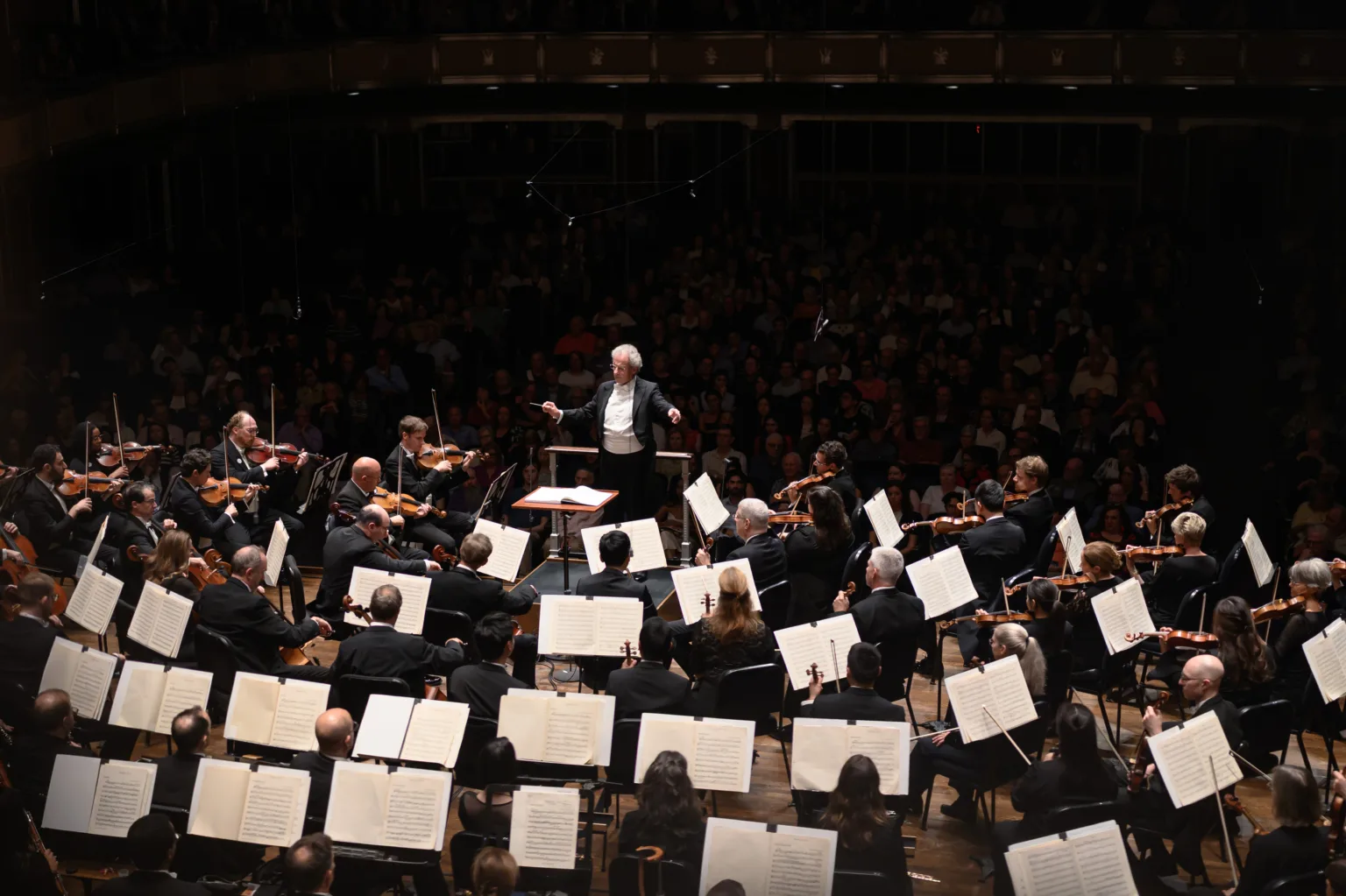
Some concerts stay with you because of one exceptional moment. Other evenings carry you from beginning to end, because the music, the performers and the mutual understanding on stage all come together. The performance of the Cleveland Orchestra under the direction of Franz Welser-Möst at Bozar belonged to the latter category. From Liszt’s Orpheus through Strauss’ Vier letzte Lieder to Brahms’ Second Symphony: three works with a very distinct character, connected by attention to sound, phrasing and the relationship between the various voices in the orchestra.
Enchantment through sound
It was a fine choice to open with Orpheus, a symphonic poem by Franz Liszt (1811-1886) that appears less often on the music stands. The two harps immediately conjured up a sound world of their own, in which the beautiful horn solo was also given full scope. The concertmaster and the cello soloist added further colours with their contributions. The quality of the orchestra was immediately noticeable: a rich sound without heaviness, with instrumental groups that stood out clearly yet remained part of a single whole.
Welser-Möst conducted calmly and with assurance. You could see how well he knows his orchestra and how naturally the musicians respond to one another. They seemed to breathe, feel and think together, without any need for outward display. The music was given every opportunity to develop.
In content too, Orpheus was a fitting opening. Liszt portrays the mythical singer not so much as a hero who conquers the world, but as someone whose music touches people and sets a world in motion. That idea found a continuation in Strauss’ Vier letzte Lieder, in which the music likewise opens a world, this time on the threshold of beauty, farewell and transience.
The expressive power of every word
For Richard Strauss’ (1864-1949) Vier letzte Lieder, the South African soprano Golda Schultz appeared on stage. Her voice seemed made for this music. She sang the notes with great attentiveness and gave the words their full meaning, with an intensity that was never contrived. I had goosebumps from beginning to end.
Her diction was precise. Schultz gave certain words additional meaning by articulating them carefully and allowing the text full room. In Im Abendrot, for example, she let a small pause fall after ‘tritt’ before singing ‘her’. That delay gave the words more relief without interrupting the musical line.
The orchestra also contributed essentially to this interpretation. Under Welser-Möst’s direction, the large ensemble often sounded like a chamber orchestra, with a remarkable sense of mutual balance. When Strauss led the music towards a climax, the orchestral sound was given full scope. At the same time, Schultz’s voice remained beautifully woven into the whole. In this way the songs retained their intimacy, even when the music unfolded broadly.
In Beim Schlafengehen there was a beautiful solo from the concertmaster, a passage in which the violin was, as it were, given a voice of its own. In Im Abendrot, the final song, the understanding between the performers became even more tangible. Schultz’s glance towards the concertmaster was a small gesture that made their musical connection visible.
Then came the question in which the song seems to converge: ‘Ist dies etwa der Tod?’ Schultz sang the words without exaggerating them. Precisely because of this, they landed with full force. The delicate entry of celesta and flutes evoked the image of larks rising above the orchestra. It gave the close an almost weightless beauty.
Between light and darkness
After the interval followed Johannes Brahms’ (1833-1897) Second Symphony, often described as the sunniest of his four symphonies. That does not mean, however, that the darker aspects of the work should recede into the background. Welser-Möst brought both poles sharply to the fore and then united them.
Already in the first movement the nuance of this reading became clear. The lyrical main theme was given full scope to unfold, carried by a string sound of great warmth. Set against this were the sharply accented passages of the second theme, which introduced a different tension. The clear horn solo also stood out. It fitted beautifully into the orchestral texture and at the same time revealed something of the melancholy beneath the seemingly sunny surface.
In the second movement the string section achieved a deep, full sound. The Adagio non troppo unfolded its lyrical lines without dragging. Beneath the musical beauty a certain wistfulness remained palpable, so that in this interpretation the movement became more than a carefree melody. The third movement, Allegretto grazioso, brought a lighter, playful motion. The refined rhythmic precision of the Cleveland Orchestra gave the music momentum, while the ensemble playing remained supple and the various voices came clearly into their own.
In the finale Welser-Möst kept the tempo high and the orchestra played with great drive. Despite the bubbling energy, the sound remained remarkably homogeneous and the individual voices stayed recognisable. Just before the end came a brief slowing, after which the orchestra erupted once more at full strength. Thanks to the careful build-up, that final explosion was all the more convincing.
Goethes Faust bevat de beroemde regel: ‘Zwei Seelen wohnen, ach! in meiner Brust.’ Die innere Zerrissenheit passt auch zu dieser Sinfonie. Lyrik und Unruhe, Licht und Melancholie sind bei Brahms keine getrennten Welten, sondern Kräfte, die einander ständig herausfordern. Welser-Möst hielt diese Spannung bis hin zum kraftvollen Schluss spürbar. Die Präzision ging dabei nirgends auf Kosten der Spontaneität: Die Musik blieb lebendig und atmete sichtbare Spielfreude.
Ein Abend, der nachhallt
Das musikalische Einvernehmen zwischen Welser-Möst und seinen Musikern verlieh dem Konzert einen besonderen Zusammenhalt. Er zeigte sich in den kleinen Details, in den Blicken zwischen den Ausführenden und in dem Raum, den jeder musikalischen Stimme gegeben wurde. So behielt jedes Werk seinen eigenen Charakter, während die Aufmerksamkeit für Klang und Phrasierung die drei Kompositionen miteinander verband.
Von der Klangpoesie Liszts über die gelebte Ausdruckskraft Strauss’ bis hin zum Wechselspiel von Licht und Melancholie bei Brahms: Dies war ein Abend, an dem die Musik einen ganz mitnehmen konnte.